
Turbulence
Turbulence
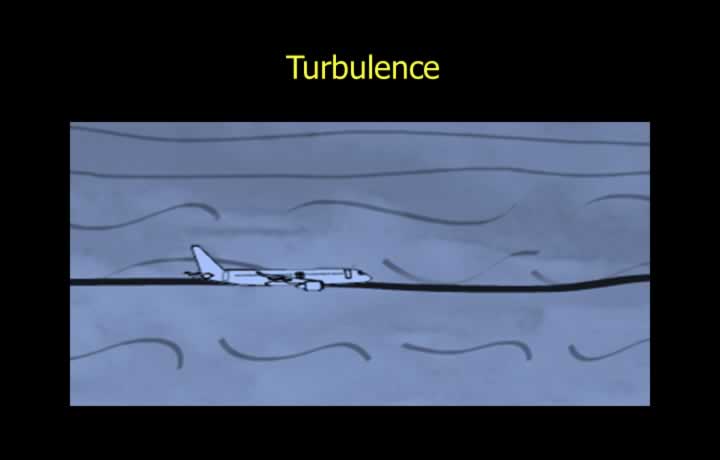
- Turbulence refers to the disturbed state of the atmosphere or rough air that causes an aircraft to deviate about its axes without significantly changing its flight path.
- Turbulence is caused by variations in wind direction, wind speed (intensity), or wind flow over time.
- Fluctuations in wind speed, such as gusts and lulls, create turbulent conditions.
Frictional and Thermal Turbulence
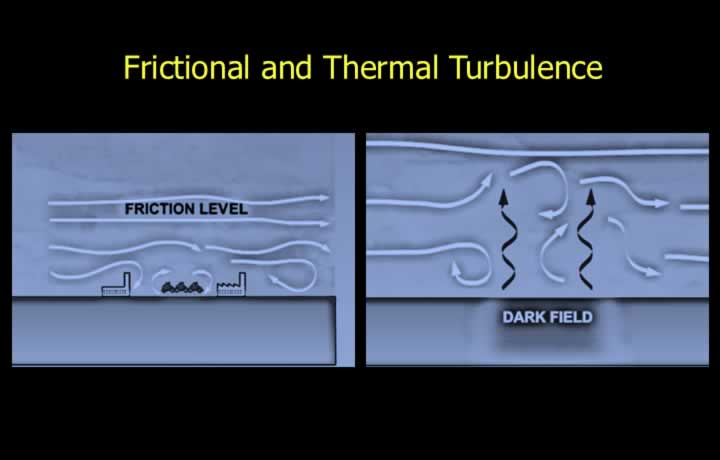
- Friction Level is the boundary between disturbed air near the Earth’s surface and relatively undisturbed airflow at higher altitudes.
- Friction Layer is the layer extending from the Earth’s surface up to the friction level.
- Frictional (Mechanical) Turbulence or eddies are produced by surface obstacles such as hills, mountains, buildings, or strong surface winds.
- Mechanical turbulence is most common over hilly terrain and built-up areas.
- Thermal Turbulence is caused by convective currents or eddies generated by uneven surface heating.
- Thermal turbulence is generally stronger than mechanical turbulence.
Diurnal Variation of Turbulence
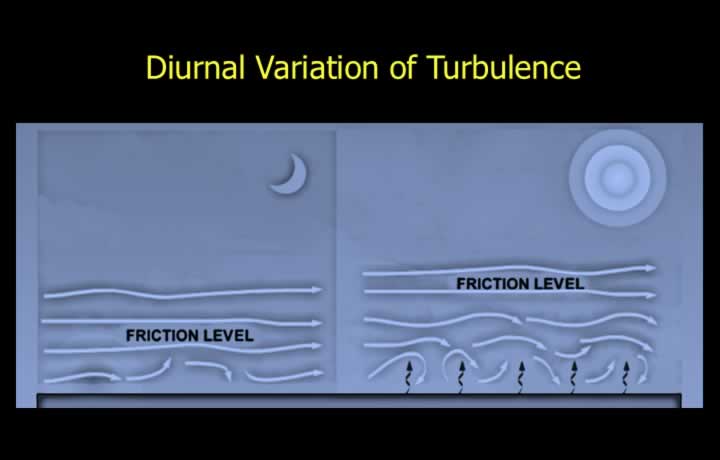
- During the day, turbulence increases due to stronger convection and a higher friction layer caused by surface heating.
- At night, the Earth’s surface cools, the friction layer becomes shallower, and turbulence generally decreases.
Turbulence in Clouds and Precipitation
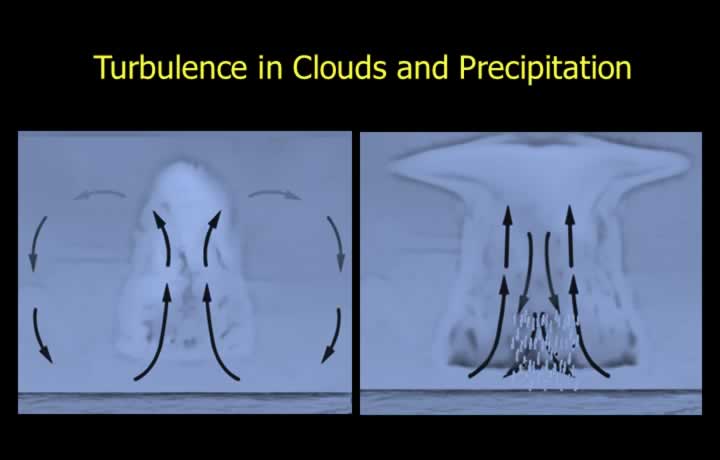
- Within vertically developed clouds, air rises rapidly while the surrounding air descends, creating turbulent conditions.
- Precipitation produces down-drafts that contribute to turbulence.
- Cloudbursts generate intense down-drafts, causing large and rapid changes in wind speed and direction, resulting in severe turbulence.
Turbulence Due to Wind Shear
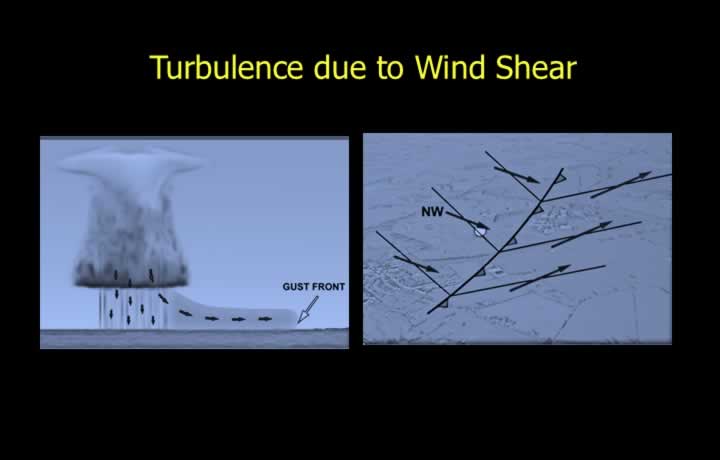
- Wind shear is commonly associated with active frontal systems.
- Wind Shear is the sudden change in wind direction, wind speed, or both, causing an aircraft to deviate from its intended flight path.
- Wind shear may cause sudden gains or losses in altitude and abrupt increases or decreases in airspeed.
- Vertical Wind Shear is the change in wind direction or speed with height and is usually expressed in knots per 100 feet.
- Horizontal Wind Shear is the change in wind direction or speed with horizontal distance and is usually expressed in knots per 1,000 feet.
Clear Air Turbulence (CAT) Due to Jet Streams
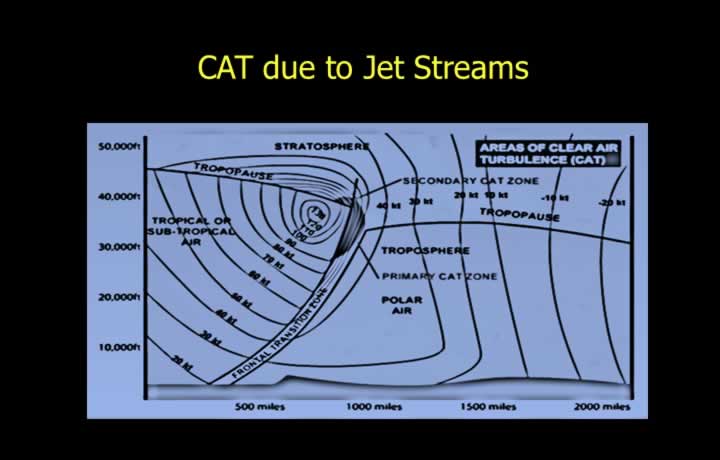
- Clear Air Turbulence (CAT) occurs in the absence of clouds and is commonly associated with upper-air troughs, ridges, and jet streams.
- Jet streams produce rapid increases in wind speed with height, leading to CAT.
- CAT areas are depicted on upper wind charts and Significant Weather (SIGWX) charts.
- In the Northern Hemisphere, when standing with your back to the wind, CAT is generally found on the left (cold-air side) of the jet stream.
- In the Southern Hemisphere, when standing with your back to the wind, CAT is generally found on the right (cold-air side) of the jet stream.
Clear Air Turbulence (CAT) in India
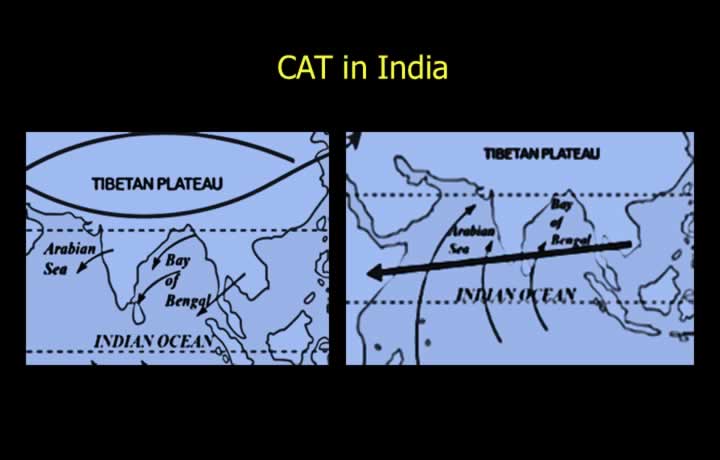
- CAT is common over North, Northeast, and Central India between October and May due to the Subtropical Jet Stream (STJ).
- The most severe CAT is generally experienced between December and February, when STJ activity is at its peak.
- Over South India, CAT is commonly experienced during July and August due to the Tropical Easterly Jet (TEJ).
- CAT typically occurs in patches approximately 120 km in the north-south direction, 250 km in the east-west direction, and extends vertically for about 2,000 feet.
- CAT can cause passenger discomfort and make aircraft control more difficult.
- The best method to avoid CAT is to climb or descend away from the boundaries of the jet stream whenever operationally feasible.