
Aircraft Icing
Dangers of Aircraft Icing
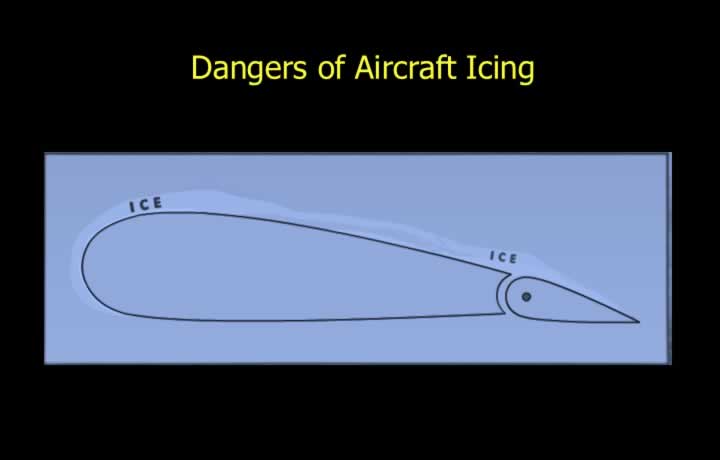
- Ice accretion during flight adversely affects aircraft aerodynamics by reducing lift while increasing weight and drag.
- Icing increases the aircraft’s stall speed.
- Differential icing can result in unequal loading on the aircraft.
- Ice accumulation may jam flight control hinges, leading to loss of aircraft control.
- Pressure instruments may become unreliable due to ice blockages.
- Icing on aircraft antennas can cause communication problems.
Ice Accretion on Aircraft
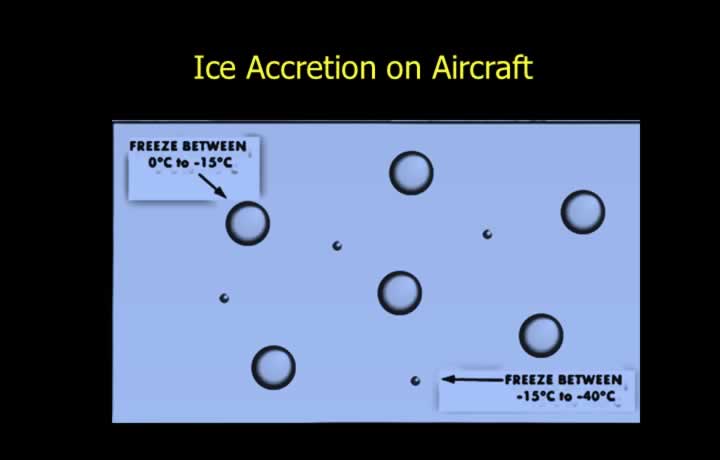
- Ice accretion refers to the accumulation of ice on an aircraft.
- It is caused by supercooled water droplets present in the atmosphere when the temperature is below the freezing point.
- Supercooled water droplets remain in the liquid state below 0°C because of the absence of sufficient freezing nuclei.
- Freezing nuclei are microscopic dust particles that initiate the conversion of water into ice.
- Large supercooled water droplets usually freeze between 0°C and –15°C, while smaller droplets freeze between –15°C and –40°C.
Types of Airframe Icing
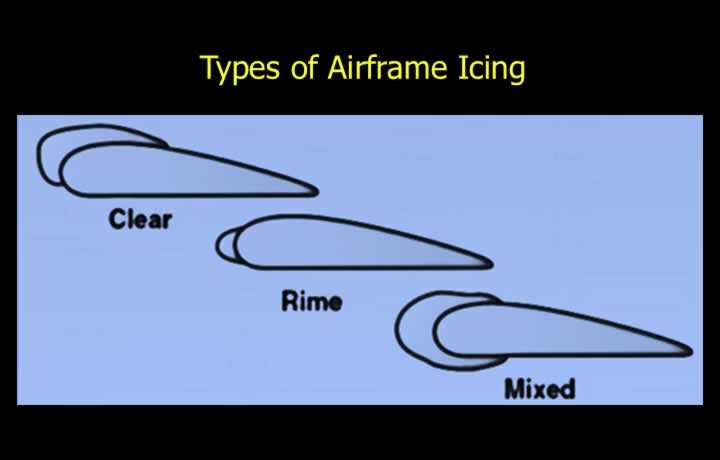
- Opaque Rime Ice: White, opaque ice deposits that form on leading edges from small supercooled water droplets in clouds above the freezing level.
- Rime ice causes relatively little aerodynamic distortion and can often be removed easily.
- Clear Ice (Glaze Ice or Translucent Rime): Smooth, transparent ice formed by large supercooled water droplets.
- Large droplets spread over the airframe before freezing, creating a dense layer of clear ice.
- Clear ice is difficult to remove and may break away in large pieces that can damage the aircraft.
- Mixed Ice: A combination of both clear ice and rime ice.
Freezing Rain
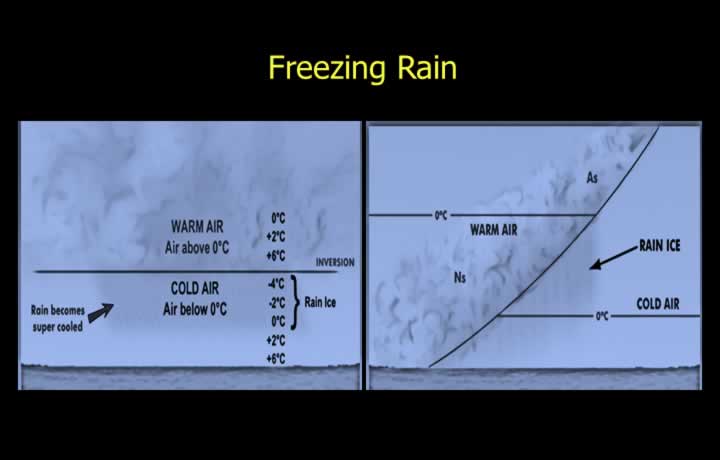
- Freezing rain consists of supercooled raindrops occurring when surface temperatures are below the freezing point.
- It is commonly associated with warm fronts, where a layer of warm air overlies cold surface air, creating a temperature inversion.
- Freezing rain is extremely hazardous because it can cause rapid ice accumulation at low altitudes.
Hoar Frost
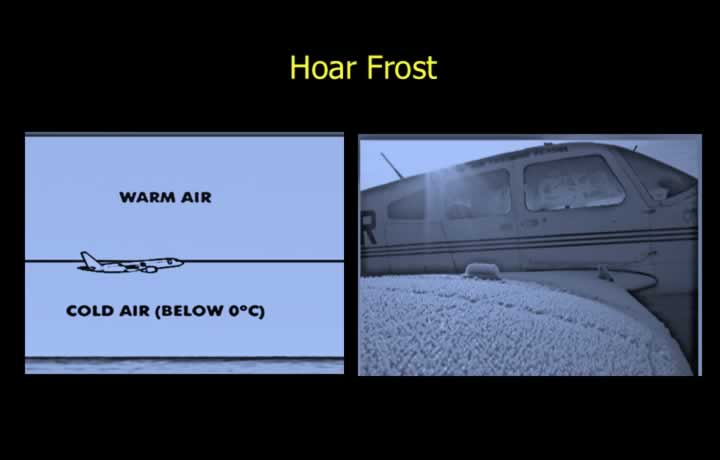
- Hoar frost consists of feathery ice deposits that form both on the ground and on aircraft in clear air when temperatures are below the frost point.
- It commonly forms when an aircraft descends rapidly from colder upper levels into warm, moist air.
- The aircraft surface remains cold while the surrounding air is warm and moist, allowing frost to form.
- Hoar frost can usually be removed easily and generally presents less danger than other forms of icing.
Risk of Icing
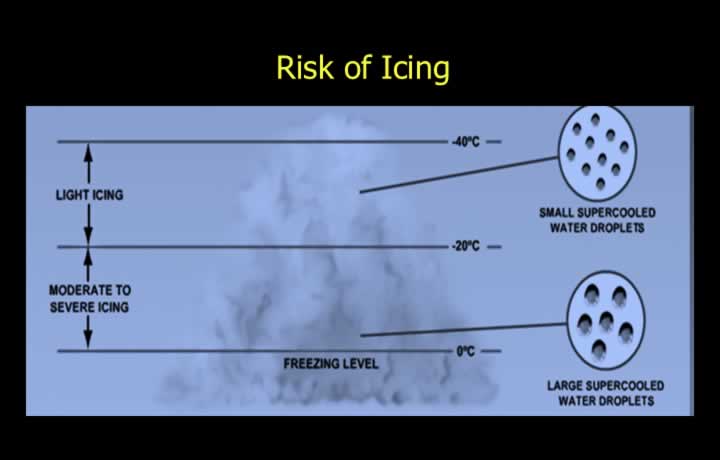
- The severity of icing depends primarily on the temperature at flight altitude.
- Severe Icing: 0°C to –7°C.
- Moderate Icing: –7°C to –12°C.
- Light Icing: –12°C to –20°C.
- Very Light Icing: –20°C to –40°C.
Icing in Clouds
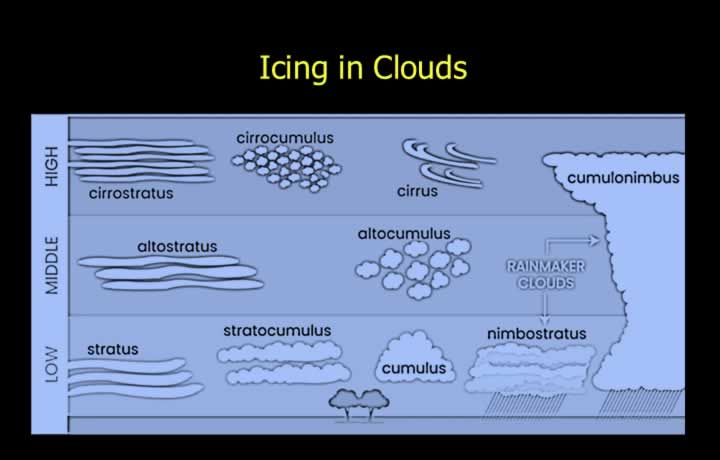
- High clouds such as Cirrus (Ci), Cirrostratus (Cs) and Cirrocumulus (Cc) contain mainly ice crystals and therefore present very little icing hazard.
- Medium-level clouds such as Altostratus (As) and Nimbostratus (Ns) contain supercooled water droplets that can cause moderate icing.
- Altocumulus (Ac) clouds may also contain supercooled droplets capable of producing moderate icing, with severity increasing over mountainous regions.
- Towering Cumulus (TCu) and Cumulonimbus (Cb) clouds contain abundant supercooled water droplets and can produce severe icing, especially down to temperatures of about –20°C.
- Except for Nimbostratus, stratiform clouds generally present a lower icing risk than cumuliform clouds.
Effect of Cloud Base on Icing
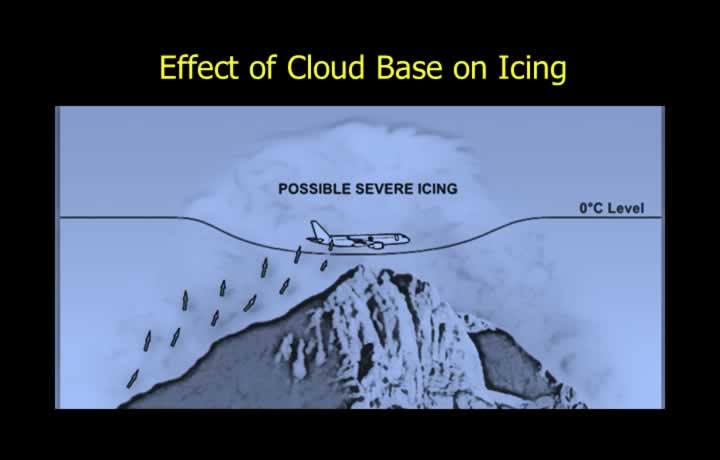
- Clouds with higher bases generally present a greater icing risk because of lower temperatures and a higher concentration of supercooled water droplets.
- Icing risk is greater in tropical regions during summer due to higher cloud bases.
- Stratiform clouds over mountainous terrain present an increased icing risk because the 0°C isotherm is lowered.
- During winter in North India, freezing levels are lower, increasing the likelihood of icing.
Engine Icing
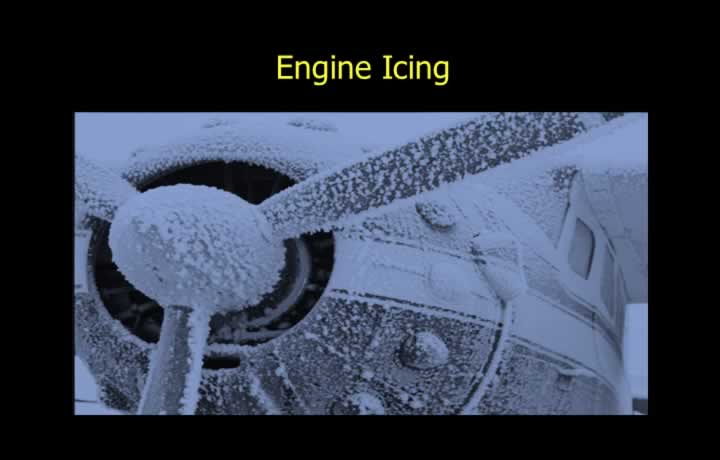
- Engine Impact Icing occurs when supercooled water droplets strike and freeze on the engine air intake.
- Impact icing restricts airflow into the engine, resulting in a loss of engine power.
- Carburettor Icing occurs when air pressure decreases inside the carburettor, causing adiabatic cooling and the formation of ice.
- Carburettor icing can occur even at temperatures as high as +30°C when the relative humidity exceeds 60%.