
Mountain Waves
Mountain Waves
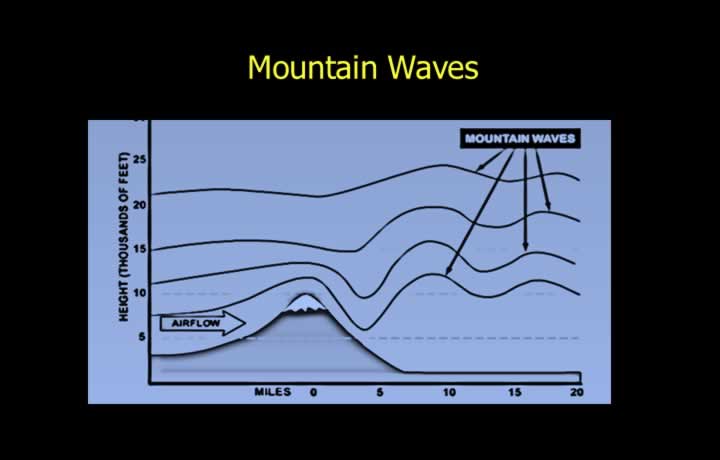
- Mountain waves are atmospheric waves that develop when stable air flows over a mountain range, producing a wave-like airflow pattern.
- They are caused by disturbed airflow over mountains, resulting in strong updrafts on the windward side and severe down-drafts on the leeward side.
- The intensity of mountain waves depends on wind speed, atmospheric lapse rate, and the length, height, and shape of the mountain range.
- Mountain waves can extend to great altitudes, making flight conditions rough and potentially unsafe.
- Pilots should avoid flying close to or below ridge level in strong wind and stable atmospheric conditions.
Conditions for Mountain Wave Formation
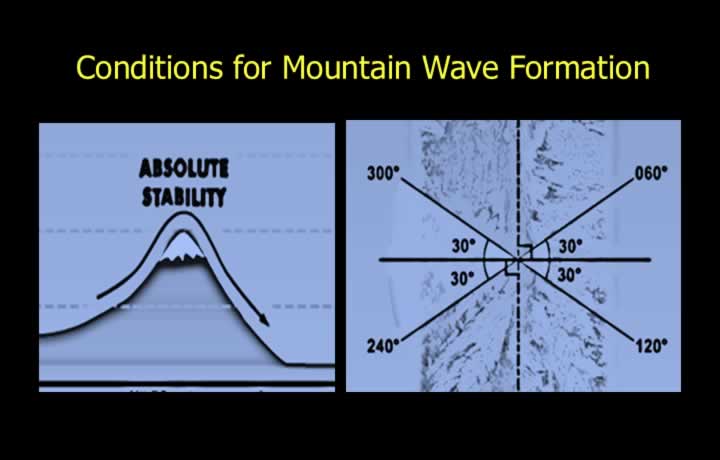
- Mountain waves develop when the atmosphere is unstable at lower levels, stable near the mountain crest, and unstable again above the stable layer.
- Absolute stability around mountain ridges is often produced by a temperature inversion.
- Minimum wind speeds required are approximately 7 m/s for small mountains and 15 m/s for large mountain ranges.
- The wind direction should remain steady and within 30° of being perpendicular to the mountain range.
Clouds Associated with Mountain Waves
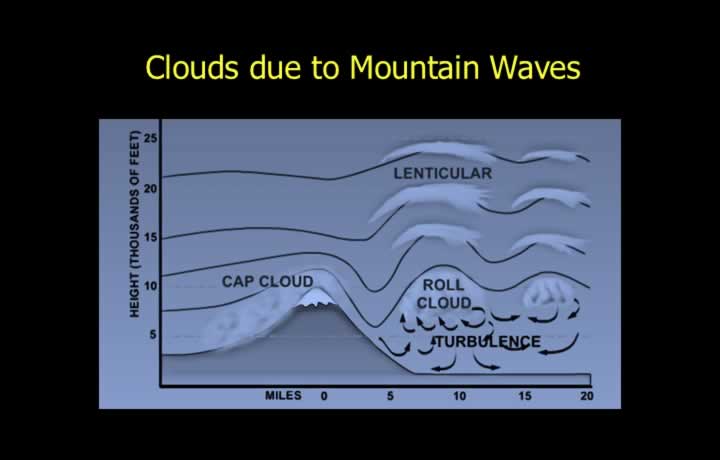
- The presence of Lenticular, Cap, and Rotor (Roll) clouds indicates mountain wave activity.
- Ragged edges on lenticular clouds are an indication of severe turbulence.
- Cap clouds may cover mountain peaks and can extend down the leeward slope as a Föhn Wall.
- Rotor and Roll clouds produce the most severe turbulence on the leeward side of mountains.
- Rotor streaming clouds are violent rotor clouds formed when strong low-level winds combine with reverse winds aloft.
- The strongest rotor is generally found above and near the first mountain wave crest.
Hazards of Mountain Waves
- Strong vertical air currents between 10 m/s and 25 m/s may occur on both the windward and leeward slopes.
- Mountain waves produce abrupt turbulence due to additional wind shear.
- Severe turbulence is commonly associated with Cap, Rotor, and Föhn Wall clouds.
- Aircraft may experience turbulence loads between 2g and 4g, with values up to 7g possible in rotor clouds.
- The severity of bumpiness depends on the size and aerodynamic characteristics of the aircraft.
- Closely spaced mountain ranges can produce multiple interacting wave systems, resulting in violent turbulence.
- Rapid fluctuations in altimeter readings may occur because of hysteresis effects and temperature deviations from ISA conditions.
Variation in Mountain Wave Activity

Diurnal Variation
- Over small mountains, mountain waves are most prominent around sunset due to radiational cooling.
- Weak low-level wind conditions associated with evening mountain waves are known as Evening Waves.
Seasonal Variation
- Mountain waves are more frequent during winter because of strong, steady winds that increase with height and a stable atmosphere at lower levels.
- Mountain waves may extend 100–200 km downstream of a mountain range and can reach into the stratosphere, with wavelengths exceeding 10 km.