Theories of Precipitation
Types of Precipitation
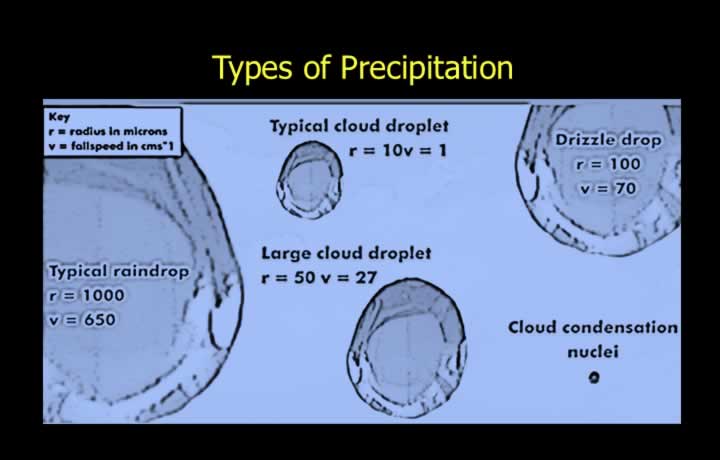
- Precipitation is a generic term that refers to liquid water droplets and solid water particles falling from clouds.
- Droplet size and texture of precipitation:
- Drizzle: Droplets between 0.2 mm and 0.5 mm.
- Rain: Droplets with a diameter of 0.5 mm to 5 mm.
- Showers: Water droplets with a diameter of 5 mm or more.
- Hail: Solid ice balls ranging from 5 mm to 50 mm.
- Snow: Ice crystals.
- Sleet: Wet snowfall or a mixture of rain and snow.
- Ice Pellets: Transparent pellets of ice.
- Snow Grains: Very small ice crystals.
Condensation Theory of Precipitation
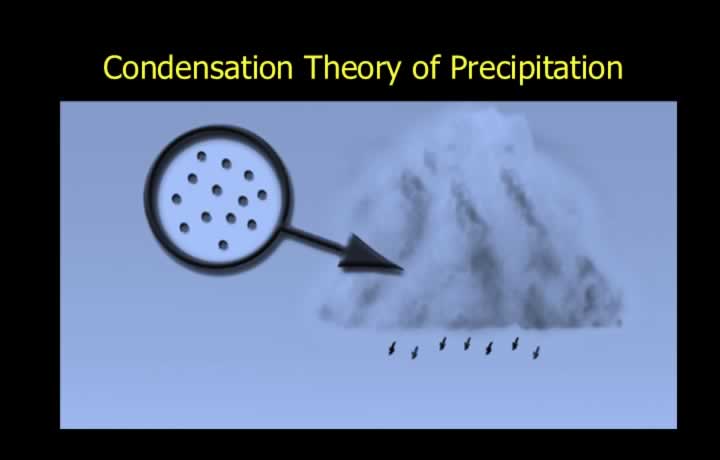
- Condensation is a small-scale process and explains only light drizzle from low clouds below the freezing level.
- Water droplets or ice crystals must become large and heavy enough to overcome the vertical air currents within clouds before they can fall as precipitation.
- According to the condensation theory, water vapour condenses into liquid water droplets, which grow sufficiently large to fall from the cloud.
Coalescence and Giant Nucleus Theory
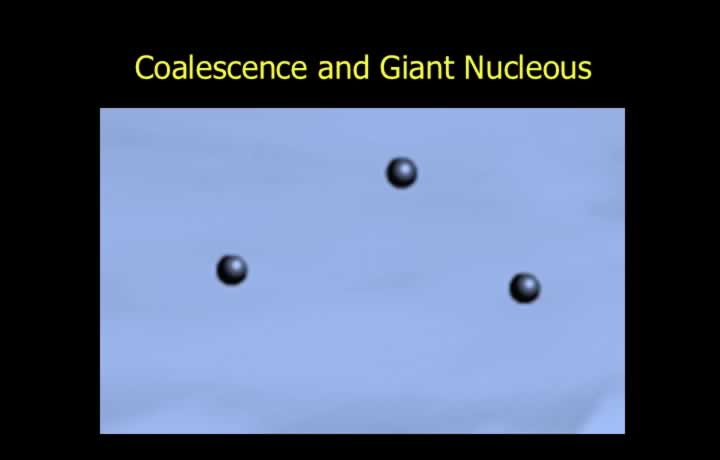
- The Coalescence Theory of precipitation is also a relatively small-scale process.
- In clouds extending below the freezing level, larger water droplets grow through collision and coalescence.
- Smaller droplets merge with larger droplets, increasing their size until they become heavy enough to fall as precipitation.
- The Giant Nucleus Theory explains precipitation over the sea.
- Over oceans, salt particles and other hygroscopic nuclei absorb moisture, initiating the coalescence process.
Ice Crystal (Bergeron) Process
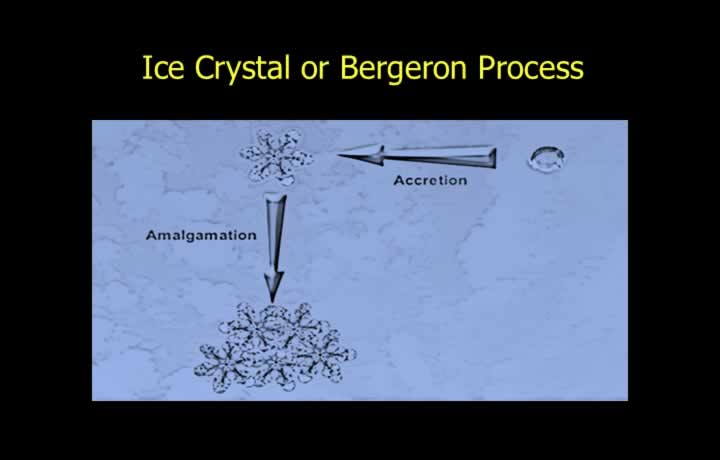
- The Ice Crystal Theory, also known as the Bergeron Process, explains heavy rain or snowfall from clouds extending above the freezing level.
- In such clouds, supercooled water droplets deposit onto ice crystals through sublimation, causing the ice crystals to grow.
- Water droplets collide with and freeze upon contact with ice crystals because of their low temperature.
- As the growing ice crystals fall, they may partially melt, become sticky, combine with other ice crystals, and eventually fall as large snowflakes or raindrops.
Cloud Types and Precipitation
- Stratus (St): Produces drizzle.
- Altostratus (As): Produces rain and snow.
- Nimbostratus (Ns): Produces continuous precipitation.
- Towering Cumulus (TCu): Produces rain, showers, hail and snow.
- Cumulonimbus (Cb): Produces rain, showers, hail and snow.
- Cirrostratus (Cs): Produces snow at high altitudes.
Conditions for Snow and Sleet
- Snow and sleet occur when:
- The surface temperature is less than 4°C.
- The temperature between the cloud and the ground remains below 0°C.
- Sleet is a mixture of rain and snow.
Timing of Precipitation
- In tropical regions (e.g., South India), maximum precipitation is generally expected during the afternoon due to strong surface heating.
- In subtropical regions (e.g., Northwest India), maximum rainfall often occurs during the morning because of winter western disturbances.
- Cloud Seeding involves spraying hygroscopic nuclei into clouds using specially equipped aircraft to enhance precipitation or disperse fog.
- Cloudbursts refer to extremely heavy rainfall occurring over a short period, often leading to flash floods.
- A day is classified as a Rainy Day when the total rainfall recorded is more than 2.5 mm.