
Atmospheric Stability
Isothermal and Adiabatic Process
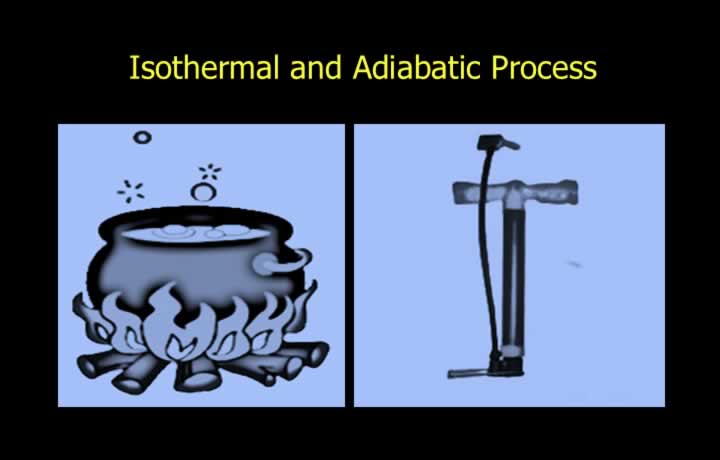
- Isothermal process is one that allows heat energy to enter or exit the system. Direct heating or cooling is an isothermal process.
- Adiabatic process is one where no heat energy enters or exits the system. Heat is generated by transfer of energy and not by direct heating or cooling.
- Warming or cooling of atmospheric air takes place by expansion and contraction of air by lowering and lifting of an air parcel and is hence an adiabatic process.
- Air is a bad conductor of heat and hence a certain air parcel can be considered to be insulated from the surrounding air.
Adiabatic Cooling and Warming
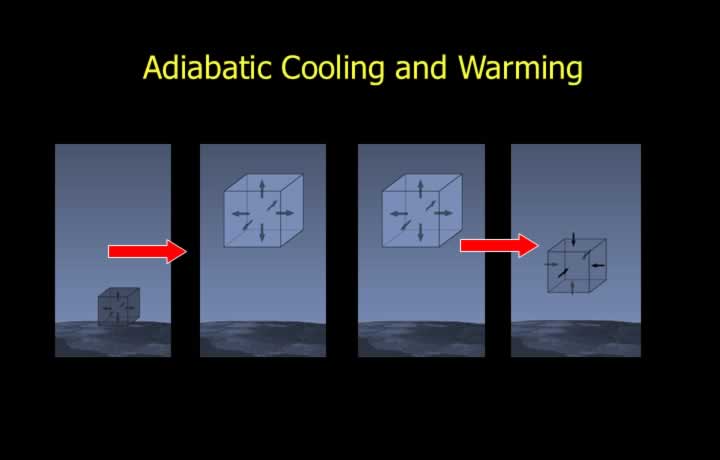
- Adiabatic cooling refers to the process by which a parcel of air cools down when it is lifted to higher levels.
- Since the pressure at higher levels is lower, the volume of the air parcel increases, resulting in adiabatic cooling.
- Adiabatic warming refers to the process by which a parcel of air warms up when it is brought down to lower levels.
- Since the pressure at lower levels is higher, the volume of the air parcel reduces, resulting in adiabatic warming.
Saturation by Adiabatic Process
- Air is said to be saturated when it holds the maximum amount of water vapour that it can hold at a particular temperature.
- Cool air has a lesser capability to hold water vapour compared to warm air.
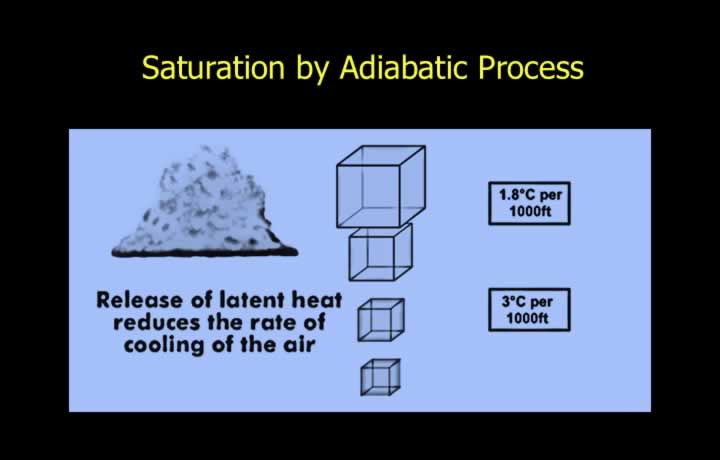
- If a warm, unsaturated parcel of air is forced to climb to higher levels, it cools due to adiabatic cooling and becomes saturated.
- Saturation results in condensation of water vapour into water droplets visible as clouds.
- Saturation releases latent heat and slows down the temperature lapse rate.
Dry Adiabatic Lapse Rate (DALR)
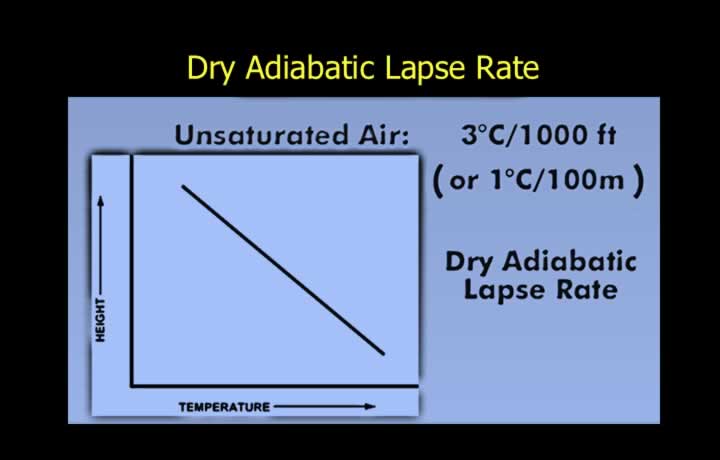
- Adiabatic lapse rate refers to the rate of change of temperature with height.
- As per ISA conditions, the average lapse rate is taken as 2°C per 1,000 ft or 6.5°C per km.
- However, the temperature lapse rate varies with moisture content.
- Dry Adiabatic Lapse Rate (DALR) refers to the lapse rate of dry air or air where the relative humidity is less than 100%.
- DALR is constant at 3°C per 1,000 ft or 9.8°C per km.
Saturated Adiabatic Lapse Rate (SALR)
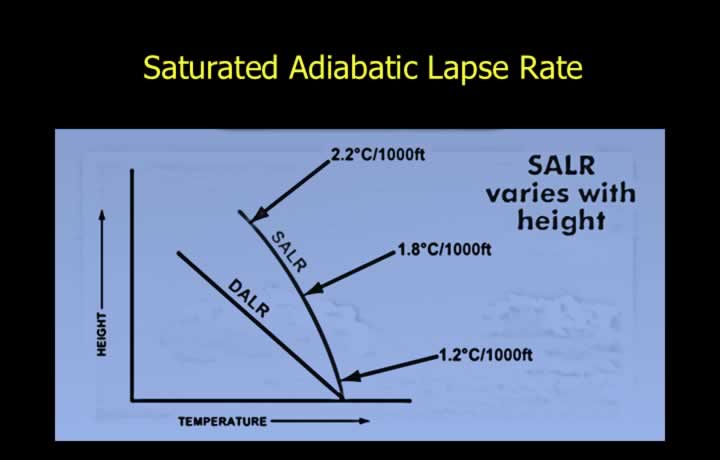
- Saturated Adiabatic Lapse Rate (SALR) refers to the lapse rate of saturated air or air where the relative humidity is equal to 100%.
- The rate of fall of temperature is lower in saturated air compared to dry air.
- The lapse rate of saturated air is not constant and varies with altitude.
- SALR varies between 1.2°C per 1,000 ft and 2.2°C per 1,000 ft.
- The average value of SALR is taken as 1.8°C per 1,000 ft or 5°C per km.
Environmental Lapse Rate (ELR)
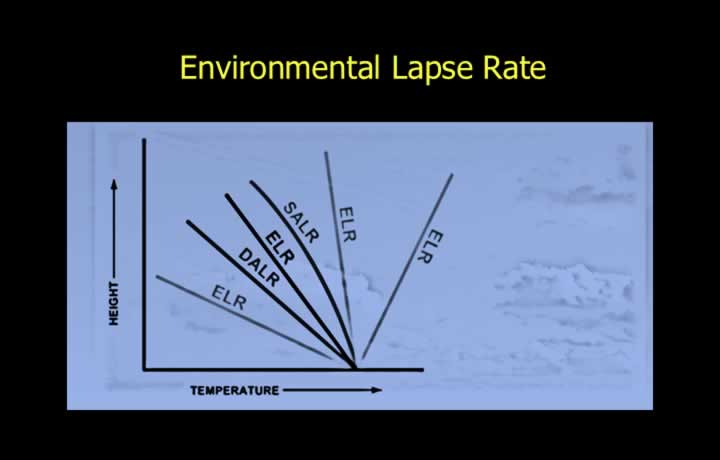
- Environmental Lapse Rate (ELR) refers to the actual or prevailing lapse rate at a particular place and time.
- ELR varies depending on atmospheric conditions such as moisture content.
- Atmospheric stability is governed by the value of ELR in comparison with DALR and SALR.
- A Tephigram is a thermodynamic diagram on which temperatures at various levels are plotted and compared with DALR and SALR.
- Tephigram is used to calculate atmospheric stability.
Absolute Stability
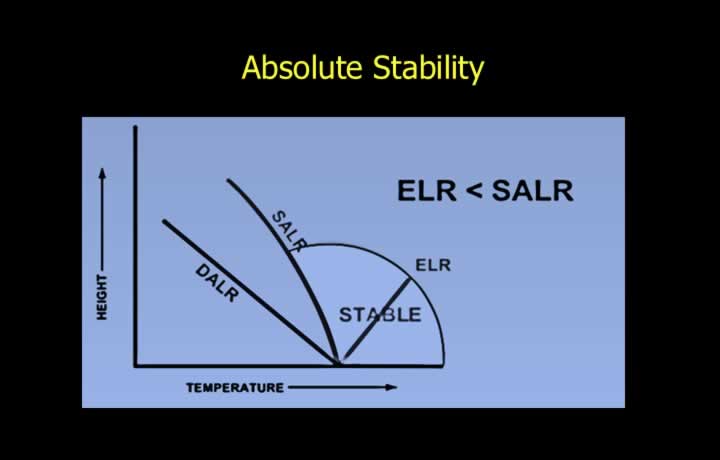
- Atmospheric stability is a measure of whether a parcel of air that is pushed upward will continue rising or descend back to its original position.
- If the Environmental Lapse Rate (ELR) is very low, or temperature decreases very slowly with height, the atmosphere is said to be stable.
- Absolute stability refers to a condition in which the temperature at any height is always higher than that of the air parcel.
- The air parcel therefore descends because it is colder and denser than the surrounding environment, irrespective of its moisture content.
- Absolute Stability: ELR < SALR < DALR
Absolute Instability
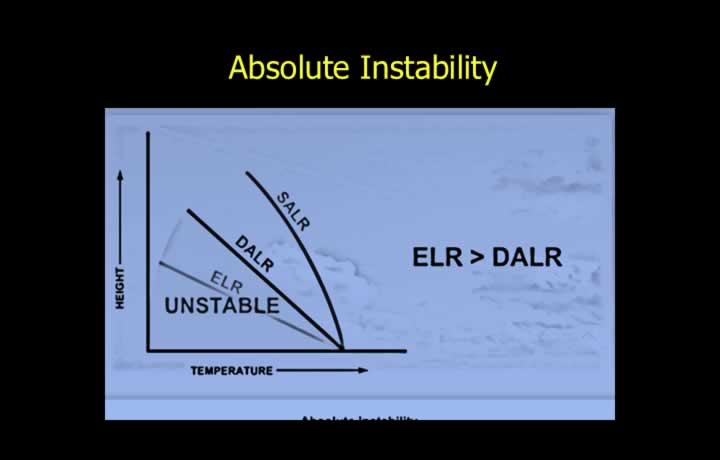
- If the Environmental Lapse Rate (ELR) is very high, or temperature decreases rapidly with height, the atmosphere is said to be unstable.
- Absolute instability refers to a condition in which the temperature at any height is always lower than that of the air parcel.
- The air parcel therefore continues rising because it is warmer and lighter than the surrounding environment, irrespective of its moisture content.
- Absolute Instability: ELR > SALR > DALR
Conditional Stability
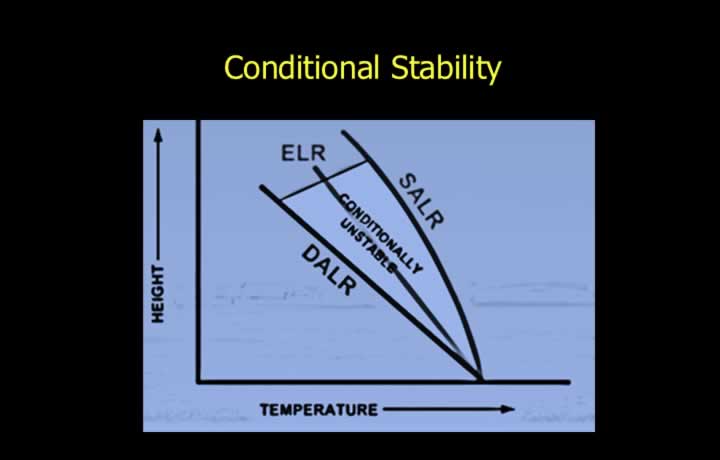
- If the Environmental Lapse Rate (ELR) is greater than SALR but less than DALR, the atmosphere is said to be conditionally stable.
- A dry air parcel is cooler than the surroundings and therefore descends, while a saturated air parcel is warmer than the surroundings and therefore continues to rise.
- Conditional Stability: SALR < ELR < DALR
Neutral and Latent Stability
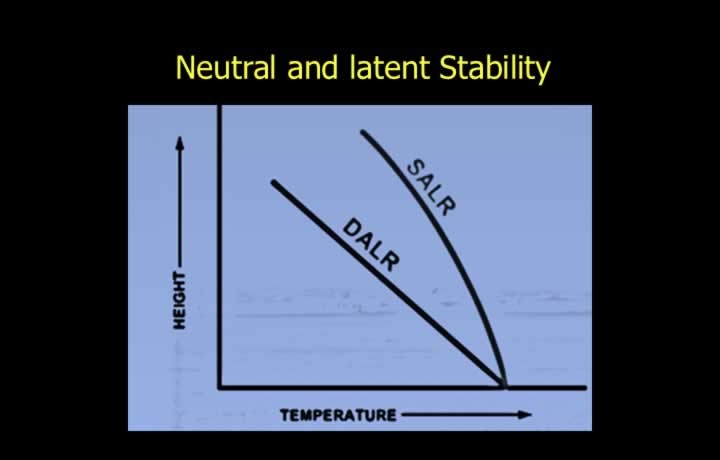
- Neutral Stability refers to a condition when either ELR = DALR or ELR = SALR.
- Latent Instability refers to a condition where a stable air parcel becomes unstable due to forced ascent.
- Real Latent Instability means that the force required is less than the force released later.
- Pseudo Latent Instability means that the force required is greater than the force released later.
- Potential Instability means that air is stable at lower levels but unstable at higher levels.
Clouds in an Unstable Atmosphere
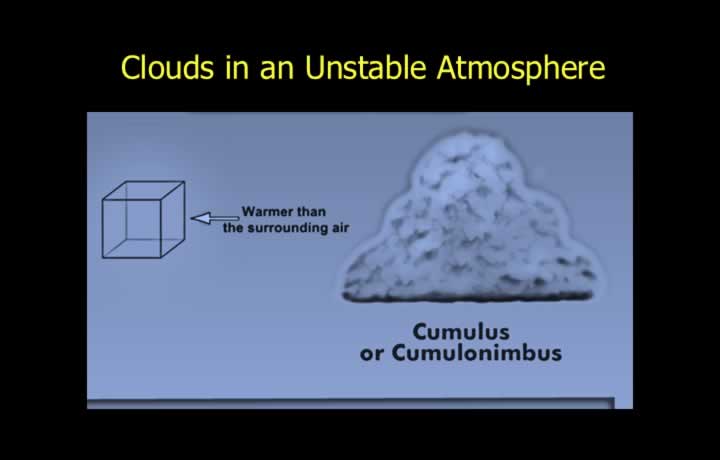
- In unstable atmospheric conditions, the air parcel is buoyant and continues to rise.
- Rising air expands and cools adiabatically, forming vertically developed clouds such as Cumulus (Cu) and Cumulonimbus (Cb).
- Aviation hazards associated with an unstable atmosphere include rain, hail, snow, icing and severe turbulence within clouds.
- Visibility outside clouds is generally good because pollutants are carried to higher levels.
Clouds in a Stable Atmosphere
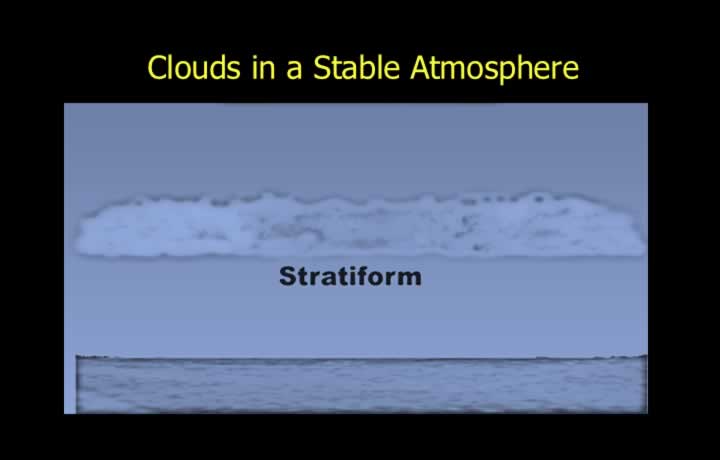
- In stable atmospheric conditions, the air parcel is not buoyant and tends to descend and settle at lower levels.
- Stratiform clouds with large horizontal spread are common in stable atmospheric conditions.
- Aviation hazards associated with a stable atmosphere mainly include poor visibility and light rain.