
Scientific Reasoning for Flow of Winds
he flow of winds is explained mainly by the Planetary Wind Theory, Ferrel Law, and the Pressure Gradient Theory. Winds move from areas of high pressure to low pressure. The Earth’s rotation causes winds to deflect to the right in the Northern Hemisphere and to the left in the Southern Hemisphere. These theories explain the direction and movement of global winds.
Pressure Gradient Force (PGF)
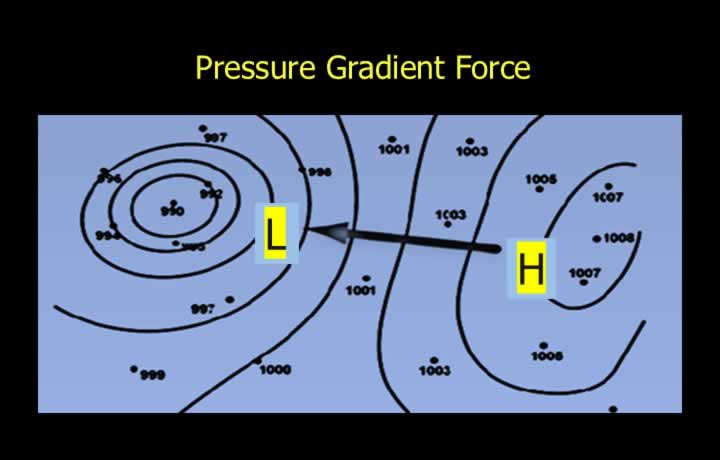
- Air is a compressible fluid, and all fluids flow from areas of high pressure to areas of low pressure.
- Pressure Gradient Force (PGF) is the force that causes air to move from high-pressure areas toward low-pressure areas.
- Closely spaced isobars indicate a greater pressure change over a shorter distance, producing a stronger Pressure Gradient Force.
Coriolis Force
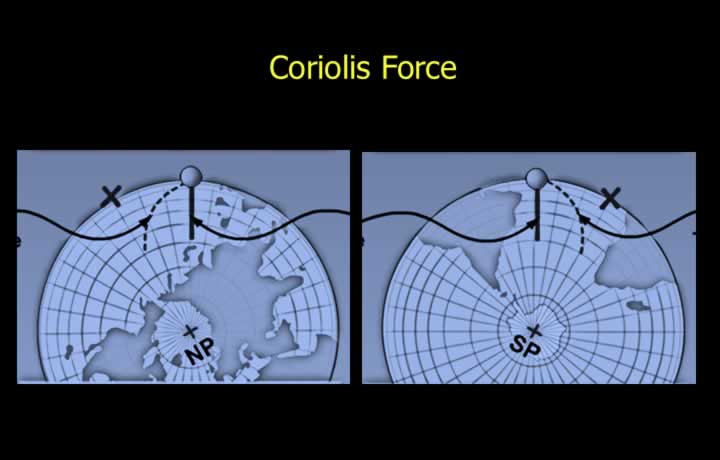
- Coriolis Force is an apparent force caused by the rotation of the Earth.
- A point on the Equator travels approximately 21,000 NM in 24 hours, whereas a point at 60° N travels only about 10,800 NM in the same period.
- Air moving between latitudes is deflected because of this difference in rotational speed.
- In the Northern Hemisphere, Coriolis Force deflects winds to the right.
- In the Southern Hemisphere, Coriolis Force deflects winds to the left.
Variation in Coriolis Force
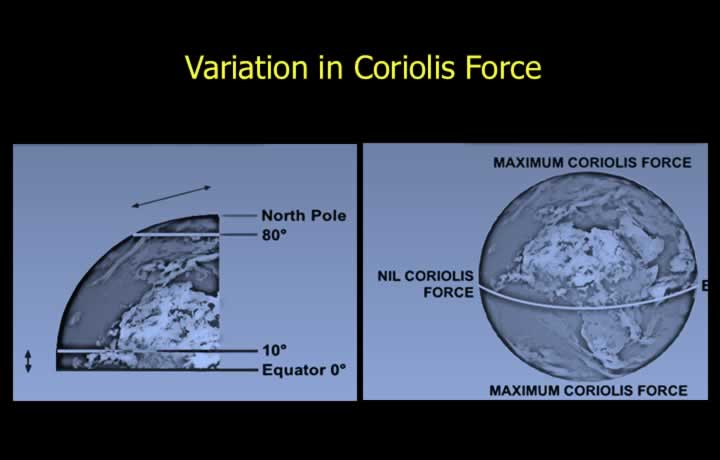
- The difference in Earth’s rotational speed between adjacent latitudes is greatest near the Equator and least near the poles.
- However, the Coriolis effect itself is:
- Maximum at the Poles.
- Zero at the Equator.
- Coriolis Force is directly proportional to:
- Wind speed
- Air density
- Sine of latitude
Formula:
F = 2 × Angular Velocity × Air Density × Wind Speed × sin(Latitude)
Geostrophic Wind
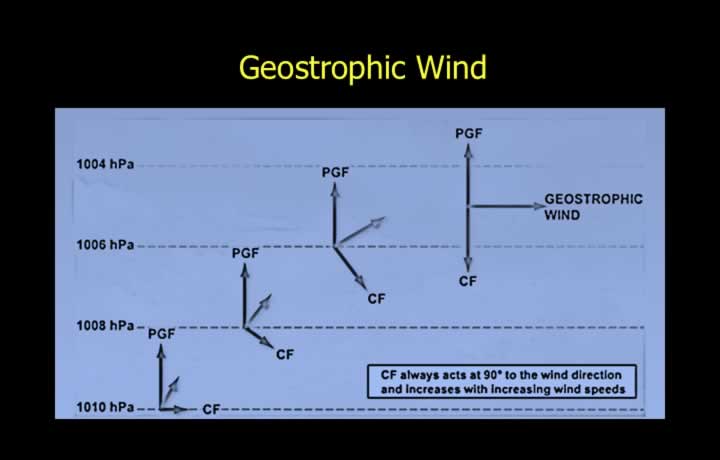
- Geostrophic Wind results from the balance between the Pressure Gradient Force and the Coriolis Force.
- It flows parallel to straight isobars.
- In the Northern Hemisphere, low pressure lies to the left of the wind.
- A stronger Pressure Gradient Force produces stronger winds, which in turn experience a greater Coriolis Force.
Buys Ballot’s Law
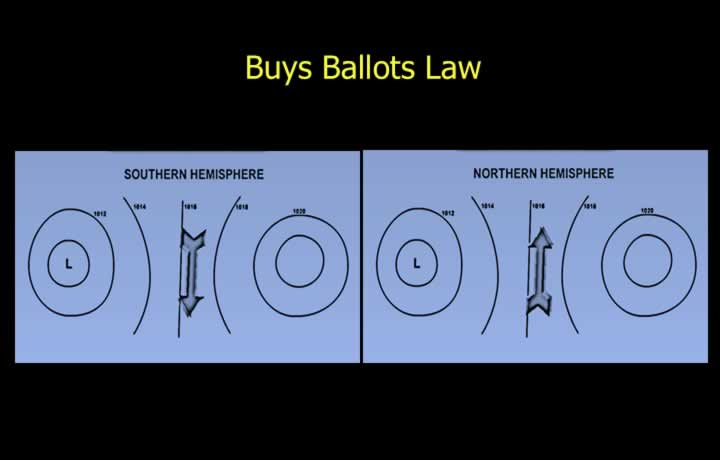
- Northern Hemisphere: If you stand with your back to the wind, the low-pressure area will be on your left.
- Southern Hemisphere: If you stand with your back to the wind, the low-pressure area will be on your right.
Geostrophic Wind Scale
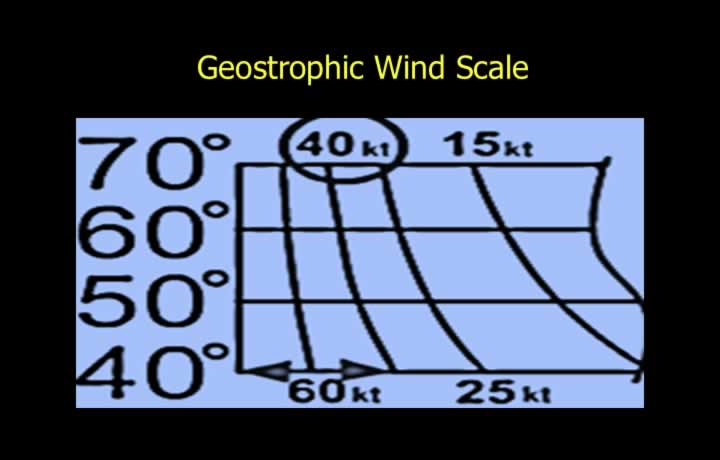
- A Geostrophic Wind Scale is provided on surface pressure charts to estimate geostrophic wind speed.
- Closer isobars indicate a stronger Pressure Gradient Force and therefore higher wind speeds.
- For the same isobar spacing, geostrophic wind speeds are higher at lower latitudes.
- Example:
- 40 kt at 40° N.
- 25 kt at 70° N.
- The scale is reasonably accurate above 30° latitude.
- It becomes unreliable near the Equator where Coriolis Force is negligible.
- Antitriptic Winds occur within approximately 15° N/S of the Equator where Coriolis Force has little effect.
Real and Geostrophic Winds
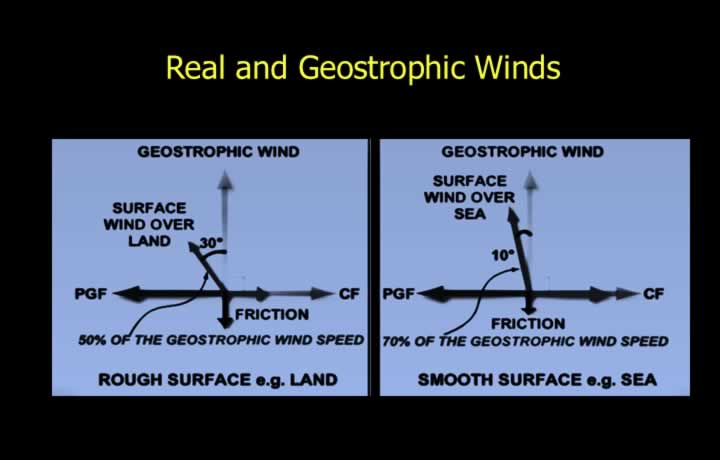
- Surface friction causes actual (real) winds to differ from geostrophic winds.
- Over Land:
- Wind crosses isobars about 30° toward low pressure.
- Wind speed is approximately 50% of the geostrophic wind.
- Over Sea:
- Wind crosses isobars about 15° toward low pressure.
- Wind speed is approximately 70% of the geostrophic wind.
- Example:
- If geostrophic wind is 285° / 20 kt, the expected surface wind over sea is approximately 275° / 14 kt.
- The smaller deviation over sea is due to lower surface friction.
Surface Winds During Day and Night
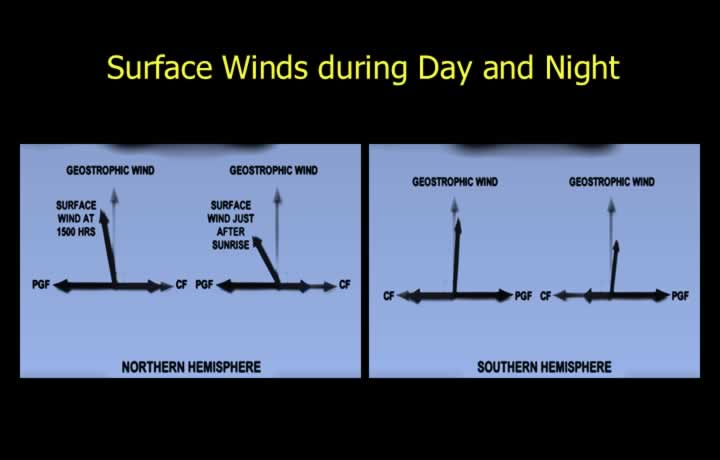
- During the Day:
- Ground heating creates thermal turbulence.
- Mixing transfers faster upper-level winds downward.
- Surface wind speed increases.
- In the Northern Hemisphere, winds generally back.
- In the Southern Hemisphere, winds generally veer.
- During the Night:
- Ground cooling reduces turbulence.
- Upper and lower winds mix less effectively.
- Surface wind speeds decrease.
- Maximum surface wind speed is usually around 1500 hrs.
- Minimum surface wind speed is usually around 0600 hrs.
Gradient Wind
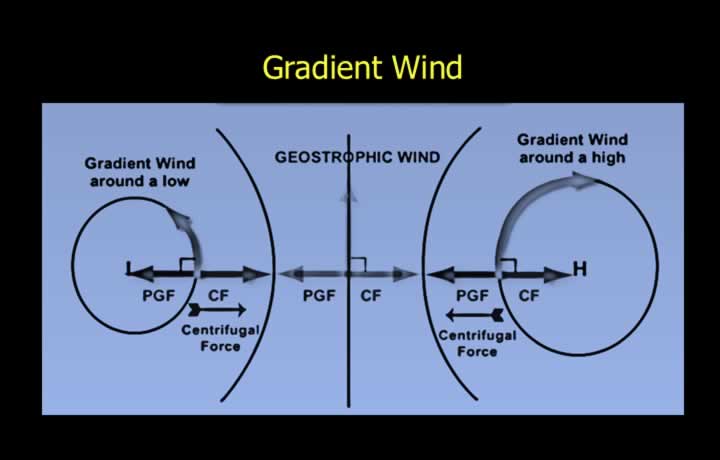
- Gradient Wind results from the combined effects of:
- Pressure Gradient Force
- Coriolis Force
- Centrifugal Force
- Around a Low-Pressure System, centrifugal force opposes the Pressure Gradient Force.
- Around a High-Pressure System, centrifugal force assists the Pressure Gradient Force.
- For the same pressure gradient, gradient wind speeds are generally higher around highs than lows.
Cyclostrophic Wind
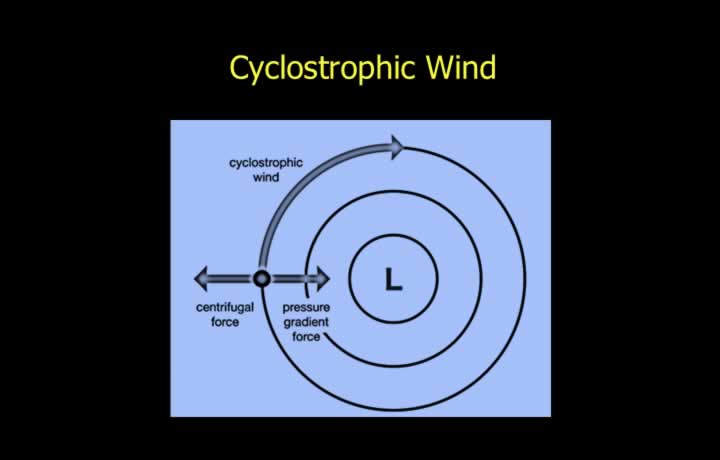
- Cyclostrophic Wind occurs in intense cyclonic circulations where Coriolis Force is negligible.
- It is produced by a balance between:
- Pressure Gradient Force
- Centripetal (Cyclostrophic) Force
- This type of wind is common in tornadoes and other small, intense vortices.
Isallobaric Wind
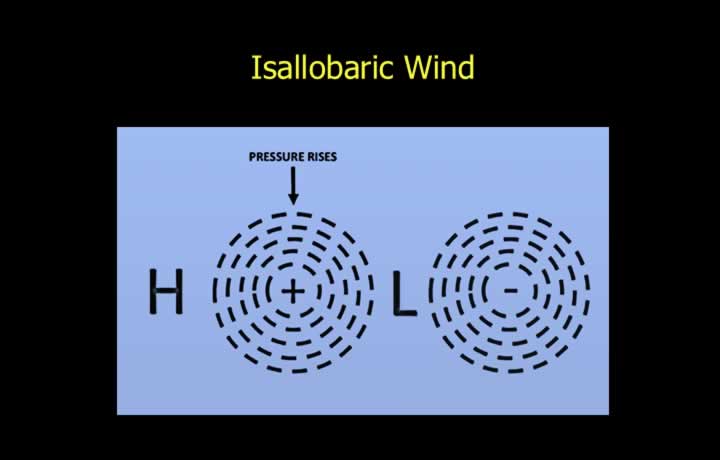
- Isallobaric Force results from rapid changes in atmospheric pressure.
- It acts from areas of rising pressure toward areas of falling pressure.
- Isallobaric winds are directed toward falling pressure.
- They are influenced by:
- Pressure Gradient Force
- Coriolis Force
- Isallobaric Force
Inertial Wind
- Inertial Wind occurs when the Pressure Gradient Force is negligible.
- It results from the balance between:
- Coriolis Force
- Centrifugal Force
- Inertial flow is anticyclonic in both hemispheres.
Types of Wind – Summary
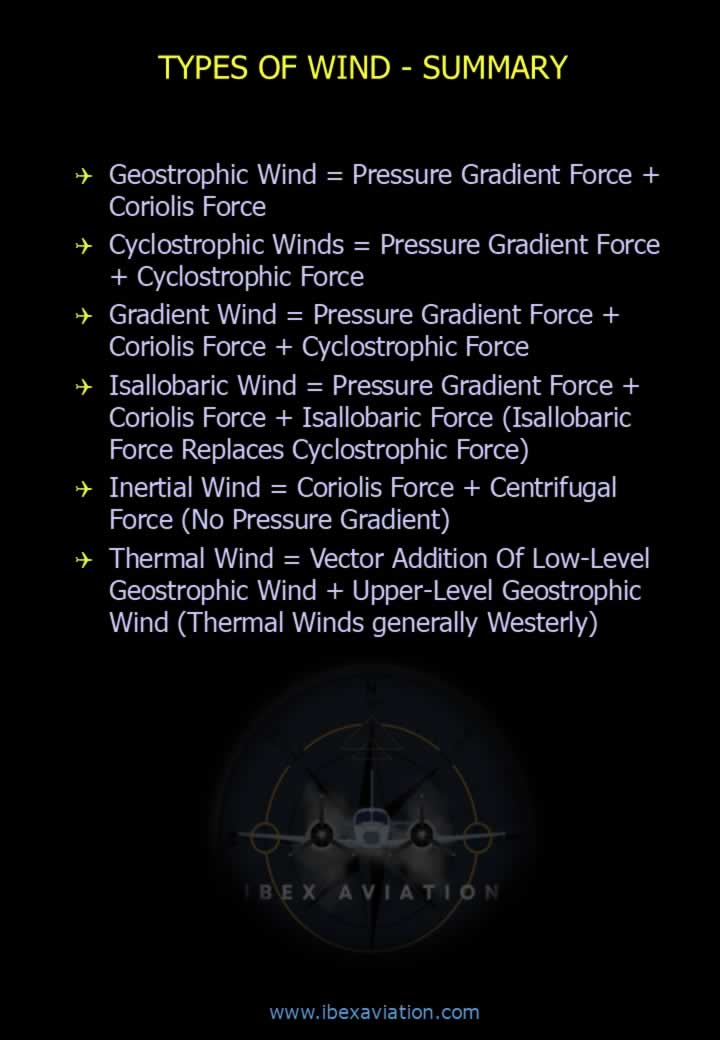
- Geostrophic Wind = Pressure Gradient Force + Coriolis Force
- Cyclostrophic Wind = Pressure Gradient Force + Cyclostrophic (Centripetal) Force
- Gradient Wind = Pressure Gradient Force + Coriolis Force + Centrifugal Force
- Isallobaric Wind = Pressure Gradient Force + Coriolis Force + Isallobaric Force
- Inertial Wind = Coriolis Force + Centrifugal Force (No Pressure Gradient Force)
- Thermal Wind = Vector addition of Low-Level Geostrophic Wind and Upper-Level Geostrophic Wind (generally westerly)