
Humidity in the Atmosphere
Humidity varies with temperature, location, and weather conditions. It is generally higher in warm, coastal, and rainy regions and lower in cold or desert areas. Humidity also changes throughout the day and with the seasons.Humidity is the amount of water vapour present in the air. It is commonly measured using a hygrometer or psychrometer. Humidity is usually expressed as relative humidity (RH), given as a percentage (%).
Latent Heat
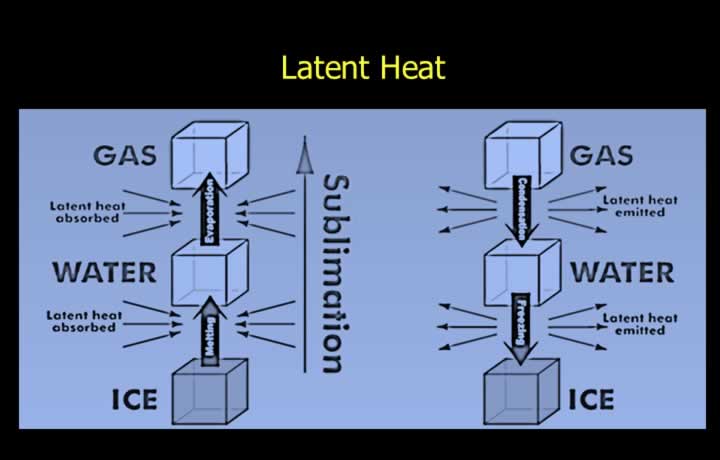
- Water exists in the atmosphere in three states:
- Solid
- Liquid
- Gas (Water Vapour)
- Dry Air refers to air that contains no water vapour.
- Latent Heat is the heat energy transferred when a substance such as water changes its physical state.
- Latent heat is exchanged whenever water changes between solid, liquid and gaseous states.
Evaporation, Melting and Sublimation
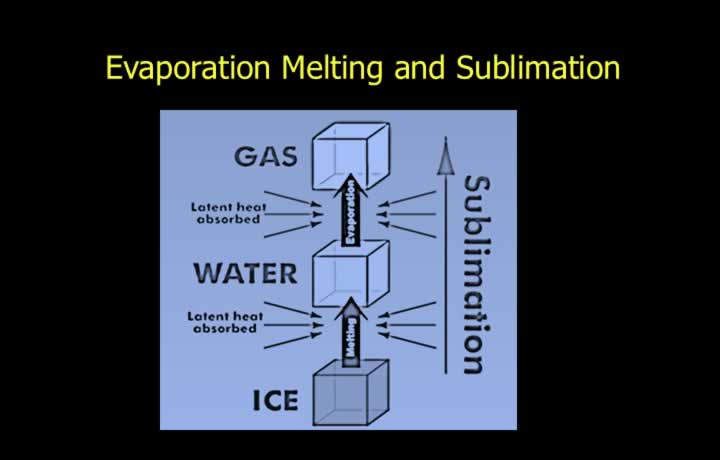
- Evaporation is the change of state from liquid to gas.
- Evaporation can occur at all temperatures above Absolute Zero (-273°C).
- The rate of evaporation increases with temperature.
- Melting is the change of state from solid to liquid.
- Sublimation is the direct change of state from solid to gas.
- Latent heat is absorbed during evaporation, melting and sublimation.
Freezing, Condensation and Deposition
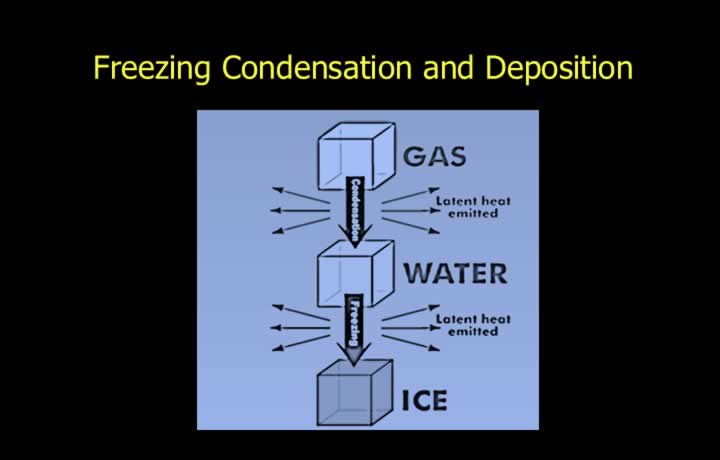
- Freezing is the change of state from liquid to solid.
- Freezing nuclei are required for water to freeze into ice.
- In the absence of freezing nuclei, water may remain as supercooled water droplets.
- Condensation is the change of state from gas to liquid.
- Condensation nuclei are required for the formation of clouds, dew and fog.
- Without condensation nuclei, air may become supersaturated.
- Deposition is the direct change of state from gas to solid.
- Latent heat is released during freezing, condensation and deposition.
Saturation
- Saturation by Evaporation occurs when the air contains the maximum amount of water vapour it can hold at a particular temperature.
- Further evaporation cannot occur unless the air is warmed or moisture is removed.
- Cooling air reduces the space between air molecules, reducing its capacity to hold water vapour.
- Saturation by Cooling occurs when cooling reduces the air’s moisture-holding capacity until saturation is reached.
Humidity Measurement
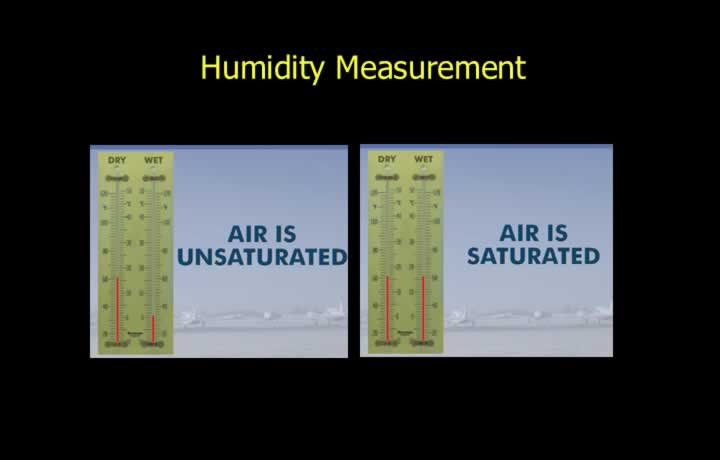
Instruments Used
- Psychrometer
- Hygrometer
- Hygrograph
Saturation of Air plays an important role in clouds formation
Dry-Bulb and Wet-Bulb Temperature
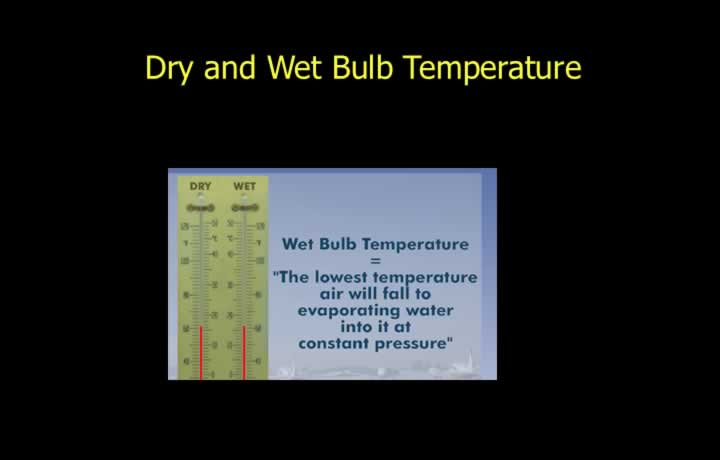
- Dry-Bulb Temperature (DBT) is the ambient air temperature measured by a thermometer freely exposed to the air but shielded from direct radiation and moisture.
- Wet-Bulb Temperature (WBT) is the temperature that air would attain if cooled to saturation (100% Relative Humidity) by the evaporation of water.
Conditions for Saturation
- Unsaturated Air: Dry-bulb and wet-bulb temperatures are different.
- Saturated Air: Dry-bulb and wet-bulb temperatures are the same.
Dew Point Temperature
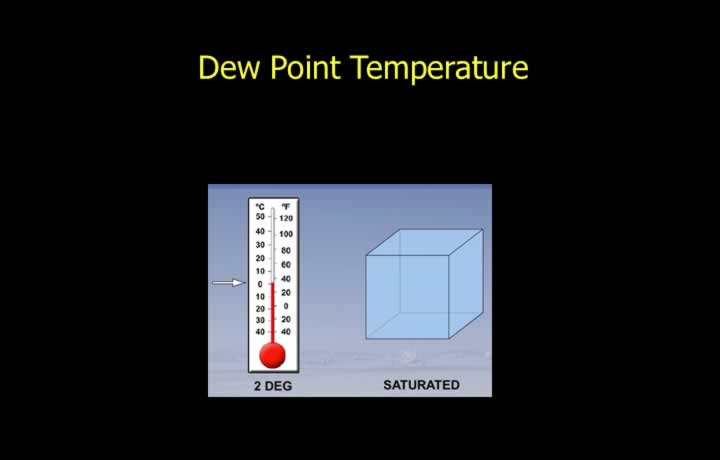
- Dew Point is the temperature to which air must be cooled to become saturated.
- Dew point depends only on the amount of water vapour present in the air.
- It is determined using the dry-bulb and wet-bulb temperatures.
- At the dew point, the air can no longer hold all its water vapour, and condensation begins.
- A higher dew point indicates a greater amount of water vapour in the air.
- Unlike relative humidity, dew point is not directly affected by air temperature.
Vapour Pressure
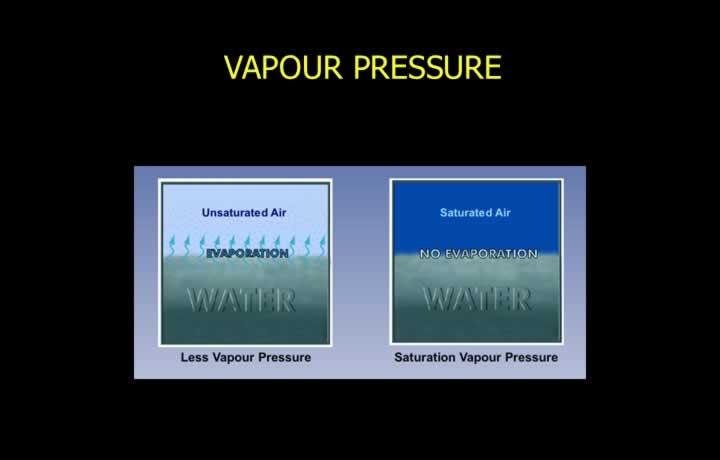
- Vapour Pressure is the partial pressure exerted separately by water vapour in the atmosphere.
- Saturation Vapour Pressure is the vapour pressure when the air is saturated.
Measurement of Humidity
Absolute and Relative Humidity
- Absolute Humidity is the actual mass of water vapour present in a unit volume of air.
- Unit: g/m³.
- Dry air has zero absolute humidity.
- Relative Humidity (RH) is the percentage ratio of the actual water vapour present to the maximum water vapour the air can hold at the same temperature and pressure.
- Saturated Air: 100% RH.
- Unsaturated Air: Less than 100% RH.
Humidity Mixing Ratio
- Humidity Mixing Ratio (HMR) is the mass of water vapour contained in a unit mass of dry air.
- Unit: g/kg.
- Humidity Mixing Ratio varies with atmospheric conditions.
- The average lapse rate of Humidity Mixing Ratio is approximately 0.5 g/kg per 1000 ft.
- Saturation Mixing Ratio (SMR) is the maximum mass of water vapour that can be held per unit mass of dry air when the air is saturated.
- When air is saturated:
- SMR = HMR
Summary of Saturation Conditions
- Frost Point is the temperature at which air becomes saturated with respect to water vapour over an ice surface.
- Cooling below the frost point produces Hoar Frost.
- Small water droplets may remain in a supercooled state.
Temperature Relationships
- In Saturated Air:
- Dry-Bulb Temperature = Wet-Bulb Temperature = Dew Point Temperature
- In Unsaturated Air:
- Dry-Bulb Temperature > Wet-Bulb Temperature > Dew Point Temperature
- The Humidity Mixing Ratio remains constant if air is lifted or lowered adiabatically (without adding or removing air).
- Supersaturation occurs when condensation nuclei are absent and air is cooled below its dew point, causing Relative Humidity to exceed 100%.
Approximate Relative Humidity Formula
Relative Humidity (%) = 100 − [(Dry-Bulb Temperature − Wet-Bulb Temperature) × 5]