Density of Air in the Atmosphere
The density of air in the atmosphere is highest near the Earth’s surface and decreases with increasing altitude. As height increases, the air becomes thinner because there are fewer air molecules. At sea level, the average density of air is about 1225 kg/m³ under standard conditions.
Absolute and Relative Density
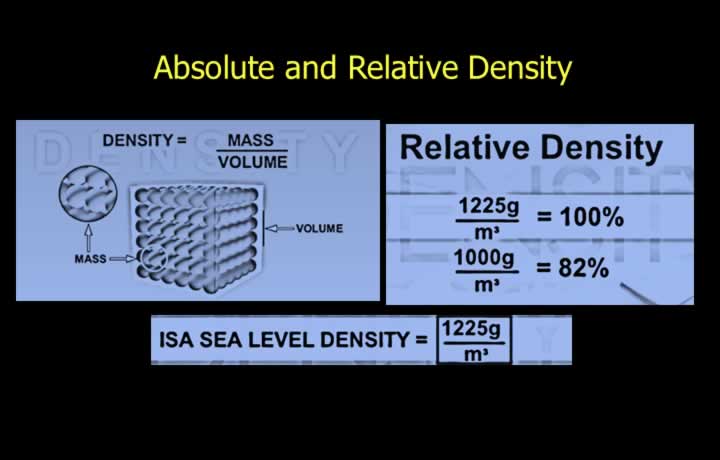
- Absolute Density is the mass of air molecules contained in a unit volume of air.
- Density is measured in g/m³ or kg/m³.
- The density of air at Mean Sea Level (MSL) under ISA conditions is 1225 g/m³.
- Relative Density is the ratio of the prevailing air density to the density under ISA conditions.
Relative Density = Actual Density ÷ ISA Density
Universal Gas Equation
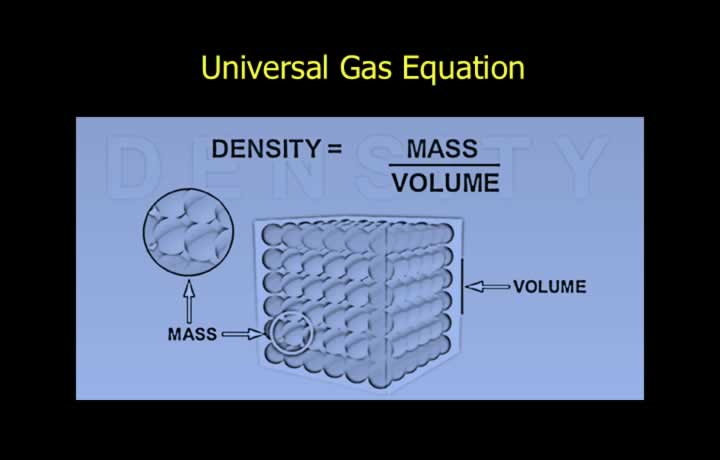
- Density varies with the volume of an air parcel.
- Density is directly proportional to mass.
- Density is inversely proportional to volume.
- The Fundamental Gas Equation is:
PV = RT
From this,
Density = P ÷ RT
Where:
- P = Pressure
- R = Gas Constant
- T = Absolute Temperature (Kelvin)
Effect of Altitude, Latitude and Humidity on Air Density<>
Variation of Density with Altitude
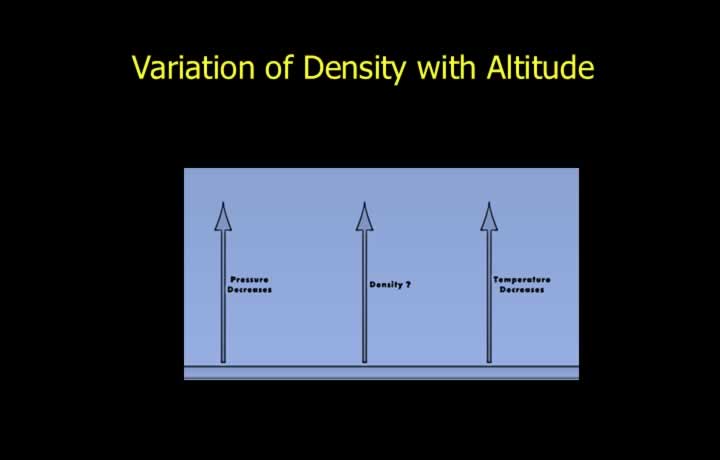
- Density is directly proportional to pressure.
- Density is inversely proportional to temperature.
- As altitude increases, both pressure and temperature decrease.
- Pressure has a greater effect on density than temperature.
- Under ISA conditions, relative density decreases with altitude at a decreasing rate.
Relative Density in ISA:
- At 6 km: ½ of the surface value.
- At 11 km: ¼ of the surface value.
- At 17 km: ⅛ of the surface value.
Variation of Density with Latitude
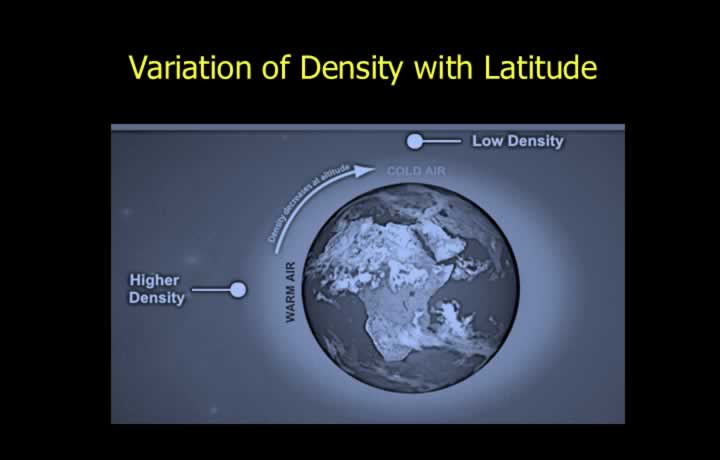
- At sea level, higher temperatures near the Equator cause air to expand.
- Therefore, air density at the Equator is lower than at the poles.
- Above approximately 8 km, the density becomes higher over the Equator than over the poles.
Variation of Density with Humidity
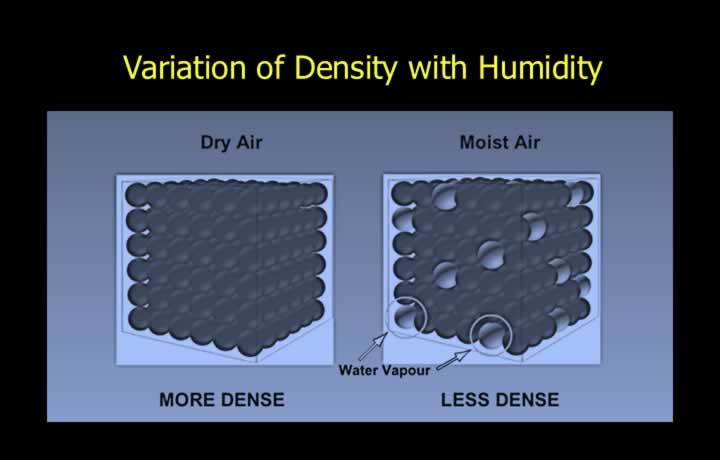
- Water vapour is lighter than dry air.
- When water vapour replaces dry air molecules, the overall mass of the air decreases.
- Therefore, air density decreases as humidity increases.
- Moist air is less dense than dry air.
Variation between Pressure and Density Altitude
Density Altitude
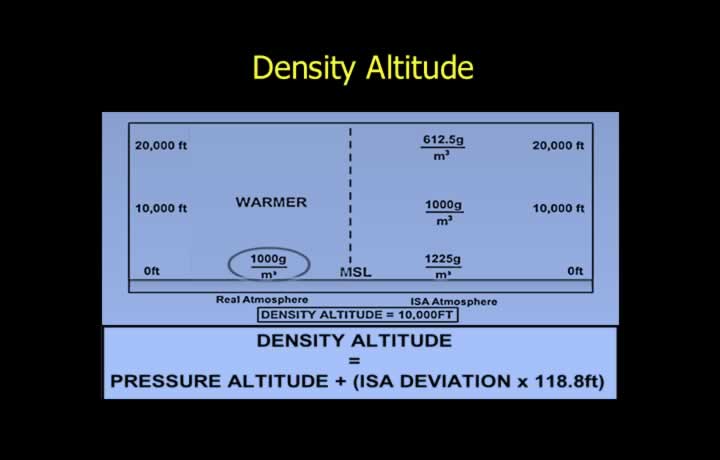
- Density Altitude is the altitude in the ISA atmosphere at which the prevailing air density exists.
- Under ISA conditions:
- Pressure Altitude = Density Altitude
- At a given altitude, if the temperature is higher than ISA, air density decreases.
- The lower density corresponds to a higher altitude in the ISA atmosphere, resulting in a higher density altitude.
- For every 1°C increase above ISA, density altitude increases by approximately 120 ft above pressure altitude.
Density Altitude = Pressure Altitude + (ISA Deviation × 118.8 ft)