
Year – Day – Time
A year is calculated based on the Earth’s revolution around the Sun, which takes about 365.25 days. A day is based on Earth’s rotation on its axis, taking approximately 24 hours. Time is calculated using Earth’s rotation, divided into hours, minutes, and seconds for navigation purposes.
Sidereal Year
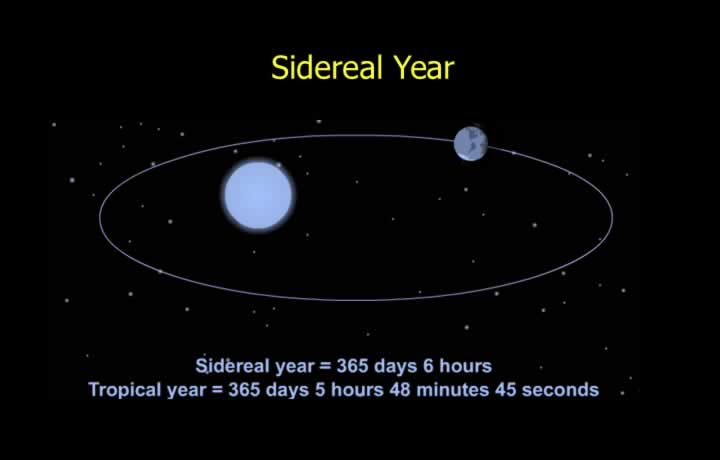
- A sidereal year is one complete revolution of the Earth around the Sun.
- A distant star (effectively at infinity) is used as the reference datum.
- The duration of a sidereal year is approximately 365 days, 6 hours, 9 minutes, and 10 seconds.
Tropical Year
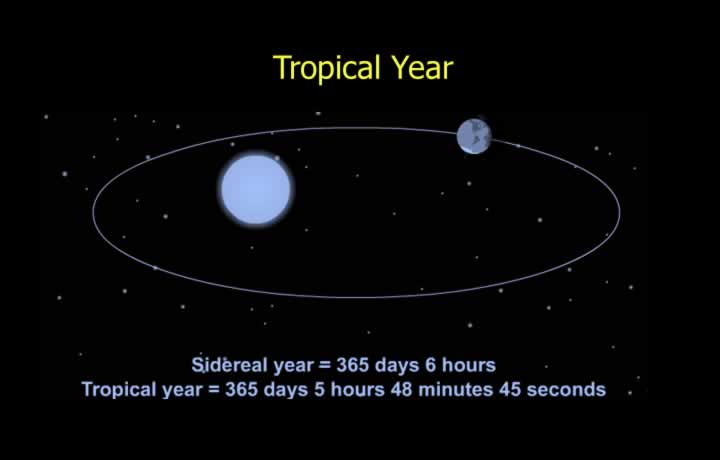
- A tropical year is one complete revolution of the Earth around the Sun.
- It is measured relative to the Sun and the vernal equinox.
- The changing inclination (precession) of the Earth’s axis is taken into consideration.
- The duration of a tropical year is 365 days, 5 hours, 48 minutes, and 45 seconds.
Calendar Year
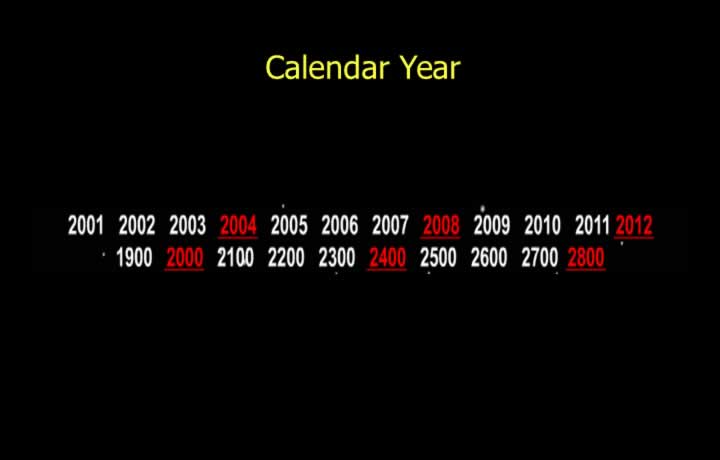
- A calendar year is designed to contain a whole number of days.
- A normal calendar year has 365 days instead of 365 days, 5 hours, 48 minutes, and 45 seconds.
- Leap years include 29 days in February to compensate for the additional quarter day accumulated each year.
- The calendar adjustment follows three rules:
- Every fourth year is a leap year.
- Century years are not leap years.
- Every fourth century (years divisible by 400) is a leap year.
Sidereal Day
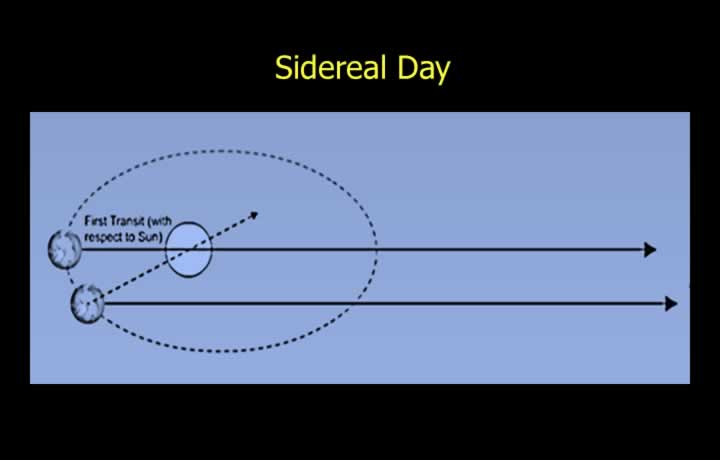
- A day is the time taken for one rotation of the Earth about its axis.
- Any celestial body may be used as the reference datum.
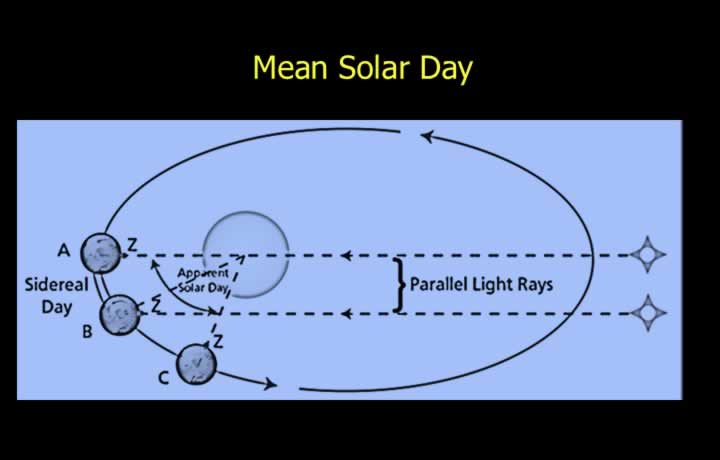
- A sidereal day is the time between two successive meridian transits of a distant star.
- The reference star is considered to be at infinity.
Usability of Sidereal Day
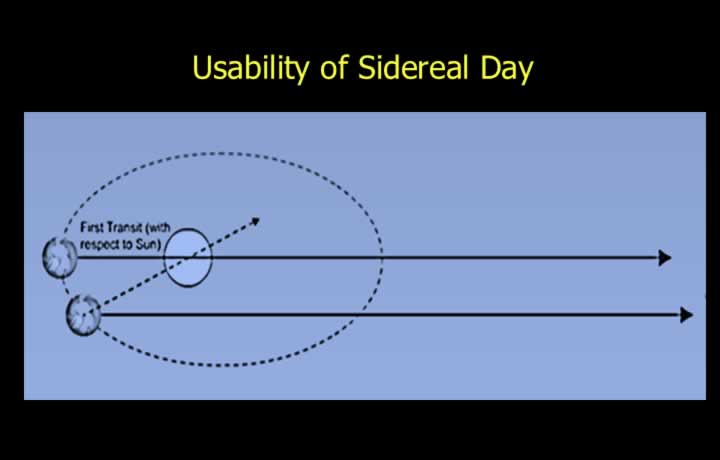
- The Earth’s revolution around the Sun does not affect the sidereal day.
- Meridian transits referenced to a distant star remain constant.
- A sidereal day is not related to daylight or darkness.
- Therefore, the sidereal day is not suitable for everyday civil use.
Apparent Solar Day
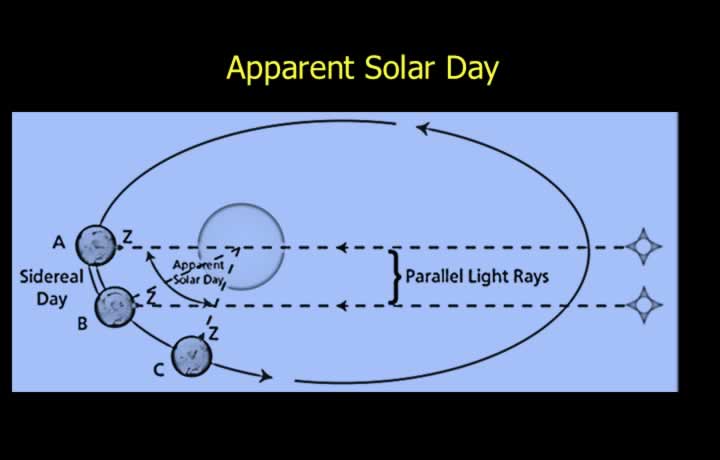
- An apparent solar day is the time between two successive meridian transits of the real Sun.
- The actual (apparent) Sun is used as the reference datum.
- An apparent solar day is slightly longer than a sidereal day.
- The Earth both rotates and revolves counter-clockwise when viewed from the North Celestial Pole.
- Between successive meridian transits, the observer’s meridian changes position due to Earth’s revolution.
- As a result, the Earth must rotate a little farther to bring the Sun back to the meridian.
Usability of Apparent Solar Day
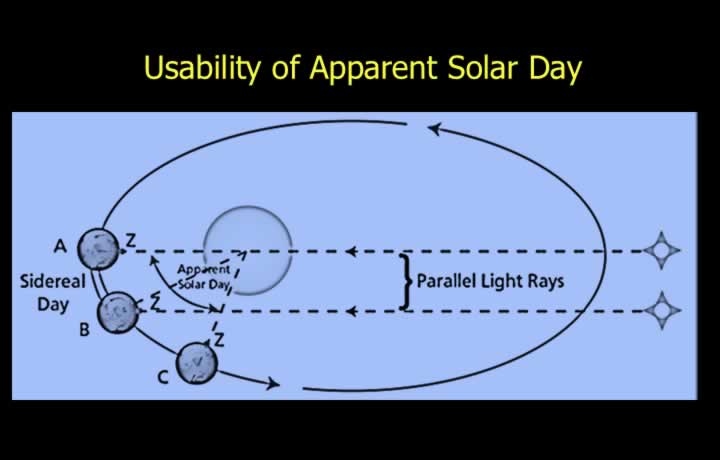
- The length of an apparent solar day varies from day to day.
- This variation occurs because the Earth’s orbital speed changes with its distance from the Sun.
- Consequently, the apparent solar day is unsuitable for practical timekeeping.
Mean Solar Day
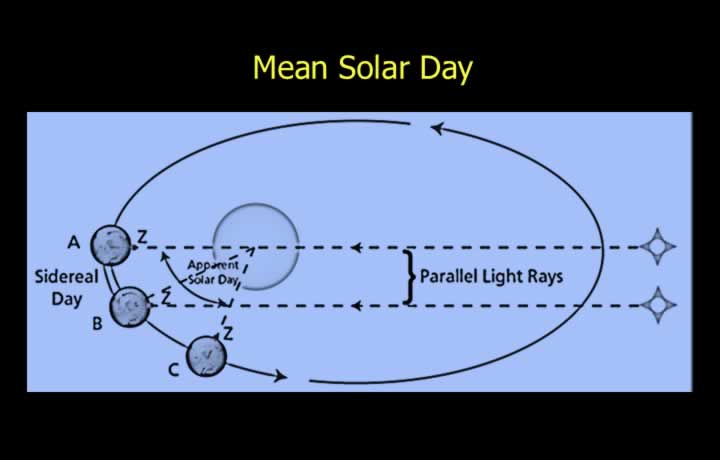
- A mean solar day is the average length of all apparent solar days.
- It is also known as the civil day.
- It is the time between successive meridian transits of the mean Sun.
- The mean Sun is an imaginary Sun assumed to move uniformly around the Earth, completing one revolution every 24 hours.
Mean Solar Day Calculations
- The mean solar day is obtained by dividing the total length of a year by approximately 365¼ days.
- 360° of Earth’s rotation = 24 hours.
- 15° of rotation = 1 hour.
- 1° of rotation = 4 minutes.
- 15′ (minutes of arc) of rotation = 1 minute of time.
Equation of Time
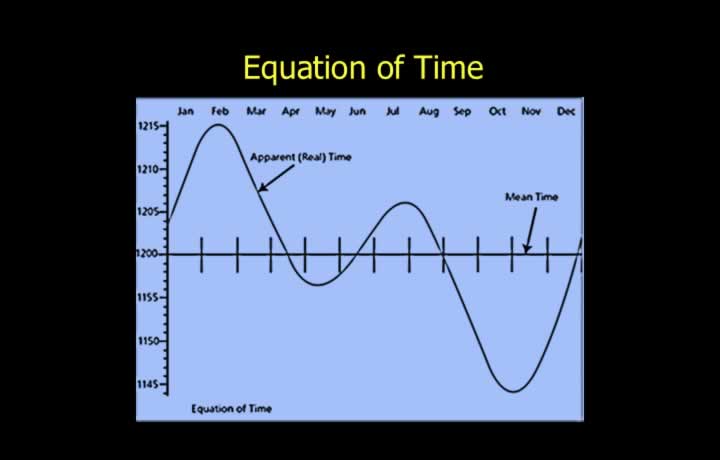
- The Equation of Time is the difference between apparent solar time and mean solar time.
- Mean solar day is the basis for measuring mean time.
- Mean time may refer to Local Mean Time (LMT) or Greenwich Mean Time (GMT).
- The difference between mean time and apparent time varies with the Earth’s position in its orbit.
Mean Time and Equation of Time
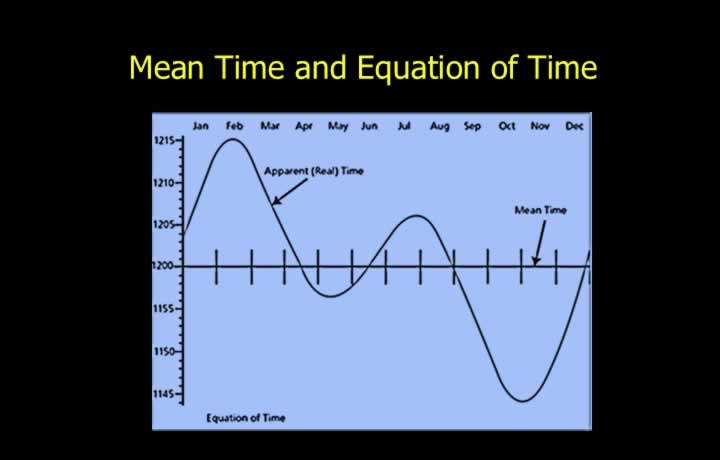
- When mean time shows 12:00 noon, the real Sun is not always exactly on the local meridian.
- The maximum difference is about 16 minutes in mid-November.
- At that time, the real Sun is approximately 16 minutes behind the mean Sun.
- A second maximum difference of about 14 minutes occurs in mid-February.
- At that time, the real Sun is approximately 14 minutes ahead of the mean Sun.