
Time
Time calculations in aviation include Local Time, UTC (Coordinated Universal Time), and Zone Time. The difference in time between locations is calculated using longitude differences (15° longitude = 1 hour). Accurate time calculation helps pilots with navigation, flight planning, and communication.
Hour Angle
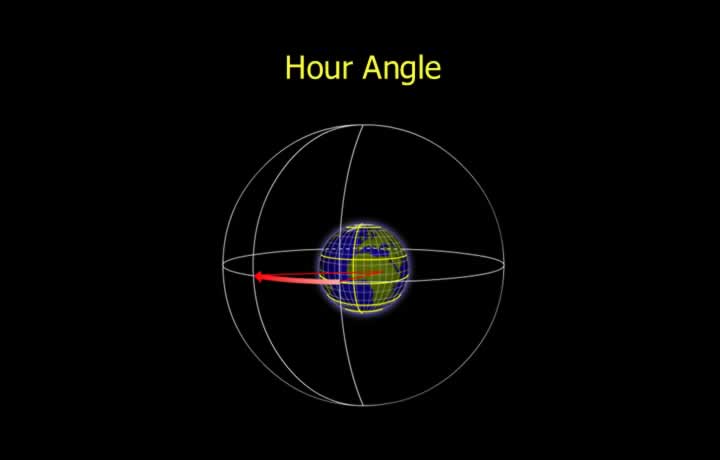
- The Hour Angle (HA) is the arc of the equinoctial (celestial equator) and is the celestial equivalent of longitude.
- It is measured between a reference (datum) meridian and the celestial body’s meridian.
- Hour angle is measured westward from the reference meridian.
- Its value ranges from 0° to 360°.
- The hour angle changes continuously due to the Earth’s rotation.
Position of a Celestial Body and Hour Angle
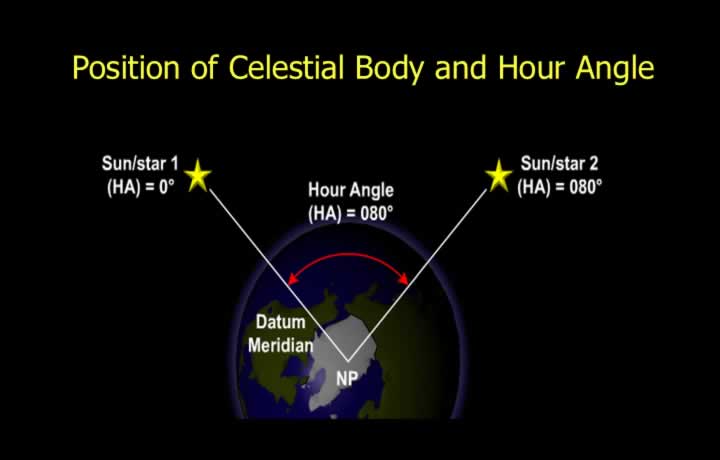
- The hour angle is 0° when the celestial body transits the reference meridian.
- When the body transits the anti-meridian, its hour angle is 180°.
Greenwich and Local Hour Angles
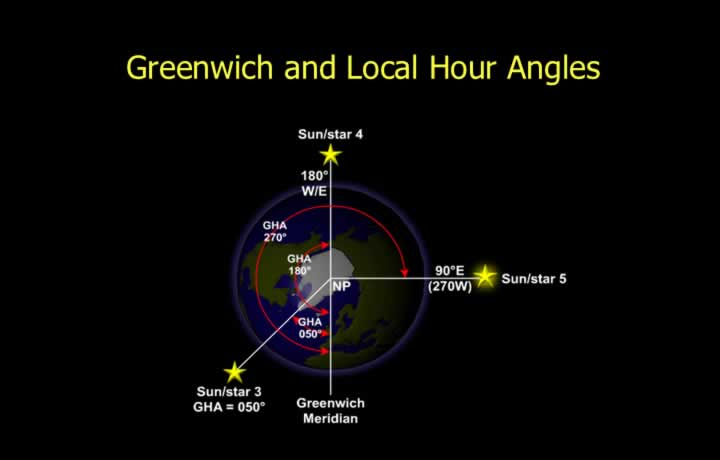
- Hour angles are classified according to the reference meridian used.
- Greenwich Hour Angle (GHA) uses the Greenwich Meridian as the datum.
- Local Hour Angle (LHA) uses the observer’s meridian as the datum.
Arc to Time Conversion
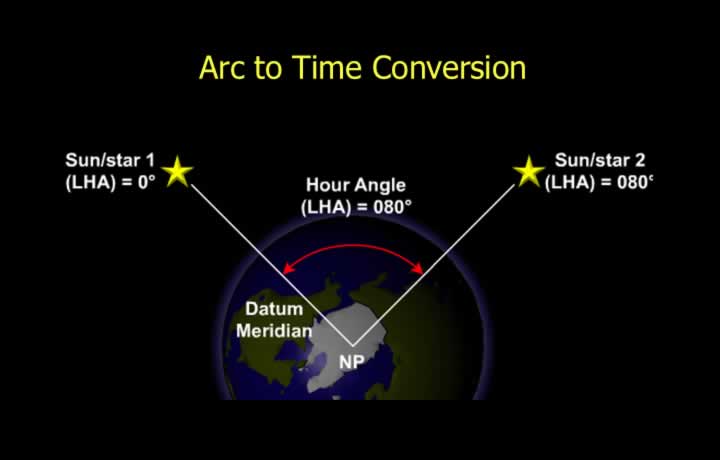
- Mean time is obtained by converting angular rotation into time.
- 360° of rotation = 24 hours.
- 15° of rotation = 1 hour.
- 1° of rotation = 4 minutes.
- 15′ (minutes of arc) of rotation = 1 minute of time.
Greenwich Mean Time (GMT)
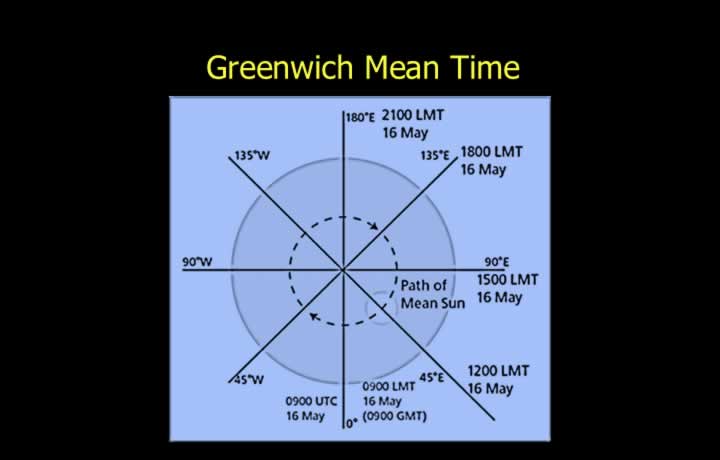
- Mean time is based on the elapsed time since the meridian transit of the mean Sun.
- Greenwich Mean Time (GMT) and Local Mean Time (LMT) are mean times measured on different meridians.
- GMT is the time elapsed since the mean Sun crossed the Greenwich anti-meridian.
- LMT is the time elapsed since the mean Sun crossed the observer’s anti-meridian.
Coordinated Universal Time (UTC)
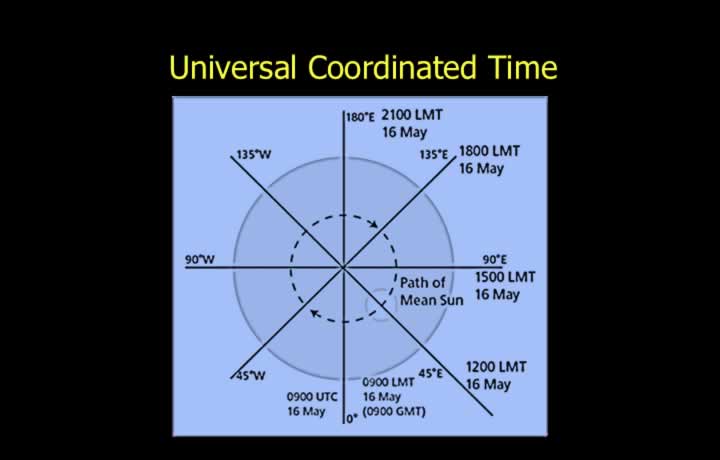
- UTC is the modern international time standard that has replaced GMT for precise timekeeping.
- UTC is maintained using highly accurate caesium atomic clocks.
- The difference between UTC and a location’s LMT depends only on its longitude.
- For east longitudes, UTC is less than LMT.
- For west longitudes, UTC is greater than LMT.
Change of Date
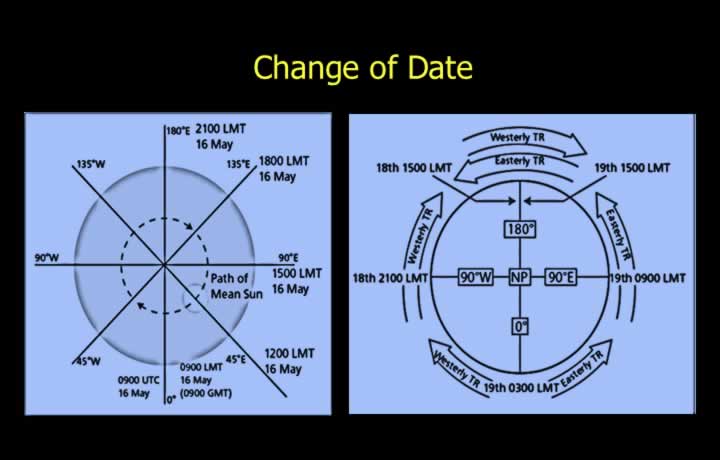
- If the mean Sun is over 45°E, the LMT is 1200 hrs on 16 May at 45°E.
- At the corresponding anti-meridian (135°W), the LMT is 0000 hrs on 16 May.
- The same instant can also be expressed as 2400 hrs on 15 May.
- The local date changes when the mean Sun crosses the anti-meridian of a location.
Flight Across the International Date Line
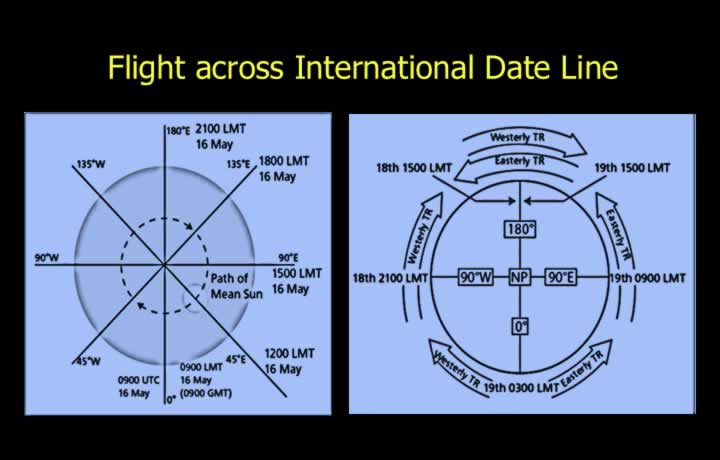
- Flying westward across the International Date Line advances the local date by one day.
- A westbound flight effectively gains one calendar day.
- Flying eastward across the International Date Line moves the local date back by one day.
- An eastbound flight effectively loses one calendar day.
Zone Time
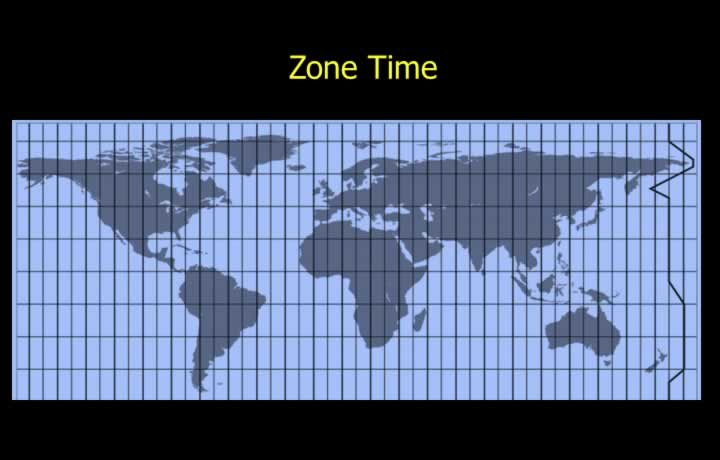
- Zone time was originally introduced for maritime timekeeping.
- It keeps daylight and darkness reasonably aligned with local time.
- The Greenwich Meridian is used as the reference for zone time.
- The Earth is divided into 24 standard time zones, each approximately 15° of longitude wide, with a one-hour difference between adjacent zones.
- Zone time differs from UTC by whole-hour increments.
Zone Time Calculation
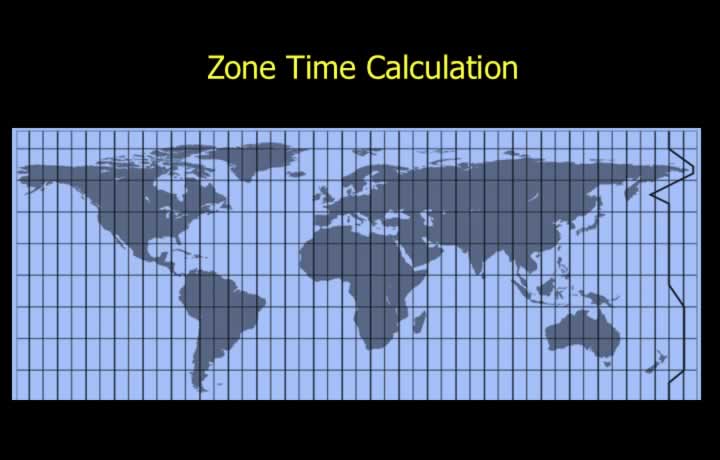
- Each standard time zone extends approximately 7.5° on either side of its central meridian.
- Near the International Date Line there are two half-zones designated M and Y.
- UTC = Zone Time + Zone Number.
- For westerly longitudes, the zone number is positive.
- For easterly longitudes, the zone number is negative.
Standard Time
- Standard time is the official time established by law or custom.
- Each country or region may adopt its own standard time.
- Standard time is generally based on the central meridian of the region.
- It is usually close to both Local Mean Time (LMT) and Zone Time.
Calculation of Standard Time
- Standard time corrections for most countries are listed in the Air Almanac.
- Some countries with a large east-west extent observe Daylight Saving Time (DST).
- Daylight Saving Time is typically 1 hour ahead of standard time.
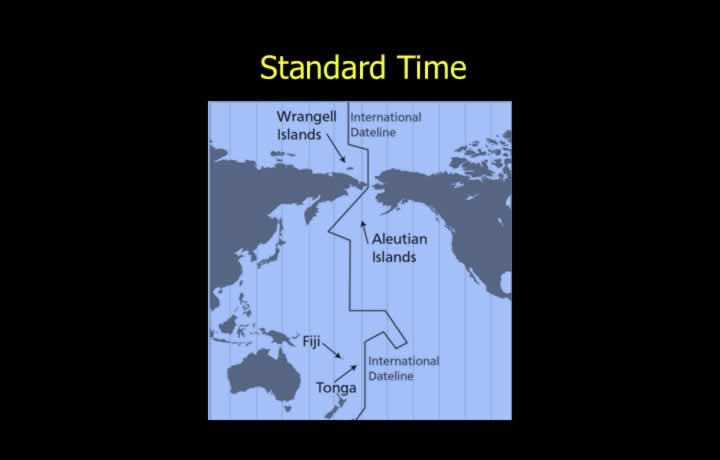
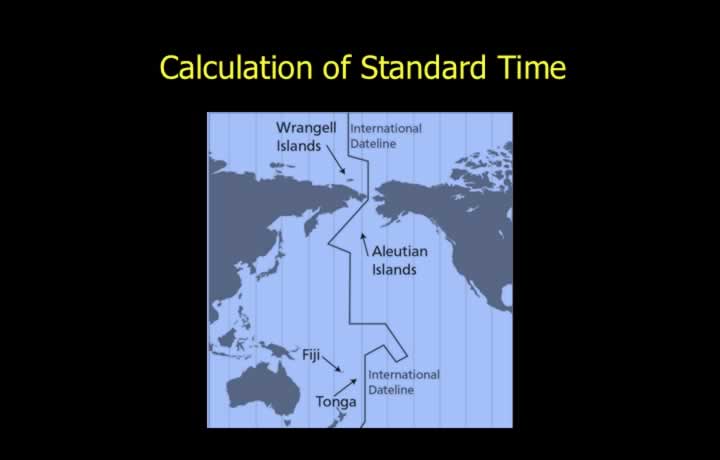
- The International Date Line follows standard time boundaries and is therefore not a straight line.