
Deviation due to Aircraft Magnetism
Magnetic deviation is the error in a compass reading due to local magnetic fields within the aircraft, like electrical systems and metal structure. It causes the compass to point away from true magnetic north, varying the aircraft heading.
Introduction to Aircraft Magnetism
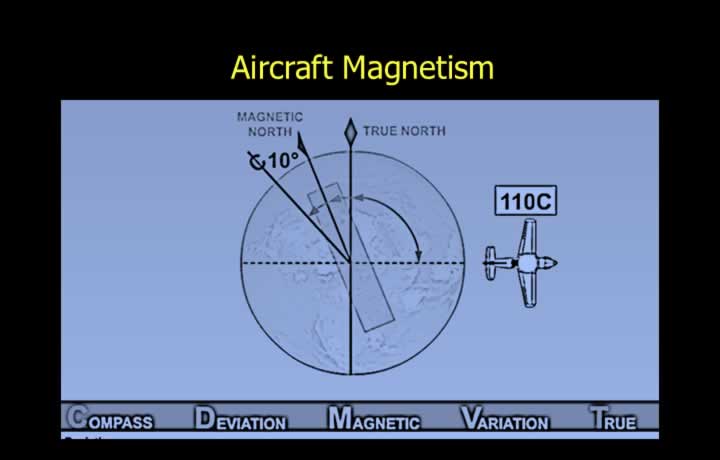
- Compass north is the direction indicated by the aircraft’s magnetic compass.
- Compass north differs from magnetic north because of deviation.
- Aircraft magnetism produces deviation errors in the magnetic compass.
- Ferrous metals and electrical equipment within the aircraft create magnetic fields that affect the compass.
- Deviation is the angular difference between compass north and magnetic north.
- A compass swing is performed to measure and minimise compass deviation.
Correction of Deviation by Compass Swing Procedure
Deviation and Compass Swing
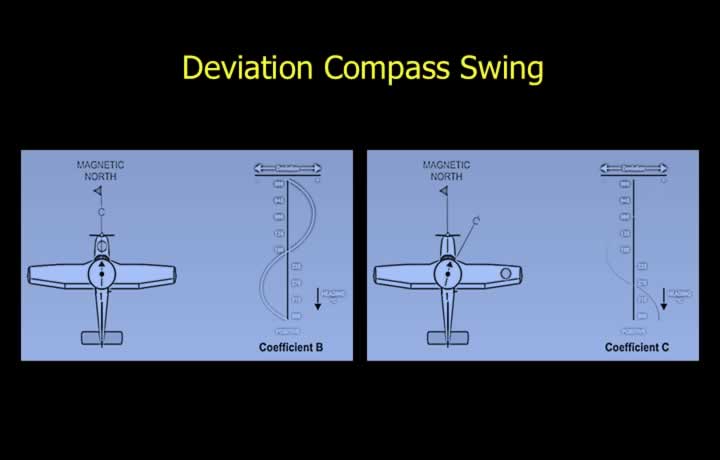
- A compass swing is carried out to calculate, correct, and record the residual compass deviation.
- The aircraft compass is compared with a calibrated reference (datum) compass located outside the aircraft.
- Deviation on the four cardinal headings is used to determine the total deviation.
- Coefficient B represents the effect of aircraft magnetism along the longitudinal axis.
- Coefficient B varies as the sine of the aircraft heading.
- Coefficient C represents the effect of aircraft magnetism along the lateral axis.
- Coefficient C varies as the cosine of the aircraft heading.
- Coefficient A represents misalignment of the aircraft or compass lubber line.
- Coefficient A remains constant on all headings.
Total Deviation Effect
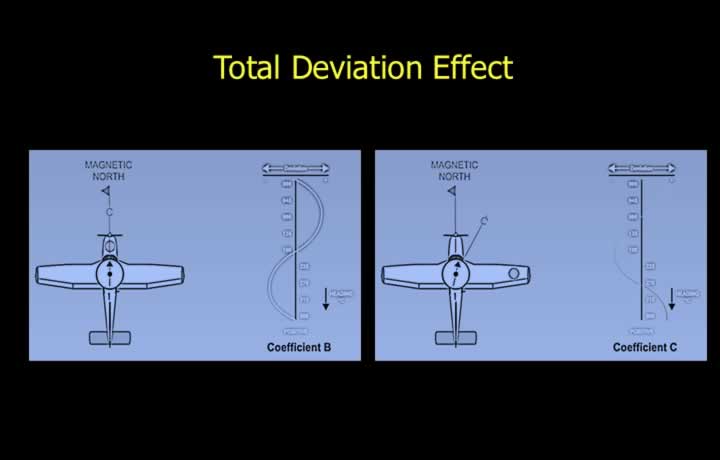
- The total compass deviation on any heading is given by:
Total Deviation = A + (B × sin Heading) + (C × cos Heading)
- A positive result is added to the indicated compass heading.
- A negative result is subtracted from the indicated compass heading.
Correction for Deviation
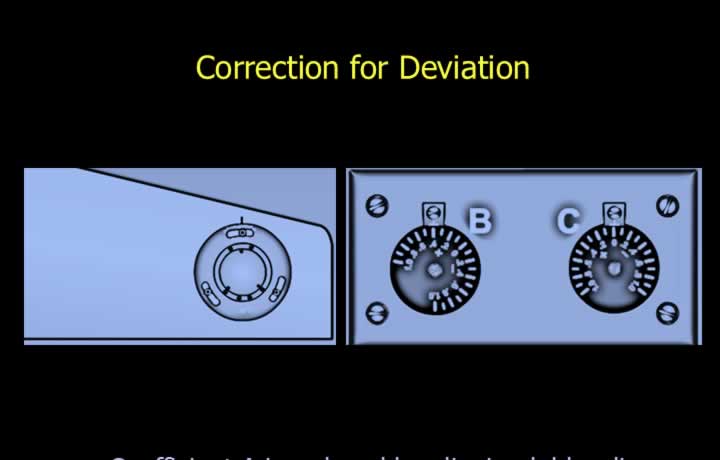
- Coefficient A is minimised by correctly aligning the compass lubber line with the aircraft’s longitudinal axis.
- Coefficients B and C are reduced by producing local magnetic fields inside the compass.
- These local magnetic fields are made equal and opposite to the aircraft’s permanent magnetic field.
- Coefficient B is adjusted while the aircraft is on easterly and westerly headings.
- Coefficient C is adjusted while the aircraft is on northerly and southerly headings.
- Any remaining error is recorded on the compass correction card.
- A direct-reading magnetic compass typically has an accuracy of approximately ±10°.
- A remote-indicating compass system typically achieves an accuracy of approximately ±1°.
Latitude Effect on Deviation due to Hard Iron
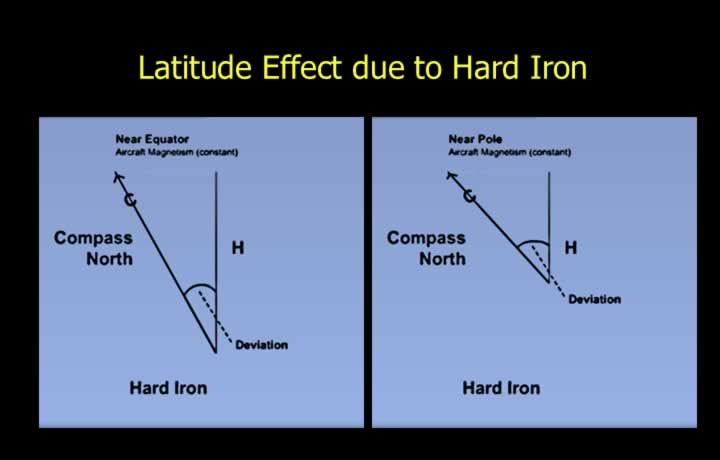
- Compass deviation caused by hard iron varies with latitude.
- The horizontal component of the Earth’s magnetic field decreases as latitude increases.
- The relative effect of permanent aircraft magnetism therefore becomes more significant.
- Deviation errors generally increase as the aircraft operates closer to the magnetic poles.
Latitude Effect on Deviation due to Soft Iron
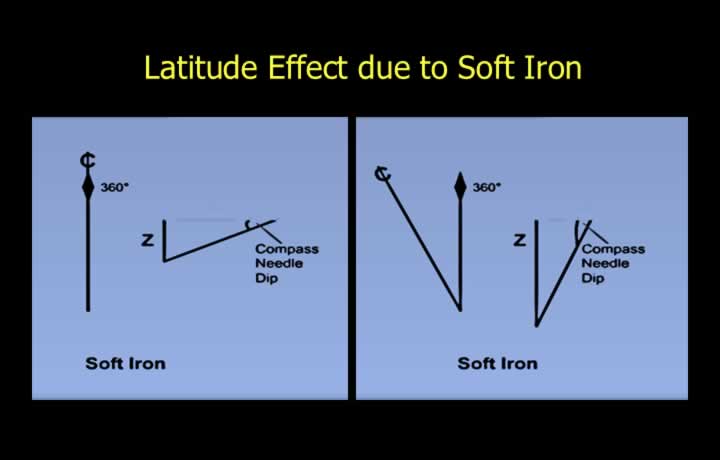
- Compass deviation caused by soft iron also varies with latitude.
- Soft-iron magnetism increases as the vertical component of the Earth’s magnetic field increases.
- Since the vertical magnetic component becomes stronger toward the poles, deviation errors increase at higher latitudes.
Occasions for Compass Swing
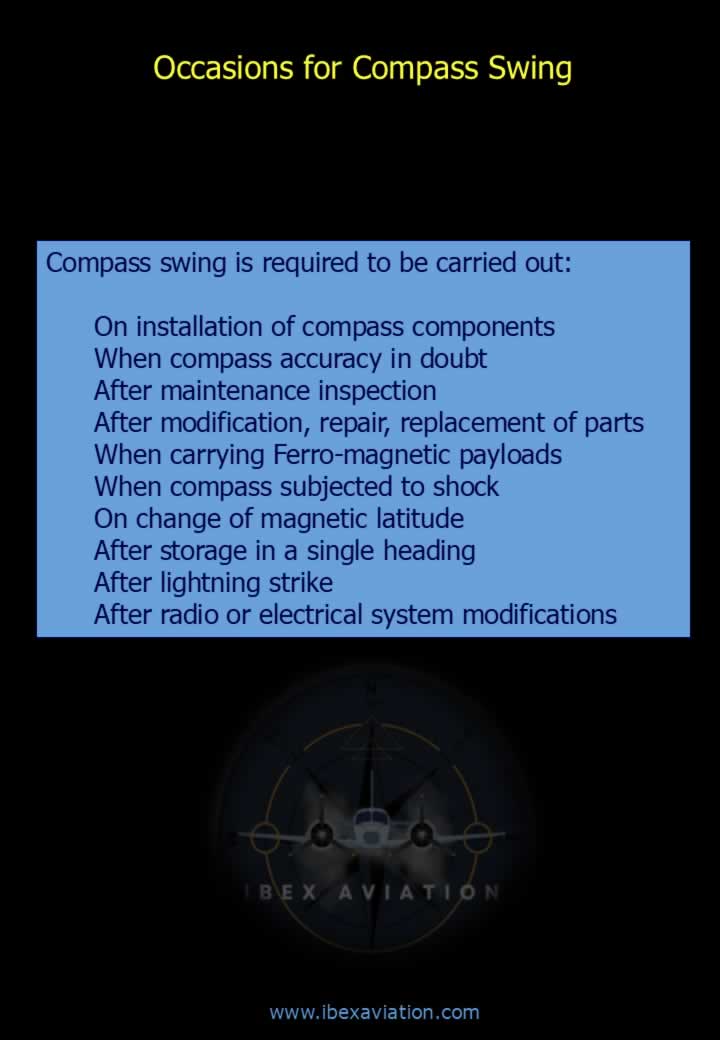
- A compass swing should be carried out under the following circumstances:
- After installation or replacement of a magnetic compass.
- After major maintenance involving ferrous structural components.
- After installation or relocation of electrical or electronic equipment.
- Following lightning strikes or severe magnetic disturbances.
- After repainting or structural repairs that may affect aircraft magnetism.
- Whenever compass errors are suspected to be excessive.
- At the intervals specified by the aircraft manufacturer or regulatory authority.