Attitude measurement using Artificial Horizon
The artificial horizon (attitude indicator) shows the aircraft’s pitch and bank relative to the real horizon, helping pilots maintain level flight. It is essential in poor visibility or instrument flight conditions to prevent spatial disorientation.
Display of an Artificial Horizon
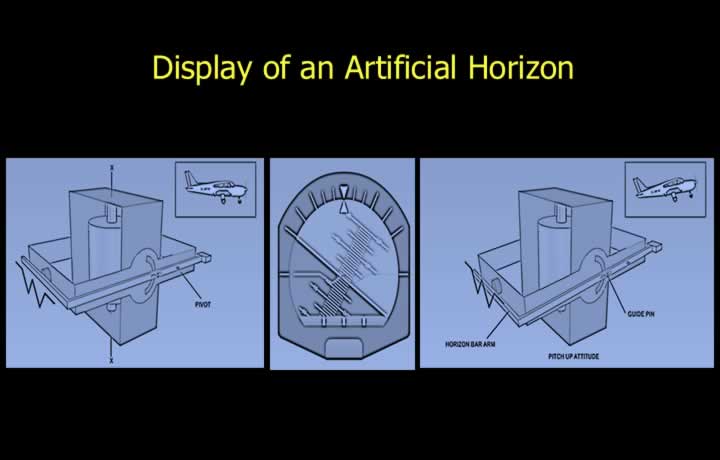
- The artificial horizon provides the aircraft’s attitude using a vertical-axis gyro.
- The gyro spin axis is maintained vertically with respect to the Earth’s surface by gravity.
- The gull-wing symbol etched on the display moves with the aircraft in pitch and roll.
- The horizon bar, attached to the earth gyro, maintains its orientation relative to the Earth’s surface.
- A nose-up attitude is indicated when the gull-wing appears above the horizon bar.
- The gull-wing is attached to the outer gimbal and moves through a guide-pin mechanism.
- The horizon bar is attached to the inner gimbal and remains vertically referenced.
- Typical indication limits are ±60° in pitch and 110° in roll.
Principle of Artificial Horizon
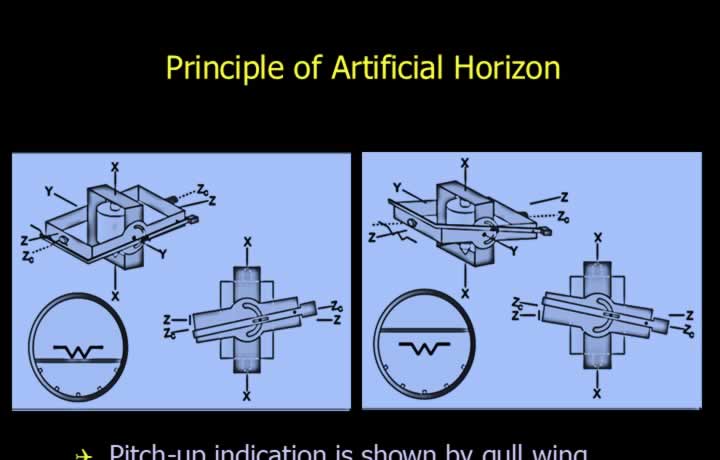
- Nose-Up Indication
- A nose-up attitude is shown when the gull-wing appears above the horizon bar.
- As the aircraft pitches up, the instrument case and outer gimbal rotate upward.
- The guide pin attached to the inner gimbal keeps the horizon bar lower.
- The resulting display shows the horizon below the gull-wing.
- Nose-Down Indication
- A nose-down attitude is shown when the gull-wing appears below the horizon bar.
- As the aircraft pitches down, the case and outer gimbal rotate downward.
- The guide pin keeps the horizon bar higher.
- The resulting display shows the horizon above the gull-wing.
Air Driven Artificial Horizon
Self-Correction in Air-Driven Artificial Horizon
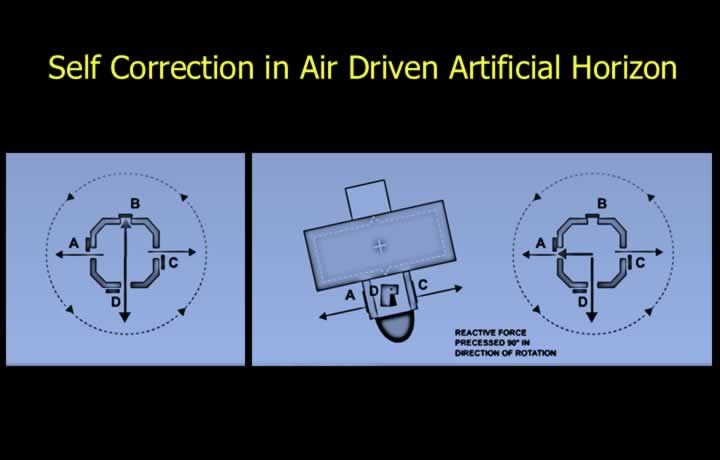
- A vertical gyro cannot drift but can topple.
- Two pairs of pendulous vanes automatically correct gyro topple.
- When the spin axis topples, one vane opens while the opposite vane closes.
- The resulting imbalance in the exhaust airflow creates an external correcting force.
- Gyroscopic precession shifts this force by 90°, restoring the gyro to the vertical position.
Acceleration Errors Due to Self-Correction
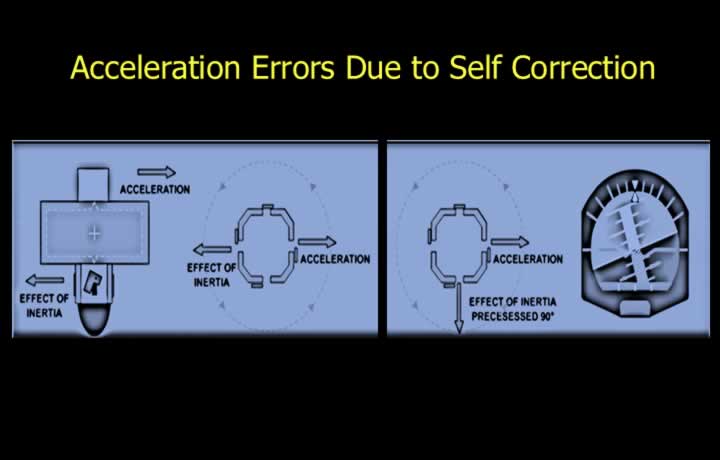
- Acceleration in straight-and-level flight can produce errors because of the self-correcting mechanism.
- The artificial horizon may falsely indicate a nose-up attitude during acceleration.
- The pitch error is caused by acceleration acting on the pendulous vanes.
- A false roll indication occurs because of the inertia of the bottom-heavy rotor housing.
- During acceleration, the instrument tends to indicate a nose-up attitude with right bank.
- During deceleration, it tends to indicate a nose-down attitude with left bank.
- Both acceleration and deceleration can therefore produce misleading attitude indications.
Turning Errors Due to Self-Correction
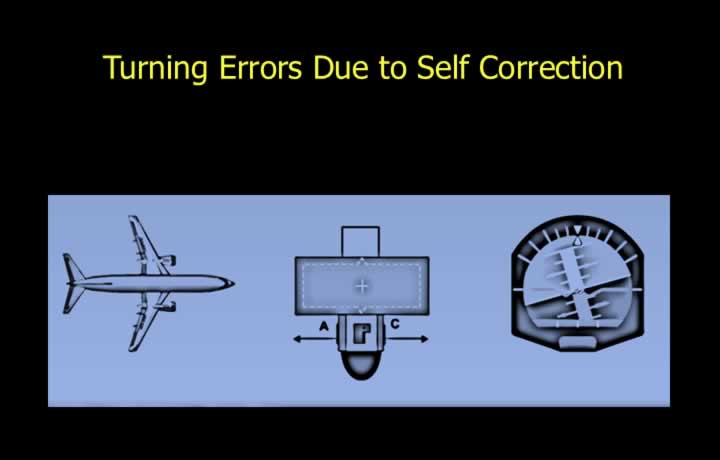
- Turns produce errors because centripetal force affects the pendulous vanes.
| Turn Angle | Bank Error | Pitch Error |
|---|---|---|
| 90° | Under-reads | Pitch Up |
| 180° | Correct | Pitch Up |
| 270° | Over-reads | Pitch Up |
| 360° | Correct | Correct |
Electrically Powered Artificial Horizon
Construction of an Electrical Artificial Horizon
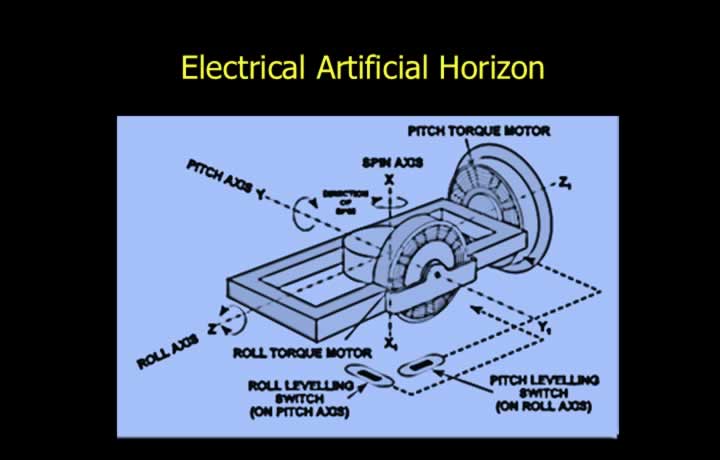
- An electrically driven artificial horizon uses an electric motor to spin the rotor.
- The rotor rotates clockwise and is referenced to gravity using two mercury switches.
- The mercury switches detect pitch and roll errors.
- The gyro spin axis is maintained vertically relative to the Earth’s surface.
- The mercury switches operate corresponding torque motors.
- The roll-axis mercury switch controls the torque motor on the inner gimbal.
- The pitch-axis mercury switch controls the torque motor on the outer gimbal.
Advantages of Electrical Artificial Horizon
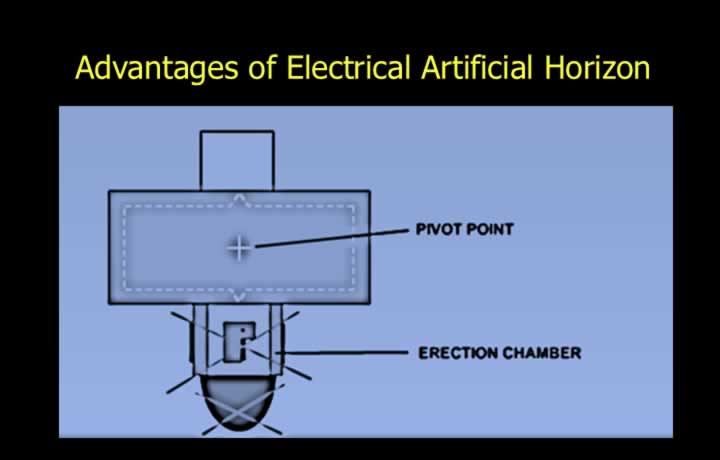
- An electrically driven artificial horizon offers several advantages over the air-driven type.
- A powerful electric motor provides a higher rotor speed.
- Higher rotor speed results in greater rigidity and lower precession.
- The instrument provides more accurate attitude information.
- A fast-erect system restores the gyro at approximately 120° per minute.
- Acceleration and turning errors are significantly reduced.
- No heavy erection chamber or pendulous vanes are required.
Errors of Electrical Artificial Horizon
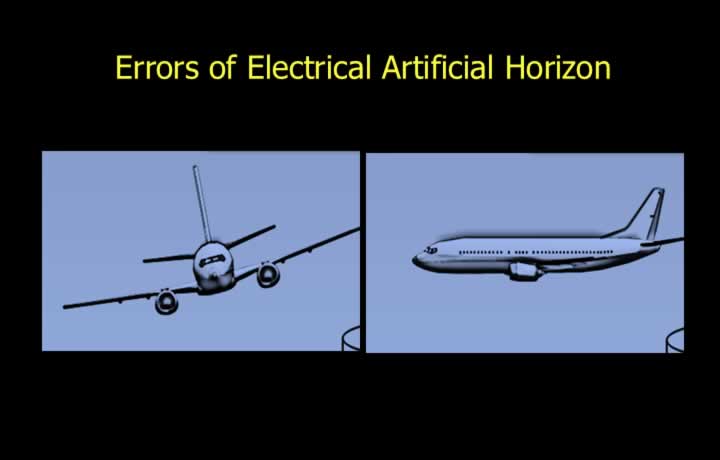
- Errors mainly result from inertia acting on the mercury switches.
- The mercury switch may falsely activate the pitch torque motor.
- A cut-off switch is provided to prevent these false corrections.
- The pitch cut-off activates at approximately 0.18 g acceleration.
- The roll cut-off activates at a bank angle of approximately 10°.
Gyroscopic Systems in Large Aircraft
Remote Vertical Gyro
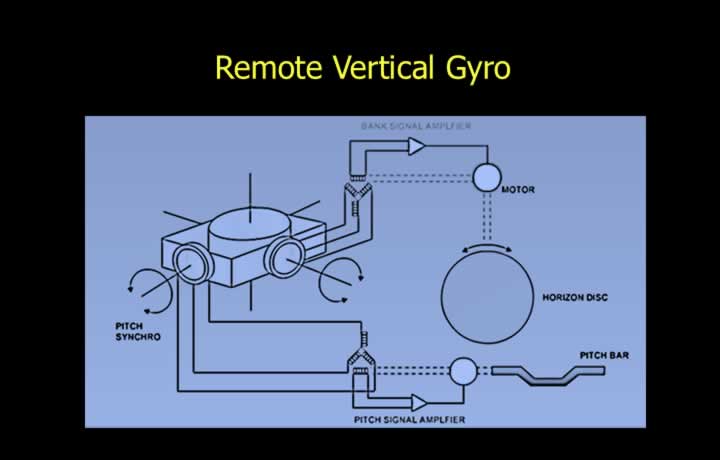
- A remote vertical gyro is also known as a Vertical Axis Data Generation Unit (VADGU).
- The gyro unit is installed remotely from the flight deck.
- The remote gyro drives synchro transmitters for multiple aircraft systems.
- The unit is larger and heavier, allowing a higher rotor speed.
- Greater rotor rigidity results in improved accuracy and reduced precession.
Advantages of Remote Vertical Gyro
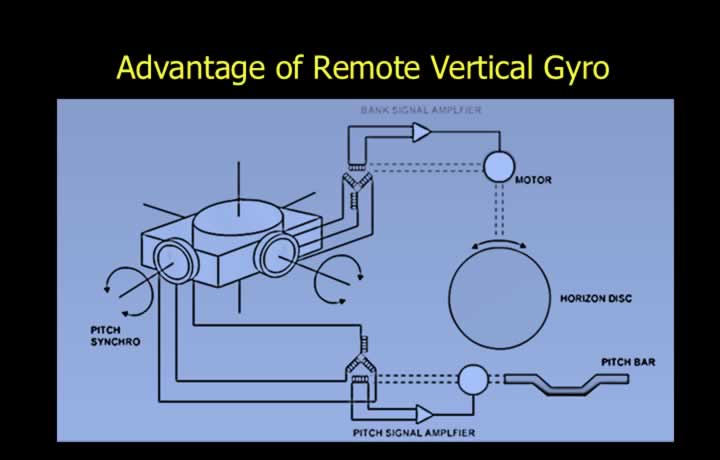
- The large, high-speed gyro provides excellent rigidity and accuracy.
- A single vertical gyro can supply attitude information to multiple aircraft systems.
- Attitude signals can be transmitted simultaneously to:
- Steering computer and amplifier unit.
- Servo units within the Attitude Director Indicator (ADI).
- Automatic Flight Control System (AFCS).