
Measurement of Directions using a Direct Indicating Compass (DIC)
A Direct Indicating Compass (DIC) is a magnetic compass that directly displays the aircraft’s heading relative to magnetic north. It operates without electrical power and serves as a reliable backup heading instrument in an aircraft.
Direct Reading Compass
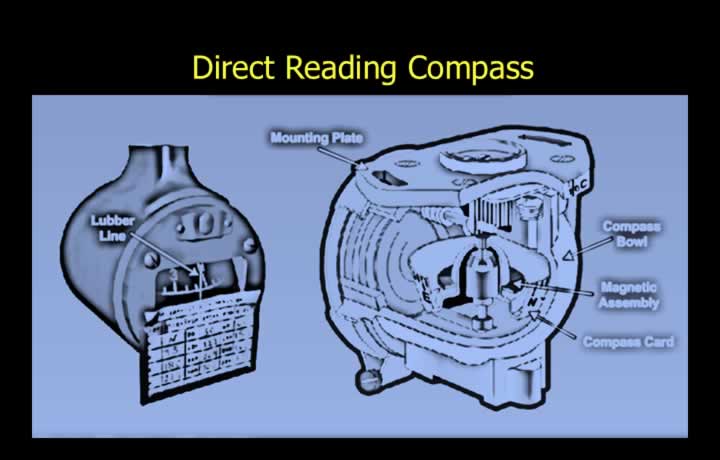
- The Direct Reading or Direct Indicating Compass (DIC) is the simplest type of aircraft compass.
- It uses the horizontal component of the Earth’s magnetic field for direction finding.
- The maximum permissible compass deviation on any heading is generally less than 10°.
- A good magnetic compass should possess:
- Horizontality
- Sensitivity
- Aperiodicity
Construction of Direct Indicating Compass
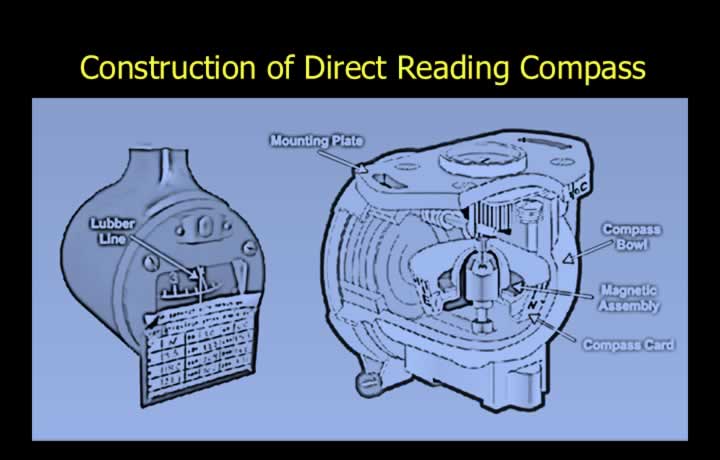
- Consists of a liquid-filled compass bowl.
- The magnetic assembly includes a compass card mounted on a pivoted system.
- A lubber line on the outer casing serves as the reference direction.
- The lubber line is aligned with the aircraft’s longitudinal axis.
Requirements of a Good Direct Indicating Compass
Important Properties of a Direct Indicating Compass are Horizontality, Sensitivity and Aperiodicity
Horizontality
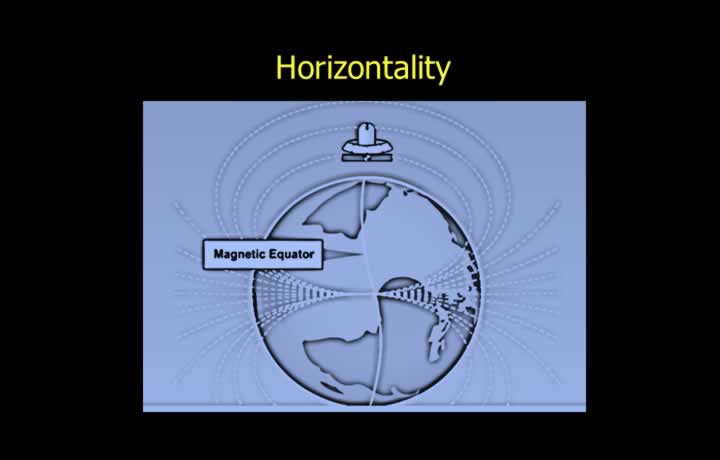
- Horizontality is the ability of the compass to respond only to the horizontal component of the Earth’s magnetic field.
- The Earth’s magnetic field consists of:
- Horizontal component (directive force).
- Vertical component.
- The horizontal component aligns the compass toward Magnetic North.
- The vertical component is undesirable and introduces compass errors.
- Magnetic Dip is the angle between the Earth’s magnetic field and the horizontal plane.
- Dip is 0° at the magnetic equator.
- Dip is 90° at the magnetic poles.
Pendulous Suspension
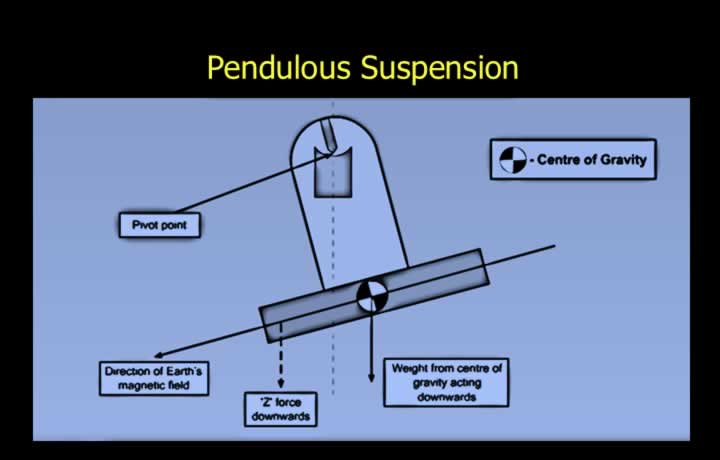
- The compass uses pendulous suspension to improve horizontality.
- It keeps the magnetic assembly horizontal despite magnetic dip.
- The design minimises the effect of the Earth’s vertical magnetic component.
- The centre of gravity is positioned to counteract magnetic dip.
- This increases the influence of the horizontal directive force.
Sensitivity
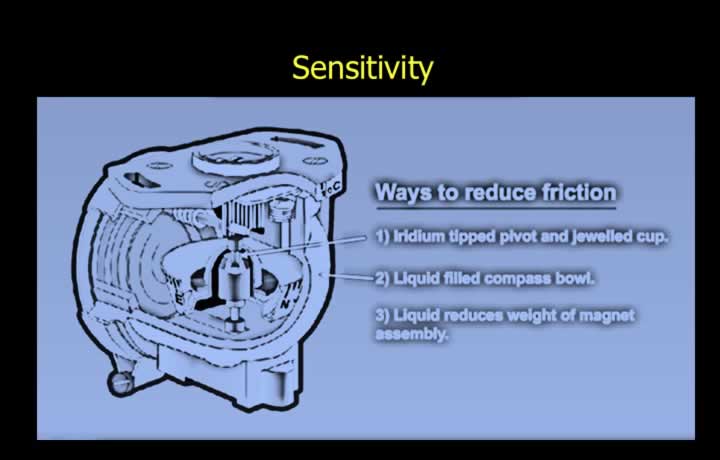
- Sensitivity is the ability of the compass to accurately align with Magnetic North.
- It depends on:
- Earth’s magnetic field strength.
- Strength of the compass magnets.
- Sensitivity is improved by using multiple short magnets.
- Multiple magnets produce greater magnetic flux.
- An iridium-tipped pivot with a jewelled bearing minimises friction.
- The liquid-filled bowl reduces effective weight, improving sensitivity.
Aperiodicity
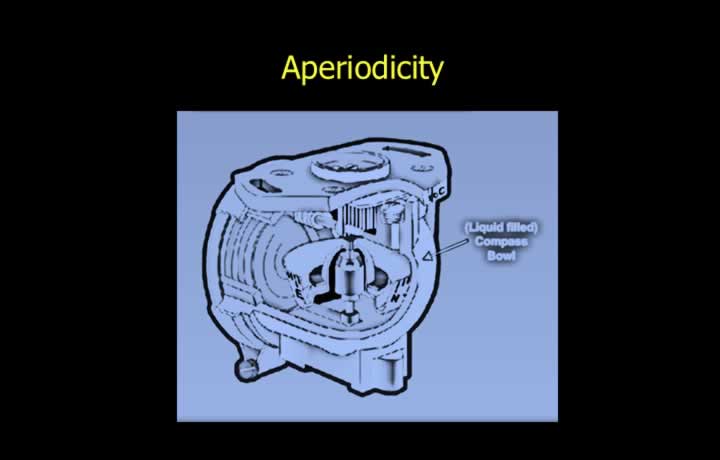
- Aperiodicity is the ability of the compass to stop oscillating quickly.
- Oscillations are damped using:
- Multiple short magnets.
- Viscous liquid inside the compass bowl.
Acceleration Errors on a Direct Indicating Compass
Acceleration errors occur because the Direct Indicating Compass (magnetic compass) responds to both the Earth’s magnetic field and the movement of its floating magnetic element producing temporary heading errors.
Acceleration Error
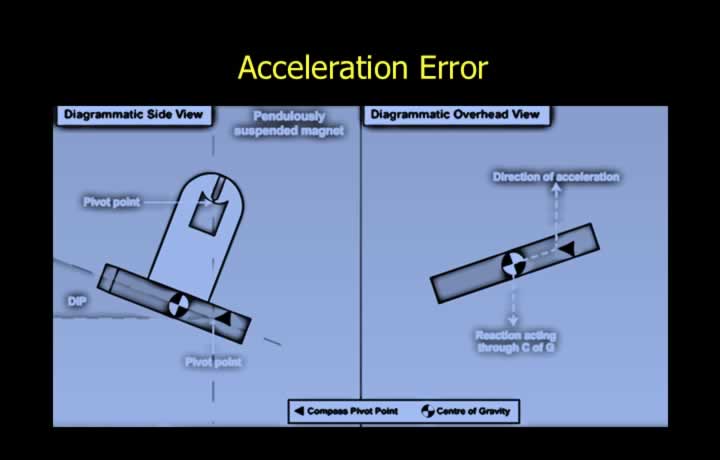
- Acceleration or deceleration in straight flight causes compass errors.
- During acceleration, the north-seeking (red) end tends to move toward the nearer magnetic pole.
- Acceleration error is zero at the magnetic equator because magnetic dip is zero.
- Acceleration error increases with magnetic dip and is greatest near the poles.
Acceleration Error and Magnetic Dip
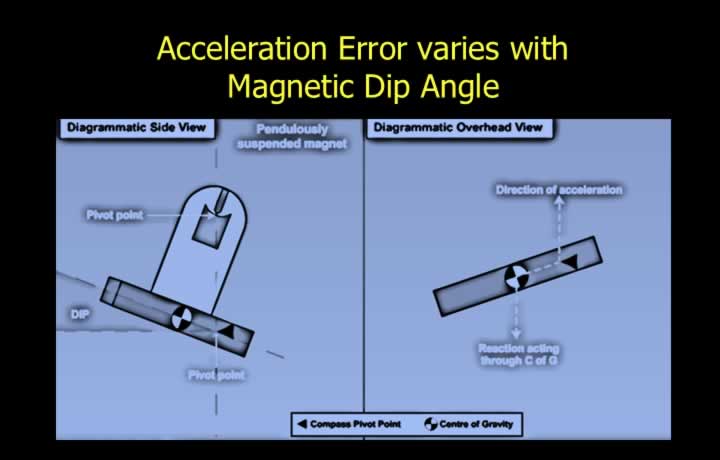
- The primary cause of acceleration error is magnetic dip.
- Magnetic forces act through the compass pivot.
- Inertial reaction acts through the compass centre of gravity.
- Because these forces act at different points, a turning moment is produced.
- This moment creates acceleration errors.
Variation of Acceleration Errors
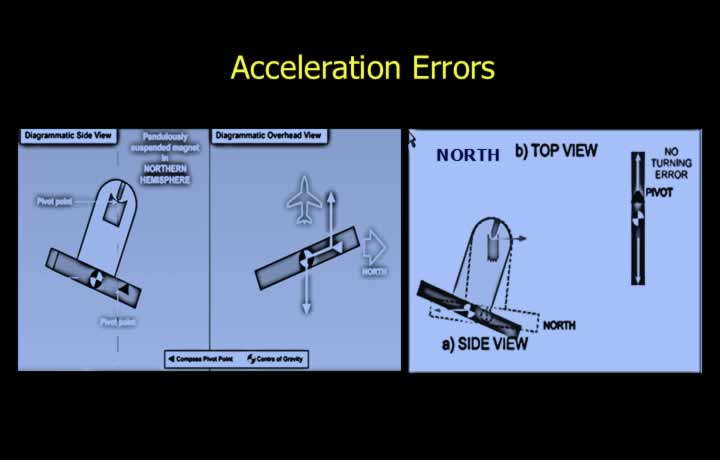
- No acceleration error occurs while accelerating North or South.
- Maximum acceleration error occurs while accelerating East or West.
- Acceleration errors depend on:
- Aircraft heading.
- Magnitude of acceleration.
- Compass magnet design.
- Magnetic latitude.
Acceleration Errors in the Northern Hemisphere
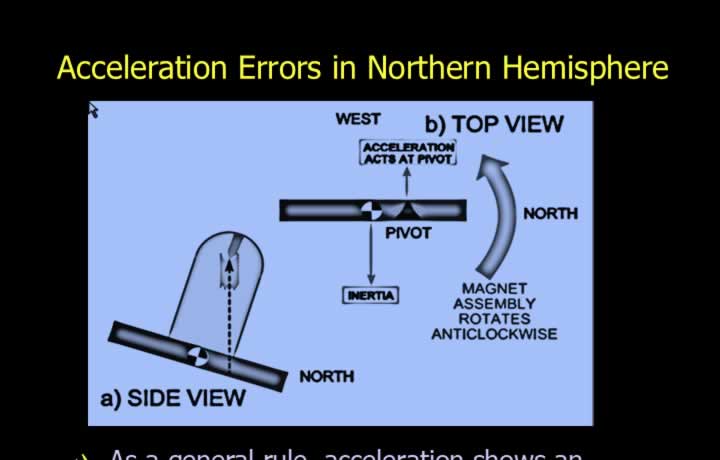
- Acceleration produces an apparent turn toward the North Pole.
- Accelerating West: Compass over-reads.
- Accelerating East: Compass under-reads.
- Deceleration produces an apparent turn toward the Equator.
- Decelerating West: Compass under-reads.
- Decelerating East: Compass over-reads.
Acceleration Errors in the Southern Hemisphere
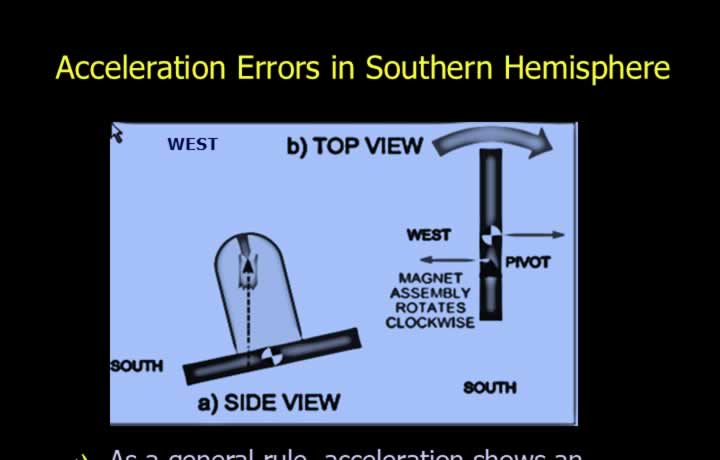
- Acceleration produces an apparent turn toward the South Pole.
- Accelerating West: Compass under-reads.
- Accelerating East: Compass over-reads.
- Deceleration produces an apparent turn toward the Equator.
- Decelerating West: Compass over-reads.
- Decelerating East: Compass under-reads.
Turn Errors on a Direct Indicating Compass
Turn errors occur in a Direct Indicating Compass because of inertia resulting in the compass to lag or lead, resulting in temporary heading errors.
Turning Errors
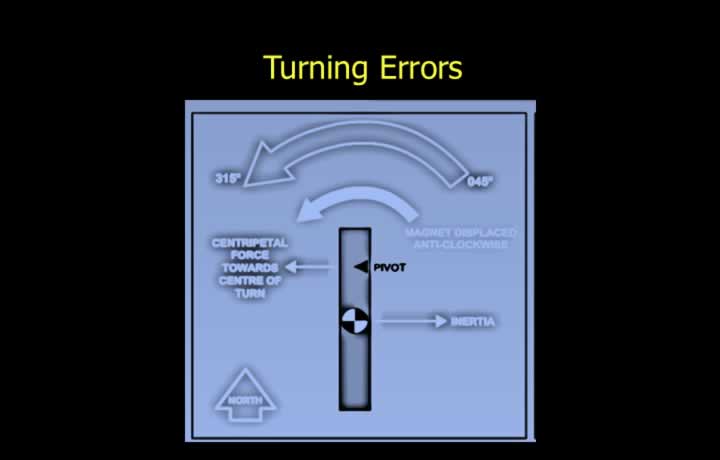
- Turning errors occur whenever the aircraft changes heading.
- Errors are greatest during turns through Magnetic North or South.
- Errors are least during turns through East or West.
- Turning errors are caused by magnetic dip.
- The error increases with increasing magnetic latitude.
- At the magnetic equator, the only turning error is due to liquid swirl.
- Liquid swirl causes approximately 5° of heading lag.
Clockwise Turns in the Northern Hemisphere
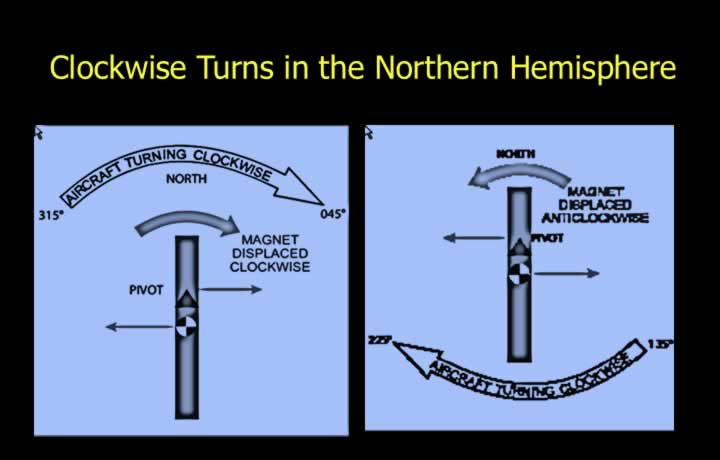
- Turning through North (315° → 045°):
- The compass becomes sluggish.
- When the compass indicates 045°, the aircraft is actually near 065°.
- The compass under-reads.
- Roll out early (undershoot).
- Turning through South (135° → 225°):
- The compass becomes lively (brisk).
- When the compass indicates 225°, the aircraft is actually near 205°.
- The compass over-reads.
- Roll out late (overshoot).
Summary of Turning Errors
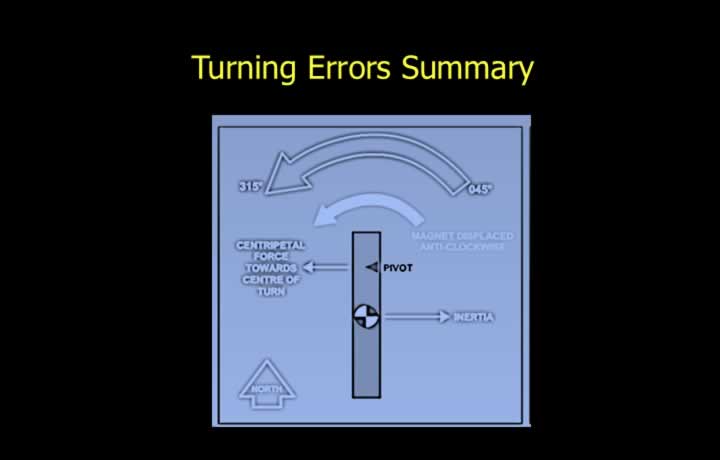
- Turning toward the nearer magnetic pole makes the compass sluggish.
- Roll out early (undershoot).
- Liquid swirl increases the turning error.
- Turning toward the farther magnetic pole makes the compass lively (brisk).
- Roll out late (overshoot).
- Liquid swirl reduces the turning error.