Measurement of Aircraft Altitude using Pressure Altimeter
A pressure altimeter measures altitude by sensing atmospheric pressure and converting it into a height reading above sea level. Pilots set the local barometric pressure (QNH) to obtain accurate altitude information during flight.
Introduction to Pressure Altimeter
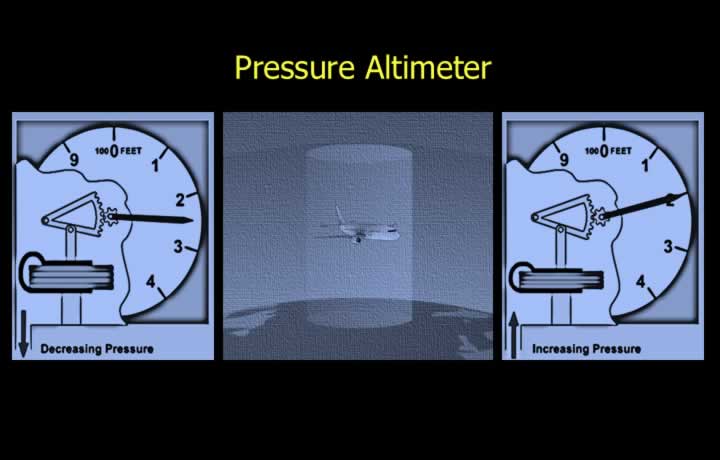
- The Pressure Altimeter is the primary instrument used to measure aircraft altitude.
- It is essentially an aneroid barometer that measures atmospheric pressure.
- The altimeter senses changes in static air pressure and displays them as altitude.
Principle of Pressure Altimeter
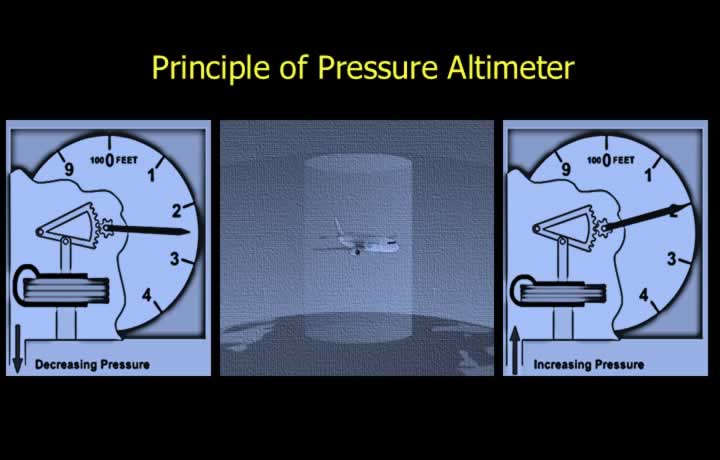
- Static (atmospheric) pressure decreases with increasing altitude at a non-uniform rate.
- This occurs because the weight of the air column above the aircraft decreases with height.
- Static pressure is also affected by variations in temperature and atmospheric pressure.
- These variations must be understood and corrected to obtain accurate altitude measurements.
Simple, Sensitive and Servo Assisted Altimeters
Construction of a Simple Altimeter
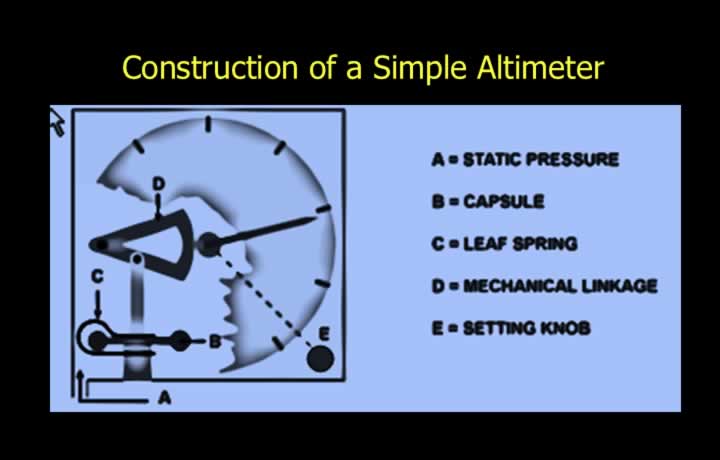
- A simple altimeter consists of a sealed instrument case containing an expandable aneroid capsule.
- Static pressure from the aircraft’s static source is supplied to the sealed instrument case.
- The aneroid capsule contains a fixed internal pressure.
- As altitude increases, external static pressure decreases, causing the capsule to expand.
- The capsule movement is transmitted through a linkage to indicate altitude.
- The instrument displays the altitude at which the sensed pressure would exist under International Standard Atmosphere (ISA) conditions.
Manual Setting Knob in a Simple Altimeter
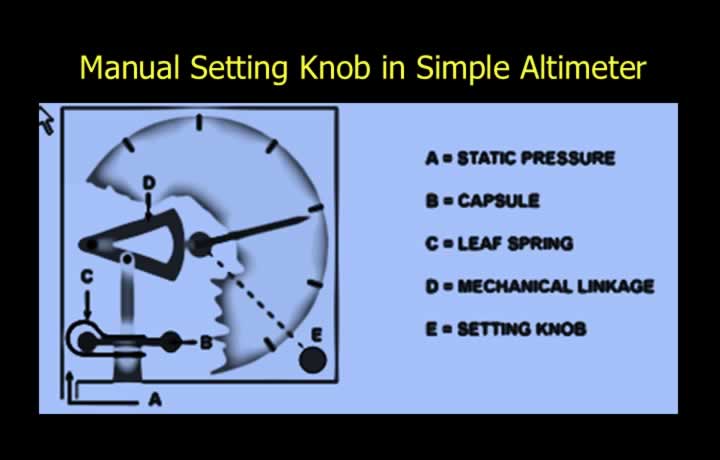
- A manual setting knob is used to adjust the datum altitude by rotating the pointer.
- On the ground, the pointer may be set to:
- Zero – to indicate height above the airfield (Above Ground Level).
- Airfield Elevation – to indicate altitude above Mean Sea Level (MSL).
Construction of a Sensitive Altimeter
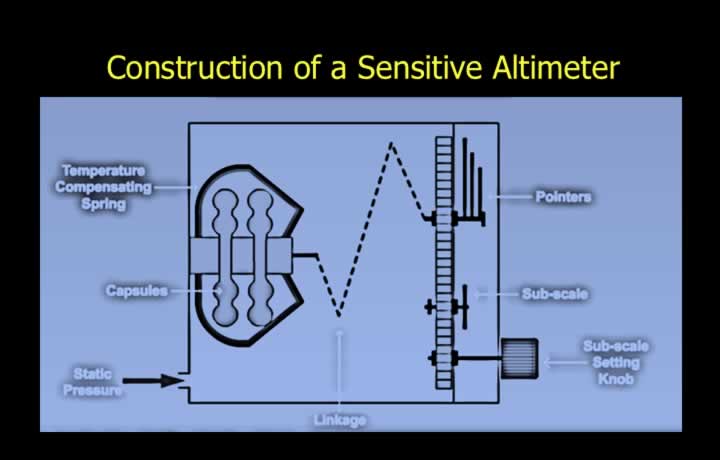
- A Sensitive Altimeter is an improved version of the pressure altimeter.
- It uses multiple aneroid capsules to increase sensitivity.
- Jewelled bearings reduce mechanical friction.
- A temperature-compensating mechanism improves accuracy.
- Mechanical vibrators help overcome friction within the instrument.
- A variable sub-scale allows selection of the desired pressure datum.
- Multiple pointers indicate hundreds, thousands, and tens of thousands of feet for improved readability.
Sub-Scale of a Sensitive Altimeter
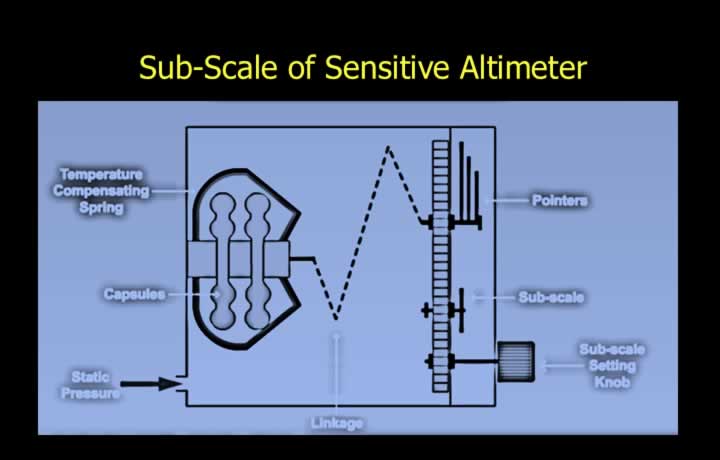
- The sub-scale setting is independent of altitude changes and surface pressure variations.
- It is used only to select the desired pressure reference (QNH, QFE, or Standard Pressure).
- The normal adjustment range is approximately 800 to 1050 hPa.
Construction of a Servo-Assisted Altimeter
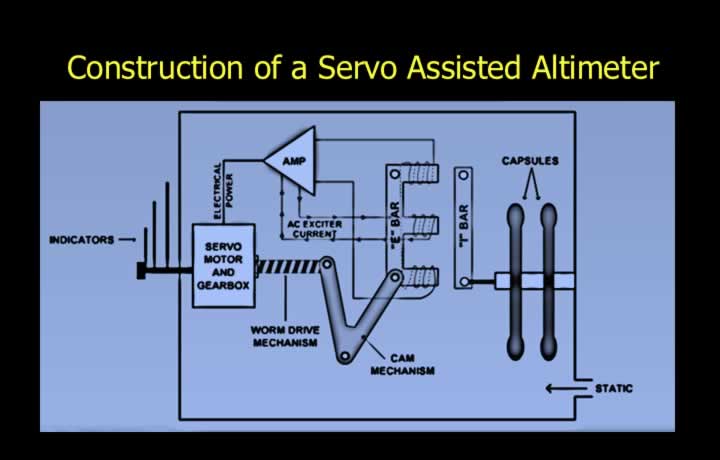
- At higher altitudes, pressure changes become progressively smaller, reducing capsule movement.
- A Servo-Assisted Altimeter uses an electromagnetic system known as the E-I Bar (Electromagnetic Indicator Bar).
- The E-I Bar amplifies very small capsule movements to improve instrument performance.
Advantages of a Servo-Assisted Altimeter
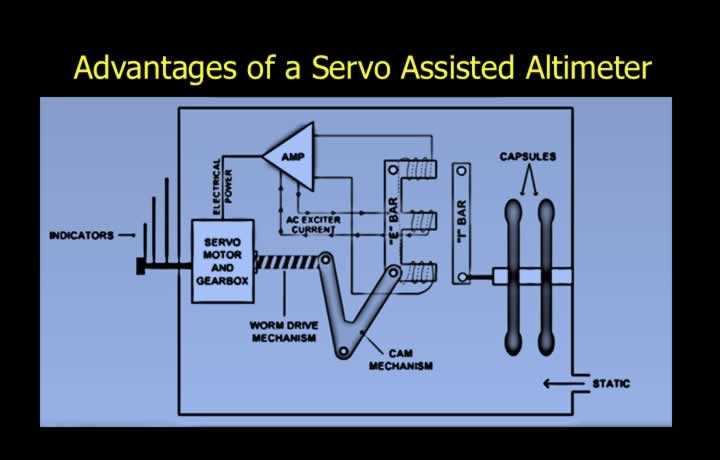
- The E-I Bar generates an electrical error signal for even very small capsule movements.
- Reduces or eliminates lag error.
- Improves measurement accuracy.
- Provides a faster instrument response.
- Allows digital altitude display and integration with electronic flight systems.
Calibration of Altimeter
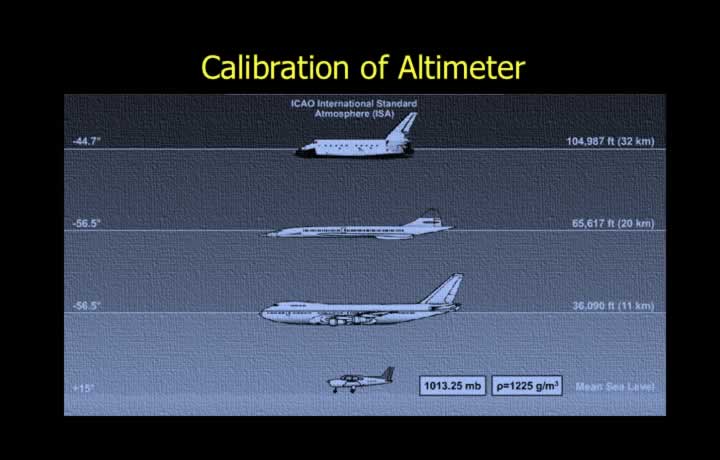
- The altimeter is calibrated according to the International Standard Atmosphere (ISA).
- It indicates true altitude only when ISA atmospheric conditions exist.
- Pressure Altitude is the altitude in the ISA at which the measured atmospheric pressure exists.
- For example, if the altimeter senses a pressure of 1013.25 hPa, it will indicate an altitude of 0 ft under ISA conditions.