
Sunrise – Sunset – Twilight
Sunrise is the time when the Sun appears above the horizon due to Earth’s rotation. Sunset is the time when the Sun disappears below the horizon as Earth continues to rotate. Pilots use sunrise and sunset calculations for flight planning, visibility, and navigation.
Sunrise and Sunset
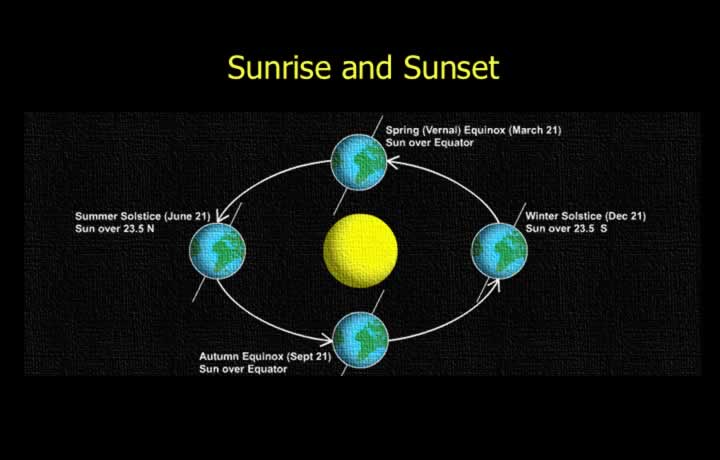
- Imagine the Earth with no axial tilt and no atmosphere.
- Sunrise and sunset would always occur at 0600 LMT and 1800 LMT, respectively.
- There would be no variation in the duration of daylight throughout the year.
- There would be no seasonal changes.
Factors Affecting Sunrise and Sunset
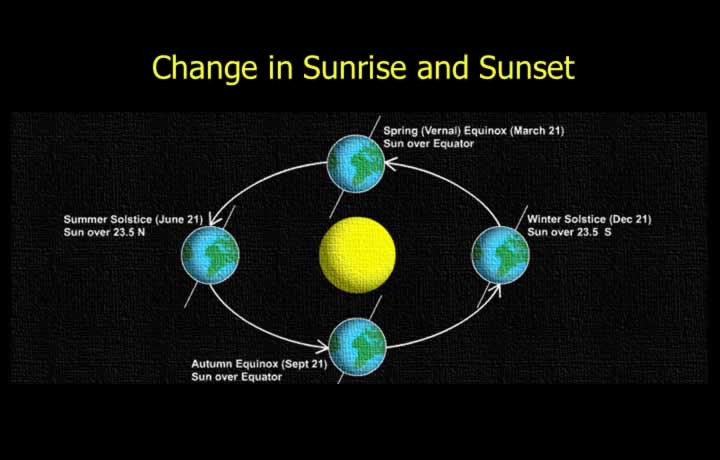
- On the real Earth, sunrise and sunset are mainly affected by:
- The combination of the Sun’s declination and the observer’s latitude.
- The Sun’s semi-diameter.
- Atmospheric refraction.
Effect of the Sun’s Declination on Sunrise and Sunset
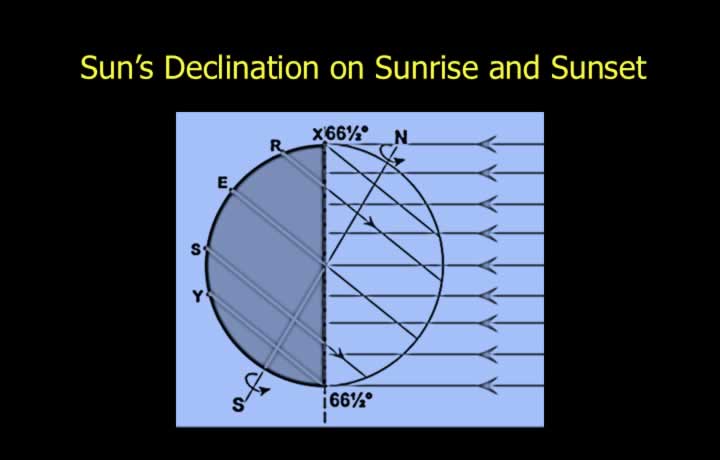
- The Sun’s declination affects the times of sunrise and sunset.
- During summer in the Northern Hemisphere, the Sun has a northerly declination.
- Northerly declination results in longer daylight hours in the Northern Hemisphere.
- The Sun rises before reaching the observer’s meridian.
- The Sun remains above the horizon after crossing the observer’s meridian.
- Sunrise occurs earlier than 0600 LMT, and sunset occurs later than 1800 LMT.
- The effect is reversed when the Sun has a southerly declination.
Effect of Latitude on Sunrise and Sunset
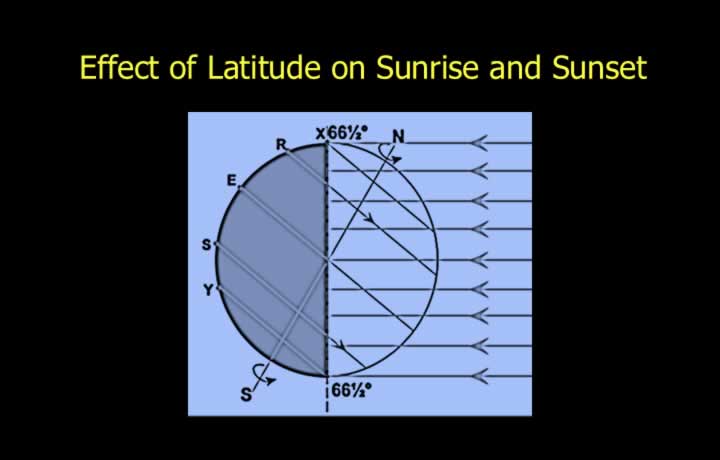
- The observer’s latitude affects the times of sunrise and sunset.
- Consider summer when the Sun’s declination is 23.5° North.
- An observer at the Equator experiences nearly equal periods of day and night.
- An observer above 66.5° N experiences continuous daylight.
- An observer above 66.5° S experiences continuous darkness.
- The effect is reversed when the Sun has a southerly declination.
Semi-Diameter of the Sun
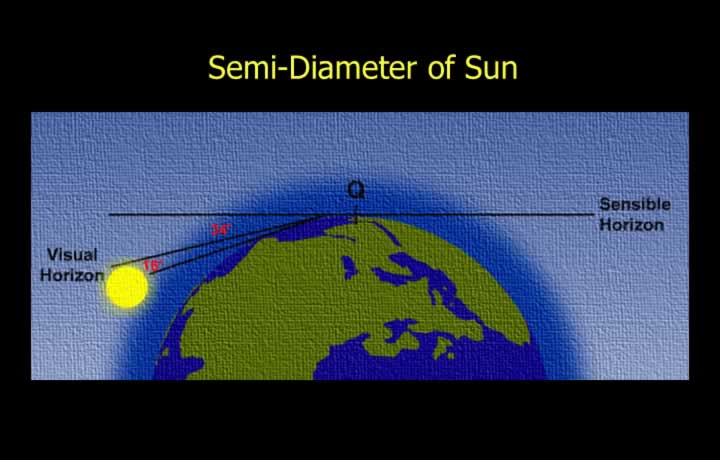
- The Sun’s semi-diameter and atmospheric refraction both affect sunrise and sunset.
- The Sun’s semi-diameter is approximately 16 minutes of arc.
- Average atmospheric refraction at the horizon is approximately 34 minutes of arc.
Sunrise and the Visual Horizon
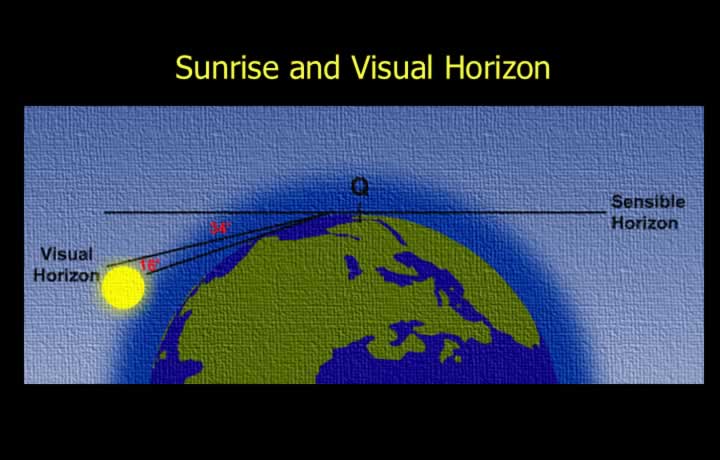
- The sensible horizon is the horizon tangential to the Earth’s surface.
- Sunlight becomes visible even when the Sun is below the horizon because of atmospheric refraction.
- The visual horizon appears approximately 34 minutes of arc below the sensible horizon.
- At sunrise, the centre of the Sun is about 16 minutes of arc below the visual horizon.
- Therefore, the Sun’s centre is approximately 50 minutes of arc below the sensible horizon at apparent sunrise.
- This corresponds to roughly 3 minutes of time before the Sun actually reaches the geometric horizon.
Civil Twilight
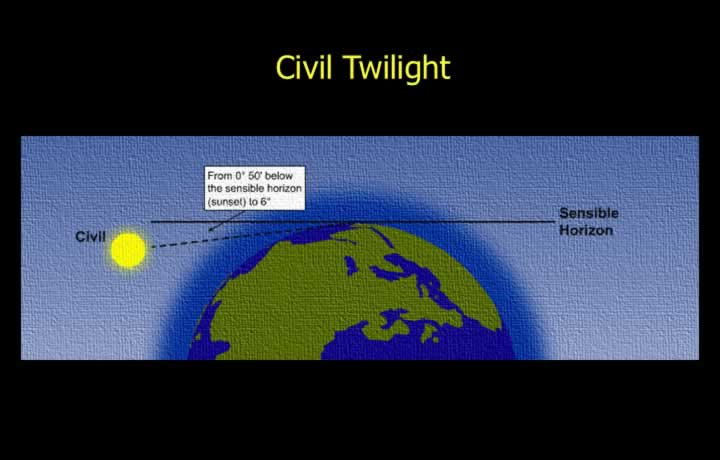
- Twilight is the period of partial daylight before sunrise and after sunset.
- For aviation, night flying generally occurs between the end of Evening Civil Twilight (ECT) and the beginning of Morning Civil Twilight (MCT).
- Many regulations define night as beginning 30 minutes after sunset and ending 30 minutes before sunrise.
Morning and Evening Civil Twilight
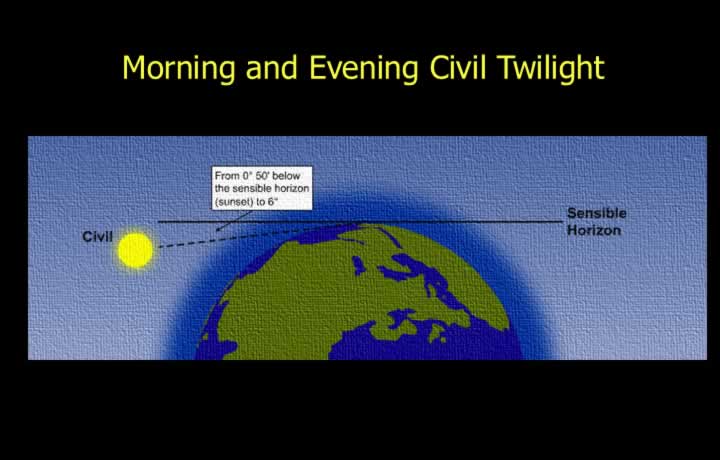
- Evening Civil Twilight (ECT) is the period of usable natural light after sunset.
- ECT extends from sunset until the Sun’s centre is 6° below the sensible horizon.
- Morning Civil Twilight (MCT) is the period of usable natural light before sunrise.
- MCT extends from the Sun being 6° below the sensible horizon until sunrise.
Nautical and Astronomical Twilight
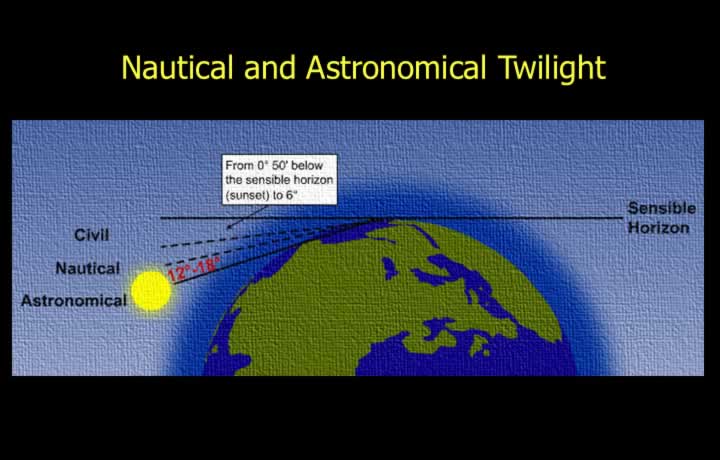
- Nautical Twilight occurs when the Sun’s centre is between 6° and 12° below the sensible horizon.
- During nautical twilight, the sky is dark while brighter stars and planets are visible.
- Astronomical Twilight occurs when the Sun’s centre is between 12° and 18° below the sensible horizon.
- Beyond 18° below the horizon, astronomical darkness is reached.
Duration of Twilight
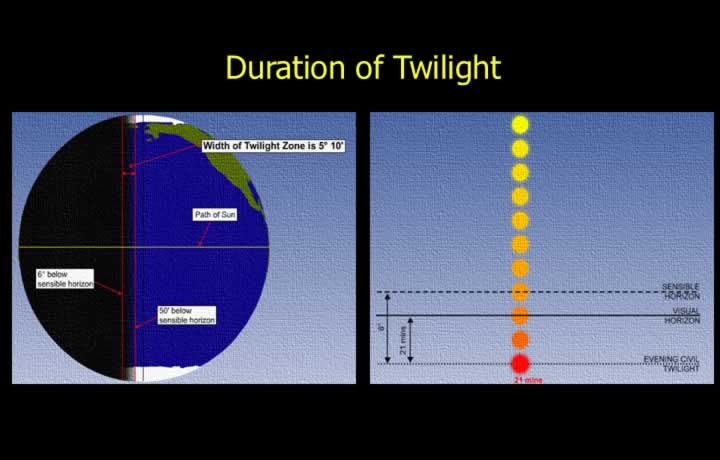
- The duration of twilight depends on four main factors:
- The Sun’s declination.
- The observer’s latitude.
- The observer’s altitude.
- Meteorological conditions.
Minimum Twilight Duration
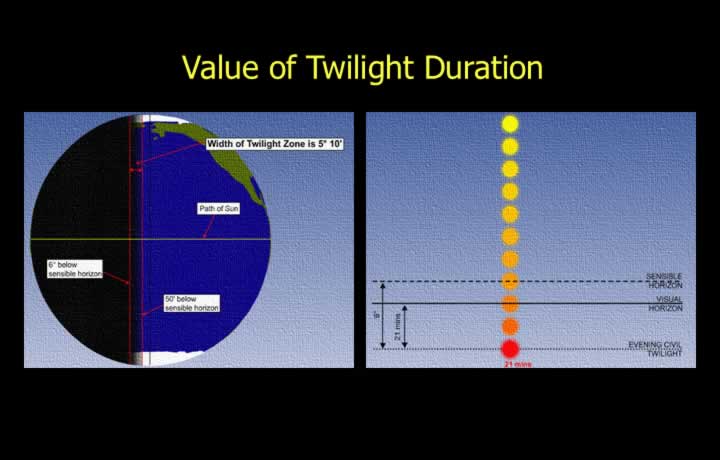
- Civil twilight is shortest when both the observer and the Sun are near the Equator.
- The minimum duration of civil twilight is approximately 21 minutes.
- The corresponding angular distance is approximately 5° 10′.
Effect of Declination on Twilight
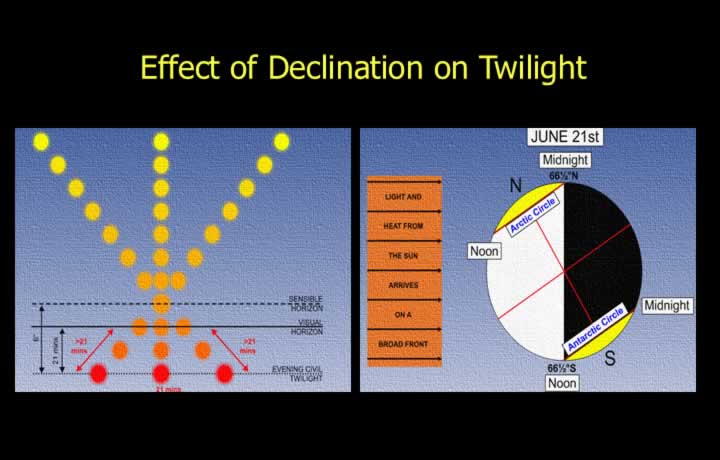
- The duration of twilight increases as the Sun’s declination increases.
- The Sun remains in the twilight zone for longer than the minimum 21 minutes.
- The longest twilight durations occur near the solstices.
Effect of Latitude on Twilight
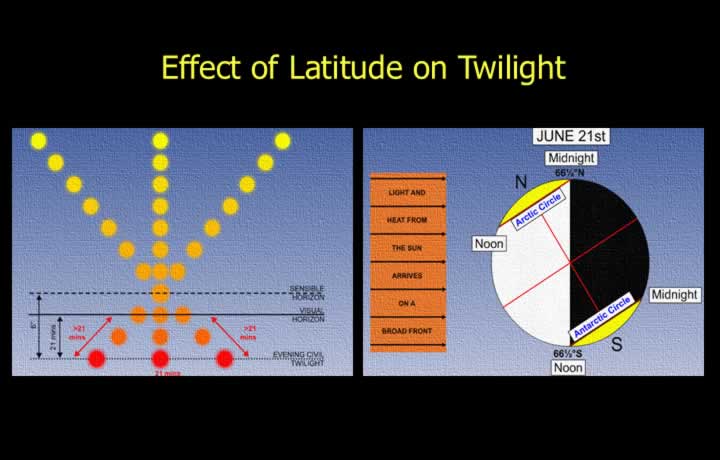
- Twilight duration increases with increasing latitude.
- The Sun remains in the twilight zone for longer periods.
- The maximum duration occurs near and beyond the Arctic and Antarctic Circles.
- In summer, the Sun may not set, or civil twilight may continue until midnight.
- In winter, the Sun may not rise, and civil twilight may be absent or greatly reduced.
Effect of Altitude on Twilight
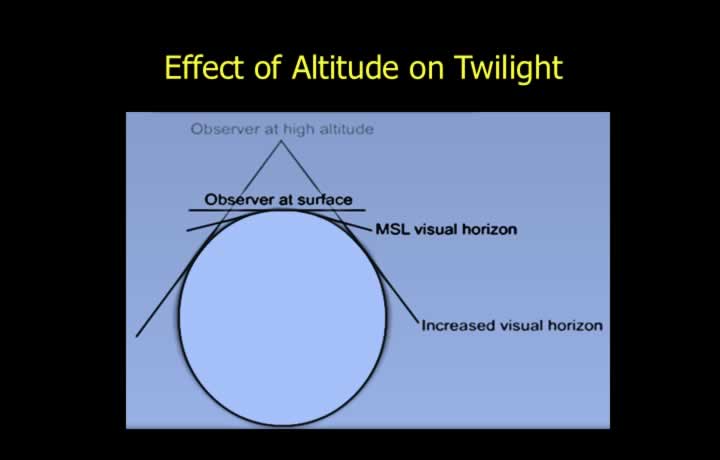
- Sunrise, sunset, and twilight times published in the Air Almanac are based on mean sea level.
- At higher altitudes, the Sun rises earlier and sets later.
- The visual horizon extends farther as altitude increases.
- Greater altitude generally reduces the duration of civil twilight.
- Reduced atmospheric density at higher altitudes decreases atmospheric refraction.
Effect of Atmospheric Scattering on Twilight
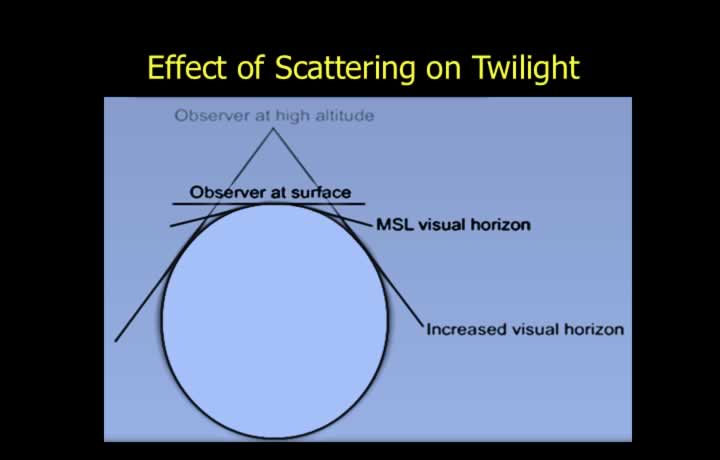
- Volcanic eruptions can increase the duration of twilight.
- Polluted or dust-laden atmospheres increase scattering of sunlight, making twilight appear longer.