Great Circle and Rhumb Lines
A Great Circle is the shortest distance between two points on the Earth’s surface. Its direction (bearing) changes continuously during the flight, making it the most fuel-efficient route for long-distance travel. A Rhumb Line (Loxodrome) is a path that crosses all meridians at the same angle, so the aircraft maintains a constant heading. It is longer than a Great Circle route but is easier to navigate, especially for shorter distances.
Vertex of a Great Circle
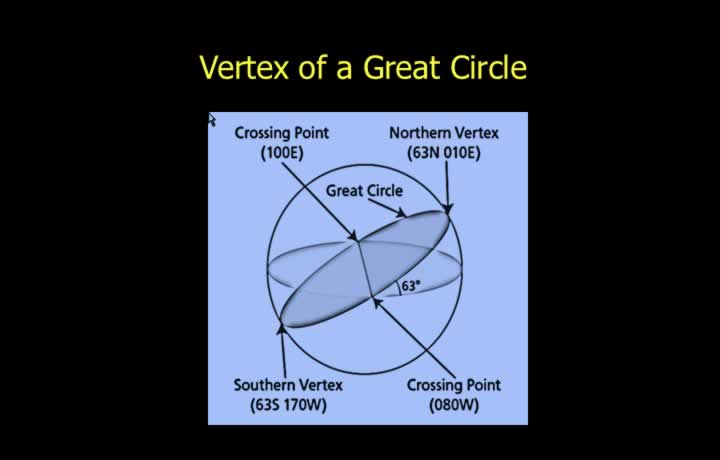
- Great circle vertices are the northernmost and southernmost points of a great circle.
- The Northern Vertex is the point on the great circle closest to the North Pole.
- The Southern Vertex is the point on the great circle closest to the South Pole.
Properties of Great Circle Vertices
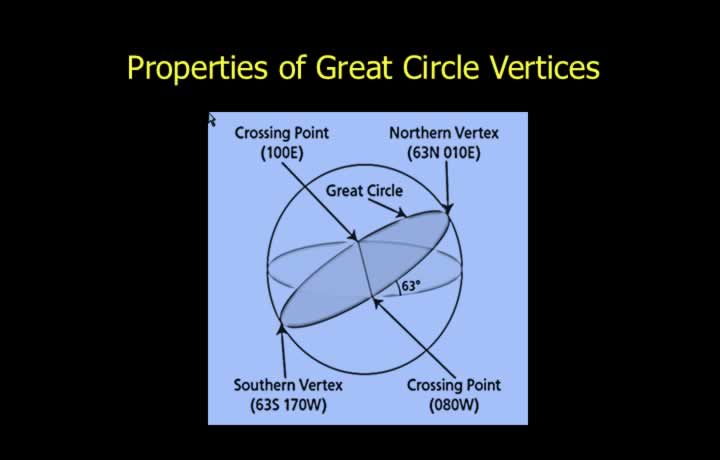
- The northern and southern vertices are antipodal points.
- Antipodal means diametrically opposite points.
- The shortest distance between the vertices is 10,800 NM.
- Flight along a great circle results in a continuous change in direction.
- At either vertex, the great circle direction is due East or West.
Latitudes and Longitudes of a Great Circle
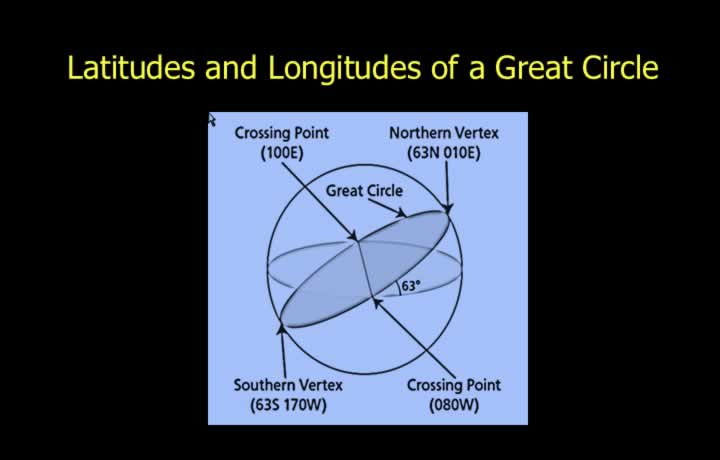
- The numerical value of the latitudes of both vertices is the same but in opposite hemispheres.
- The longitudes of the vertices lie on a meridian and its anti-meridian.
- An anti-meridian is the meridian located 180° from a given meridian.
Equator Crossing of Great Circles
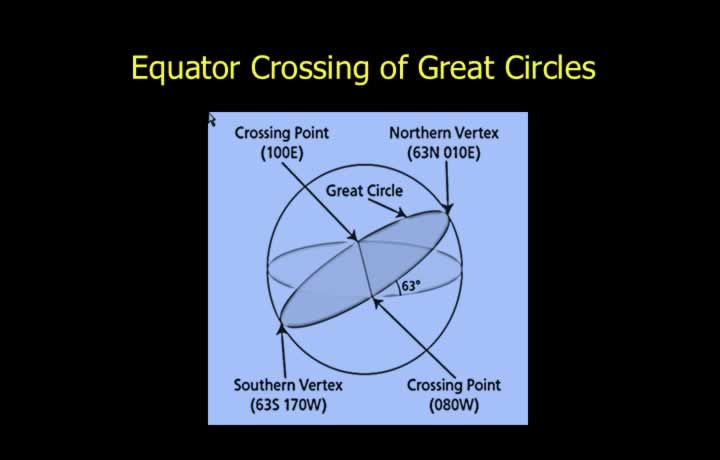
- Great circles intersect the Equator at two points.
- Each intersection occurs at a longitude 90° from the vertex.
- The angle between the Equator and the great circle equals the latitude of the vertex.
- This relationship allows calculation of the great circle track at the Equator crossing.
Equator Crossing on an Easterly Track
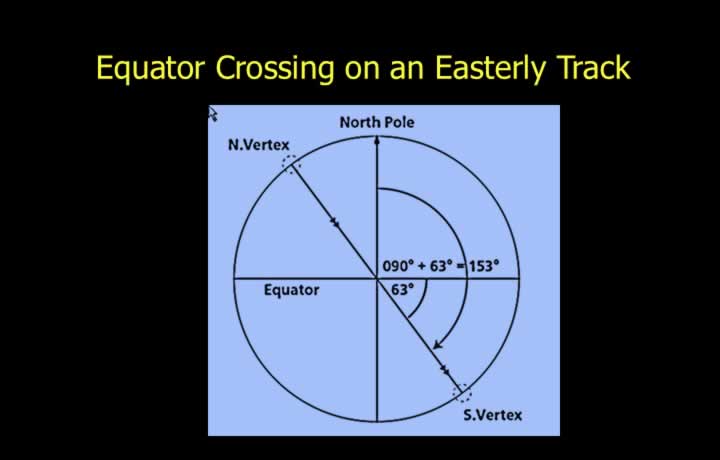
- North-to-South Equator crossing = 90° + Vertex Latitude.
- South-to-North Equator crossing = 90° − Vertex Latitude.
Equator Crossing on a Westerly Track
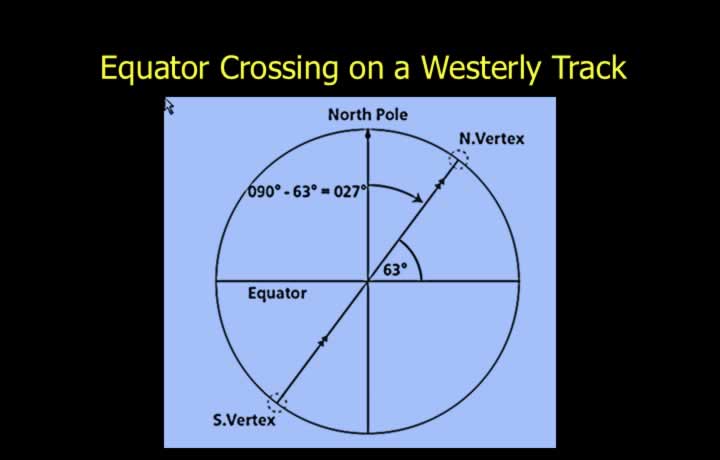
- North-to-South Equator crossing = 270° − Vertex Latitude.
- South-to-North Equator crossing = 270° + Vertex Latitude.
Properties of Rhumb Line
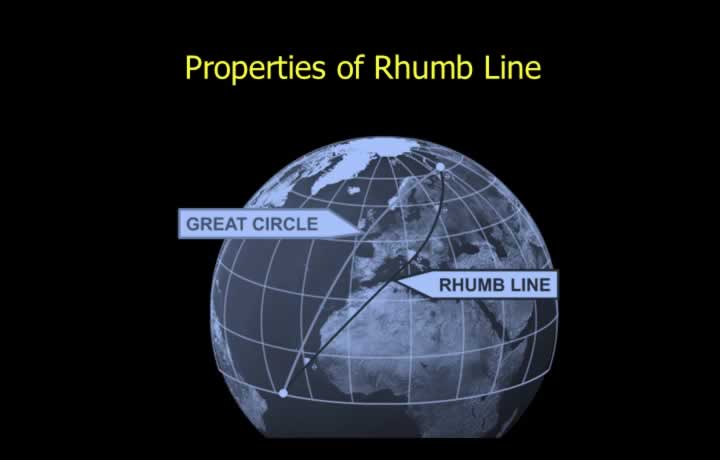
- Rhumb lines are uniformly curved lines joining two points on the Earth’s surface.
- Meridians converge toward the poles.
- A rhumb line intersects every meridian at the same angle.
- Rhumb lines maintain a constant track direction with respect to True North.
- The track angle between True North and a rhumb line remains constant.
- Only one rhumb line can be drawn between any two points.
- Infinite rhumb lines can be drawn between diametrically opposite points.
Equator is a Special Line
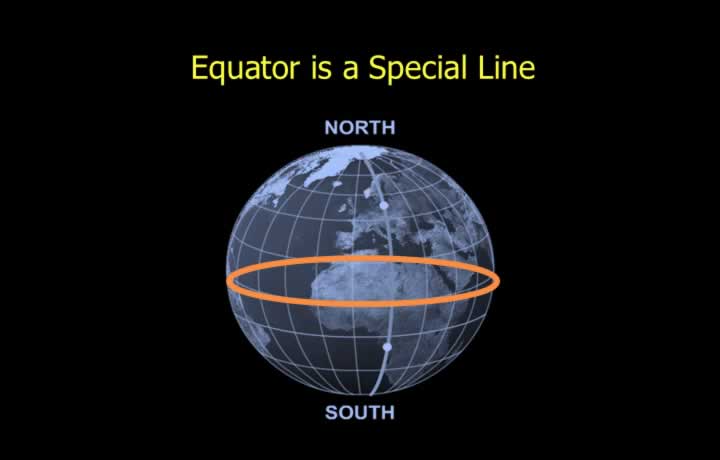
- The Equator is both a rhumb line and a great circle.
- As a great circle, it represents the shortest distance.
- As a rhumb line, it has a constant direction.
- The Equator is a great circle with vertices at 0° latitude.
- It has infinite vertices pointing due East or West.
- All points on the Equator have a constant direction of 090° or 270°.
Meridians are Special Lines
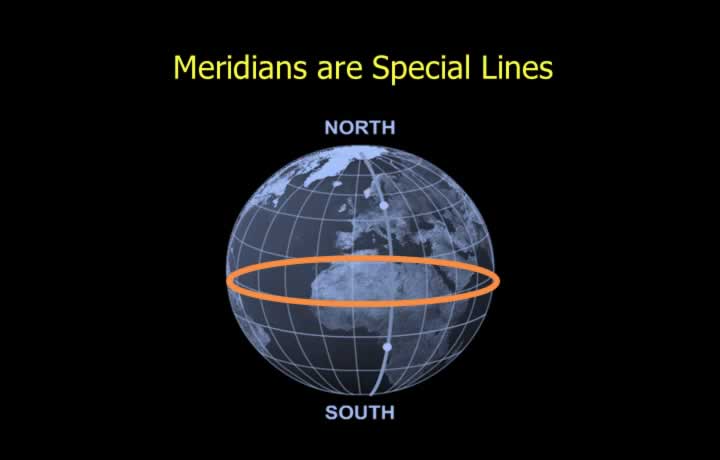
- Meridians are both rhumb lines and great circles.
- As great circles, they represent the shortest distance.
- As rhumb lines, they maintain a constant direction.
- Meridians have vertices at 90° North and 90° South.
- Meridians intersect all latitudes in northerly and southerly directions.
- All points on a meridian have a constant direction of 000° or 180°.
Rhumb Line and Great Circle Directions
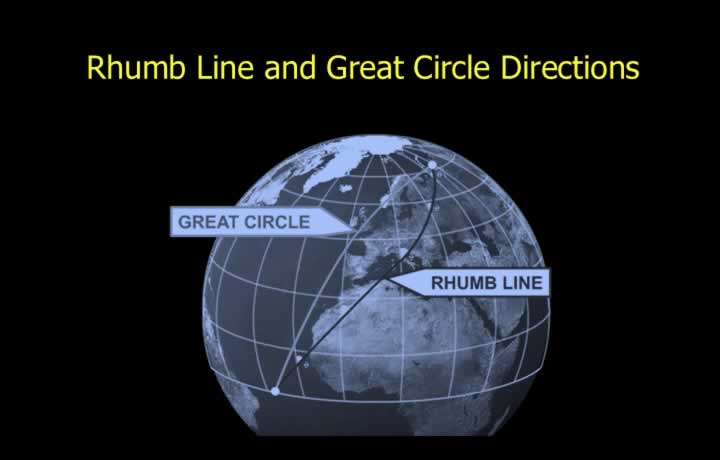
- Rhumb lines maintain a constant track direction.
- Great circles do not maintain a constant track direction.
Rhumb Line and Great Circle Distances
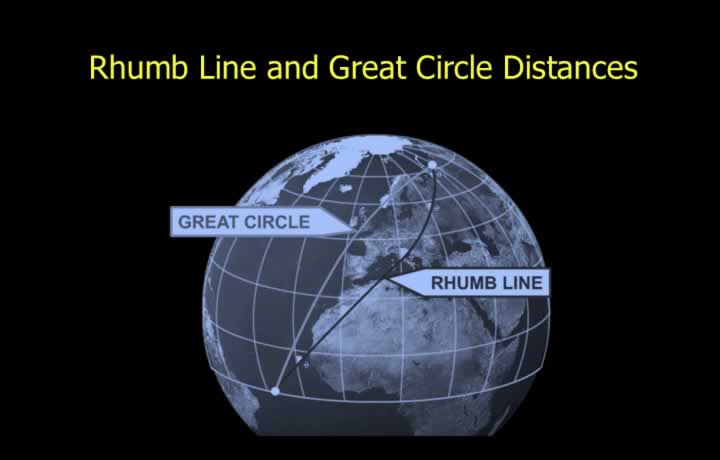
- Great circle routes provide the shortest distance between two points.
- Rhumb line distances are always greater than or equal to great circle distances.
Appearance of Rhumb Lines and Great Circles
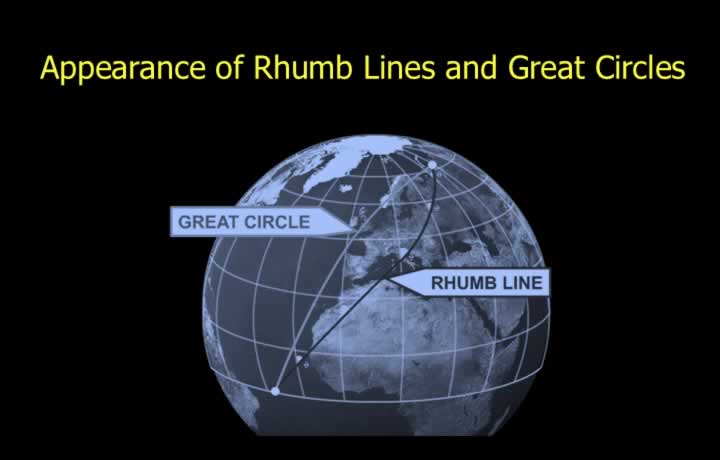
Great Circle
- Great circle tracks are convex toward the nearer pole.
- Great circle tracks are concave toward the Equator.
Rhumb Line
- Rhumb lines are convex toward the Equator.
- Rhumb lines are concave toward the nearer pole.
Great Circle vs Rhumb Line
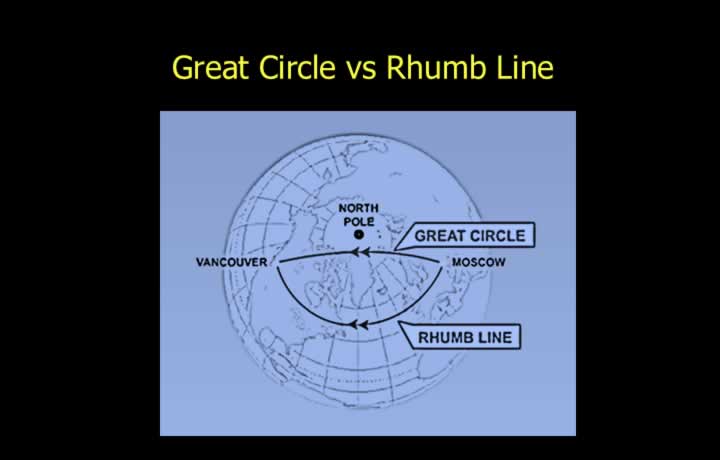
- A rhumb line is a regularly curved line with constant direction.
- A great circle track changes direction continuously.
- Up to the midpoint, a great circle moves toward the nearer pole.
- At the midpoint, its direction matches the rhumb line track.
- After the midpoint, it gradually moves toward the Equator.
Value of Great Circle Track in the Northern Hemisphere
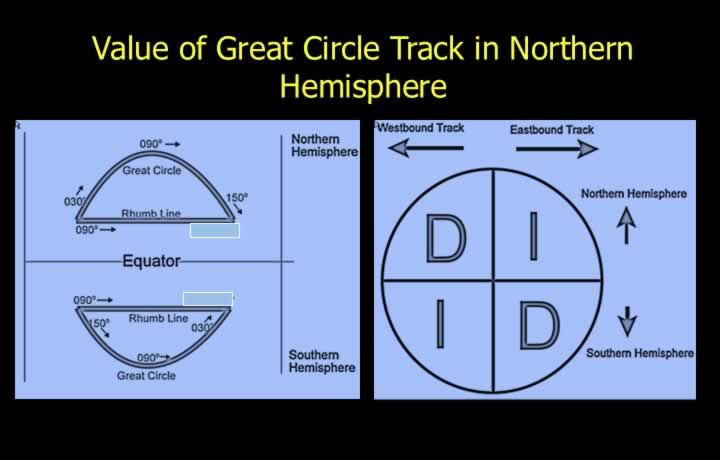
- The numerical value of a great circle track depends on the hemisphere and direction of flight.
- For easterly tracks, the track value increases while moving toward the North Pole (clockwise).
- For westerly tracks, the track value decreases while moving toward the North Pole (anti-clockwise).
Value of Great Circle Track in the Southern Hemisphere
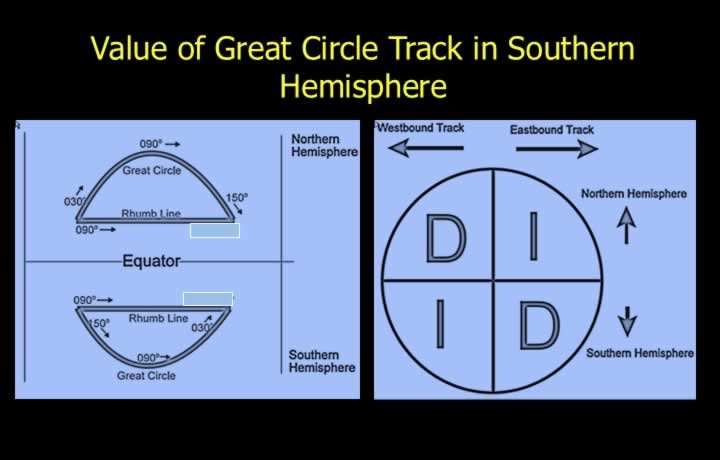
- The numerical value of a great circle track depends on the hemisphere and direction of flight.
- For easterly tracks, the track value decreases while moving toward the South Pole (anti-clockwise).
- For westerly tracks, the track value increases while moving toward the South Pole (clockwise).