Direction Finding using VHF Direction Finder (VDF)
VDF (Very High Frequency Direction Finding) is a radio navigation system used to determine the direction of a VHF radio transmitter. It helps aircraft find their bearing relative to a ground station. VDF is mainly used for aircraft navigation and air traffic control assistance.
Introduction to VDF
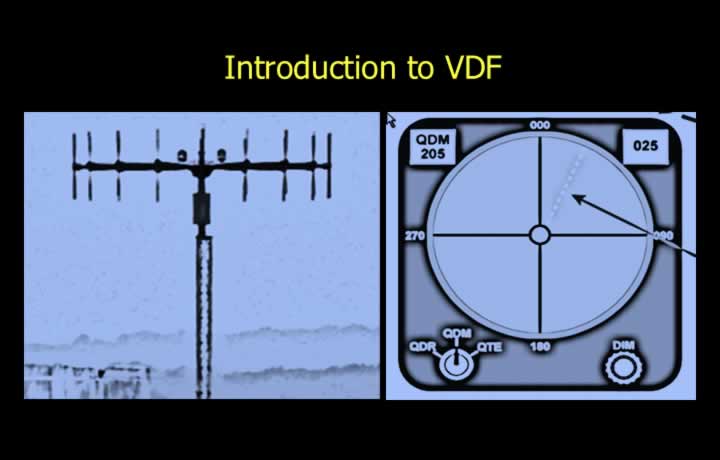
- VHF Direction Finder (VDF) is a ground-based radio navigation aid used to determine the bearing of an aircraft.
- VDF operates in the VHF frequency range of 118–137 MHz.
- It uses the loop antenna principle to determine the direction of incoming transmissions.
- A transmission arriving perpendicular to the loop antenna produces zero phase difference.
- Modern VDF systems use an Ad-cock antenna array and the Doppler principle to accurately determine the bearing.
- Mechanical rotating loops have been replaced by electronically switched fixed vertical antenna elements.
- VDF provides bearing accuracy of approximately ±0.5°.
- VDF provides bearing information only and does not provide range information.
Introduction to Q Codes
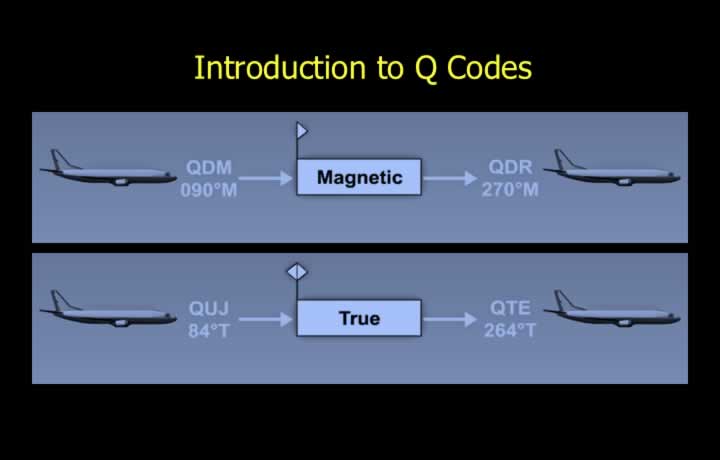
- A VDF station can provide QDR, QDM, QTE, and QUJ upon request from an aircraft.
- QDR (Radial): Magnetic bearing from the VDF station to the aircraft.
- QDM: Magnetic heading to steer to reach the VDF station in nil wind conditions.
- QDM is the reciprocal of QDR.
- QTE: True bearing from the VDF station to the aircraft.
- QUJ: True bearing from the aircraft to the VDF station.
- QUJ is the reciprocal of QTE.
Range and Accuracy of VDF
Range of VDF
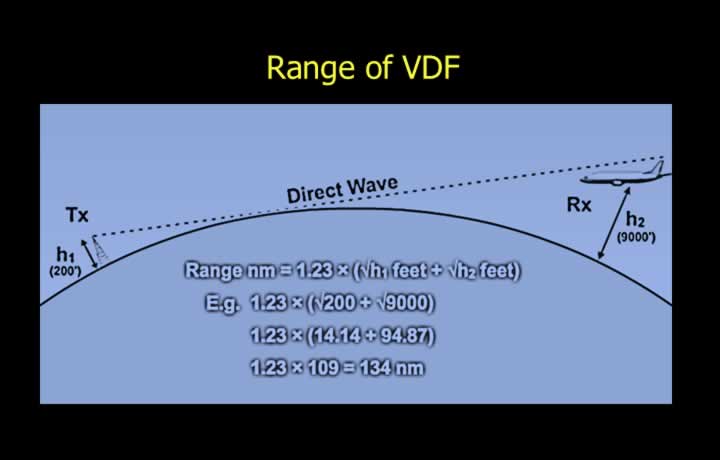
- The maximum range of a VDF station is governed by the line-of-sight principle.
- Operational range is also limited by terrain and transmitter power.
- Meteorological conditions may either increase or decrease the effective range.
Accuracy of VDF
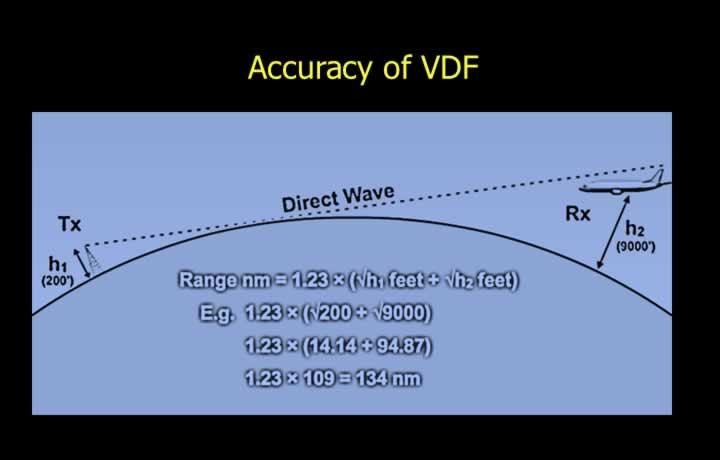
- VDF bearings are classified into four accuracy grades: Class A, B, C, and D.
| Class | Bearing Accuracy |
|---|---|
| A | ±2° |
| B | ±5° |
| C | ±10° |
| D | Greater than ±10° |
The accuracy of VDF bearings may be reduced due to the following factors:
- Reflections from nearby buildings or structures (site error).
- Simultaneous transmissions from two or more aircraft.
- Aircraft not maintaining straight-and-level flight.
- Reduced accuracy during climbs, descents, or turns.
- Multipath fading when the aircraft is close to the station overhead.
Fixing Position Using VDF
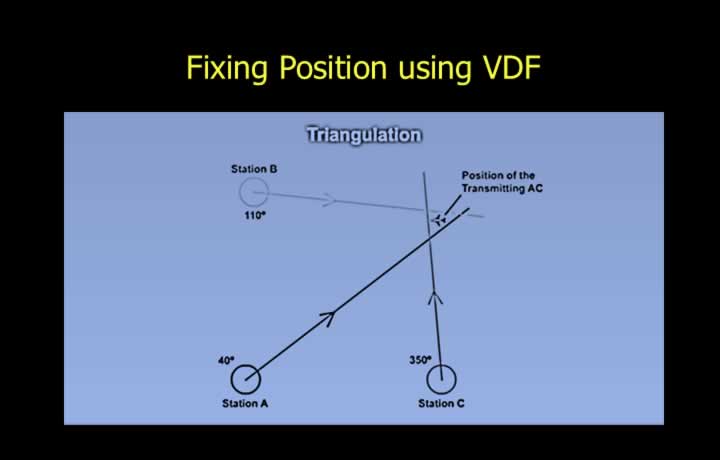
- A network of VDF stations can determine an aircraft’s position using triangulation.
- Triangulation is commonly used to assist lost or distressed aircraft.
- The international emergency frequency of 121.5 MHz is used for emergency triangulation.
- Air Traffic Control (ATC) may assist aircraft by providing:
- QDM – Magnetic tracks to the station.
- QGH – Calculated headings and recommended altitudes for approach assistance.