En-route Performance
En-route performance refers to the aircraft’s capability while flying between departure and destination. It includes maintaining the required speed, altitude, fuel efficiency during cruise. En-route performance is affected by aircraft weight, weather, altitude and engine efficiency.
Forces Acting on the Aircraft
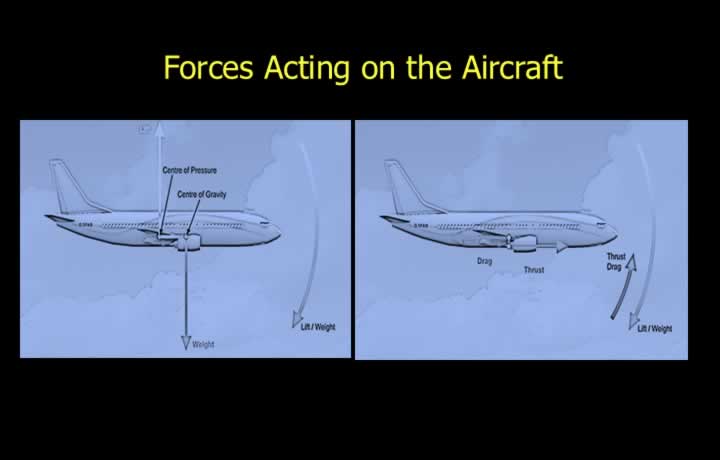
- Lift acts through the centre of pressure, while weight acts through the centre of gravity.
- Lift and weight form a strong couple, producing a pitching moment.
- Thrust and drag act along the aerodynamic axis of the aircraft.
- Thrust and drag form a comparatively weaker couple.
Tail Load
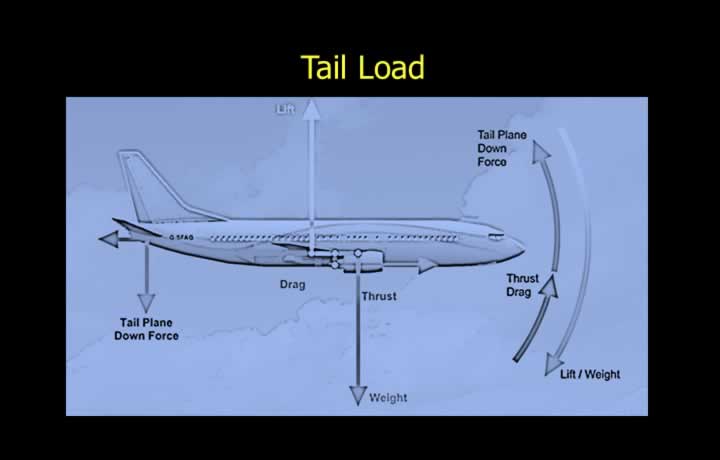
- The stronger lift-weight couple creates a natural nose-down pitching tendency.
- The tailplane produces a downward force to create a balancing nose-up pitching moment.
- This downward force is known as tail load or tailplane download.
- Aircraft trimming generates the required tail load.
- Tail load increases the effective weight and drag of the aircraft.
- Both induced drag and parasite drag increase due to tail loading.
Fuel Consumption Technique
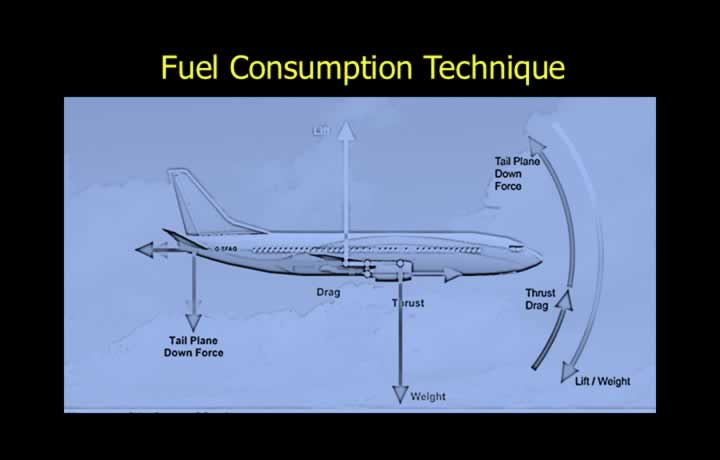
- Tail load can be reduced by moving the centre of gravity (CG) rearwards.
- This can be achieved through selective fuel consumption or fuel transfer.
- Burning fuel from forward tanks moves the CG aft.
- A rearward CG reduces the nose-down pitching moment.
- Less tail load reduces aircraft weight and drag.
- Reduced drag improves both range and endurance.
Maximum and Minimum Speeds
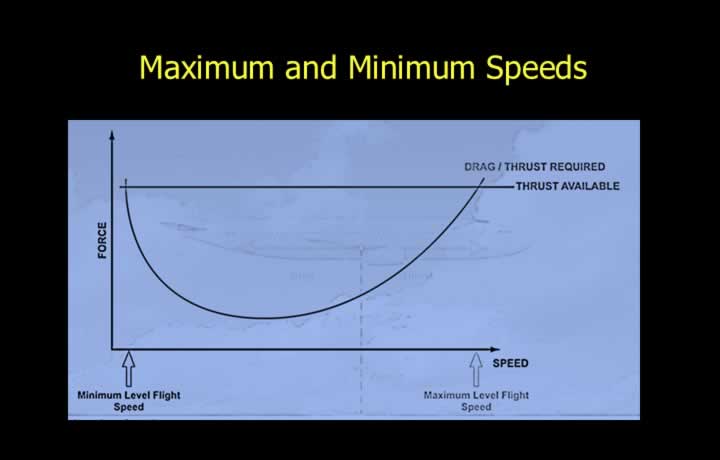
- Constant speed is maintained when thrust equals drag.
- Increasing thrust causes the aircraft to accelerate.
- Acceleration continues until drag again equals thrust.
- The aircraft then stabilises at a higher speed.
- Maximum and minimum speeds depend on the balance between thrust and drag.
- Maximum speed occurs when maximum available thrust equals drag.
- Minimum steady speed occurs where minimum thrust balances minimum drag.
Back of the Drag Curve and High-Altitude Speeds
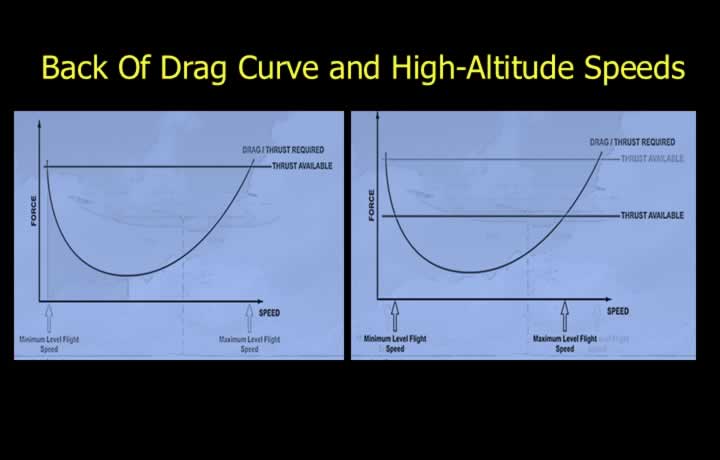
- Very low speeds are referred to as the back of the drag curve.
- At these speeds, drag increases rapidly while available thrust is limited.
- Flying behind the drag curve should be avoided whenever possible.
- At high altitudes, engine thrust decreases because of reduced air density.
- Aircraft must therefore operate within a narrower speed range.
Factors Affecting Endurance or Loiter Time
Flight for Endurance
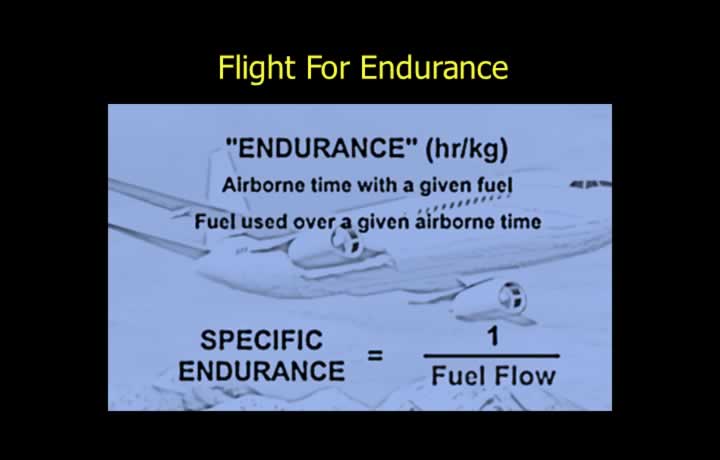
- Endurance is the amount of airborne time obtained from a given quantity of fuel.
- Maximum endurance is important during holding operations.
- Greatest endurance is achieved when fuel consumption is minimum.
- Endurance = Airborne Time (hours) ÷ Fuel Used (kg)
- Specific endurance is the reciprocal of fuel flow.
- Specific Endurance = 1 ÷ Fuel Flow
Flying for Endurance in Jet Aircraft
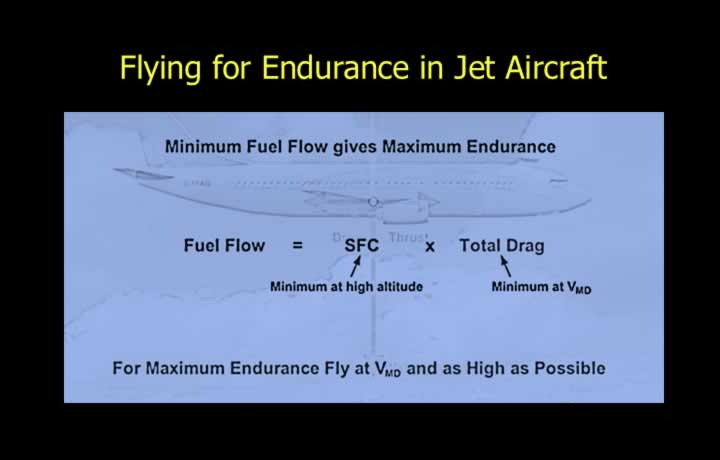
- Fuel consumed per unit thrust is known as Specific Fuel Consumption (SFC).
- Maximum endurance is achieved when both SFC and thrust are minimum.
- SFC is lowest at high altitudes, low temperatures and appropriate engine RPM.
- High altitude reduces fuel consumption per unit thrust.
- Minimum thrust occurs at the minimum drag speed (Vmd).
- Jet aircraft achieve maximum endurance by flying at high altitude near Vmd.
Flying for Endurance in Propeller Aircraft
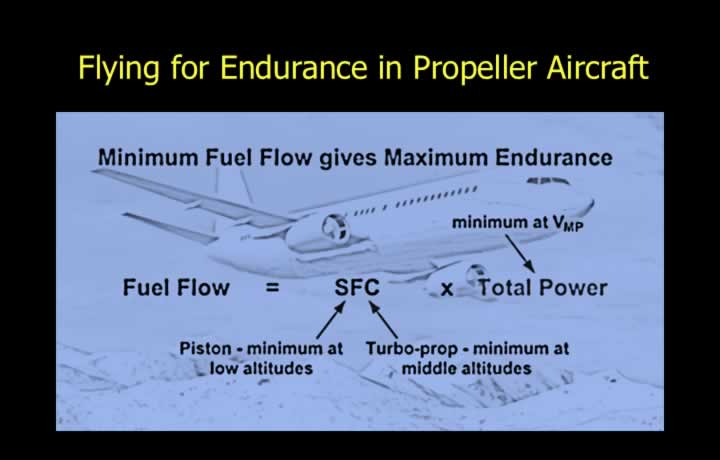
- Maximum endurance occurs at minimum power.
- Lower power reduces fuel flow and Specific Fuel Consumption.
- Piston-engine aircraft achieve minimum SFC at lower altitudes.
- Turboprop aircraft achieve minimum SFC at medium altitudes.
- Best endurance is achieved by flying at the minimum power speed (Vmp).
Effect of Weight and Speed on Endurance
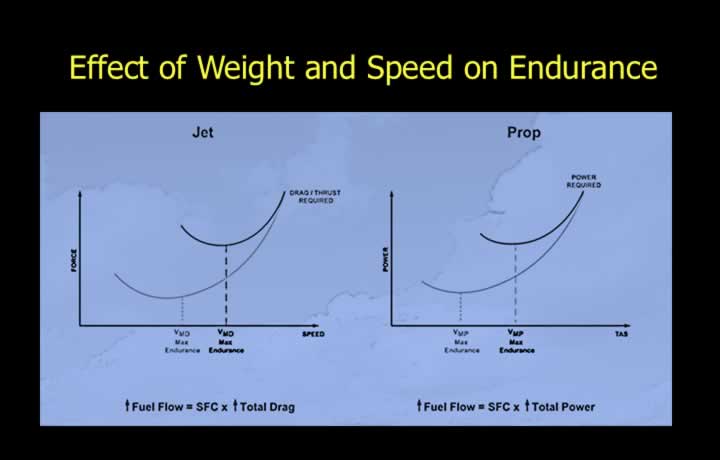
- Increasing weight shifts the total drag curve upward and to the right.
- Drag and power required increase.
- Fuel flow increases, reducing endurance.
- Best endurance speeds increase with aircraft weight.
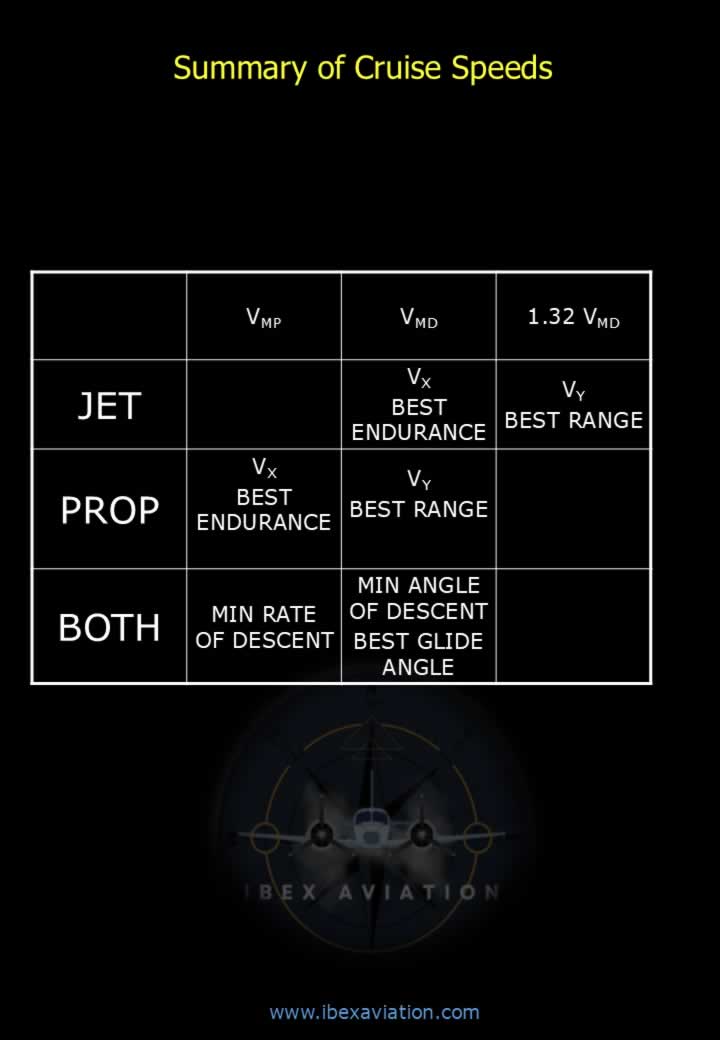
- Jet aircraft achieve endurance at Vmd, while propeller aircraft achieve endurance at Vmp.
- Higher weight also lowers the optimum operating altitude.
- Lower cruising altitude further reduces endurance.
Effect of Configuration on Endurance
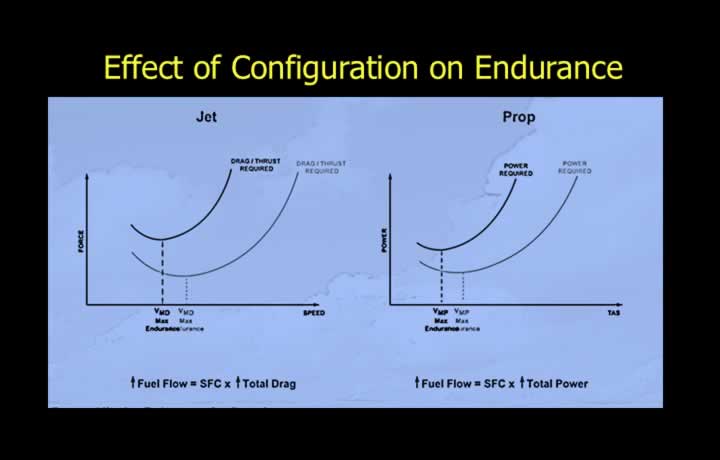
- Flaps and landing gear increase parasite drag.
- The drag curve shifts upward and to the left.
- Fuel flow increases and endurance decreases.
- Maximum endurance speeds decrease in dirty configuration.
- Flaps should be extended only when operationally required.
- Wind does not affect endurance because only airborne time is considered.
Effect of Altitude on Endurance
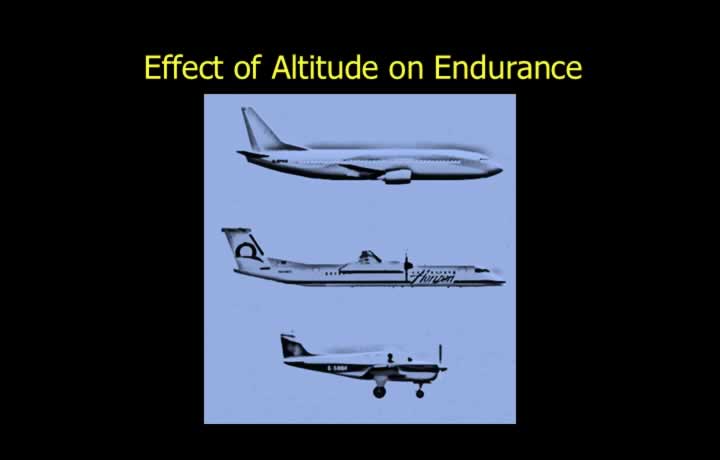
- Jet aircraft achieve the best endurance at high altitudes.
- Maximum endurance for jets is typically obtained above the tropopause.
- Turboprop aircraft achieve maximum endurance at medium altitudes.
- Piston-engine aircraft achieve maximum endurance at lower altitudes.
Factors Affecting Range or Distance Travelled
Flying for Range
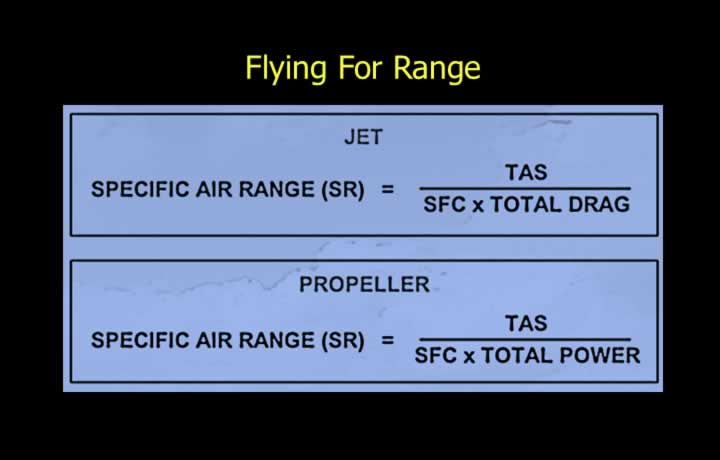
- Range is the distance travelled for a given quantity of fuel.
- Maximum range is achieved by minimising fuel consumption over a given distance.
- Range = Distance (NM) ÷ Fuel Used (kg)
- Specific Air Range (SAR) = True Airspeed ÷ Fuel Flow
- Maximum range requires high TAS together with low fuel flow.
- Lower Specific Fuel Consumption increases Specific Air Range.
Range Flying in Jet Aircraft
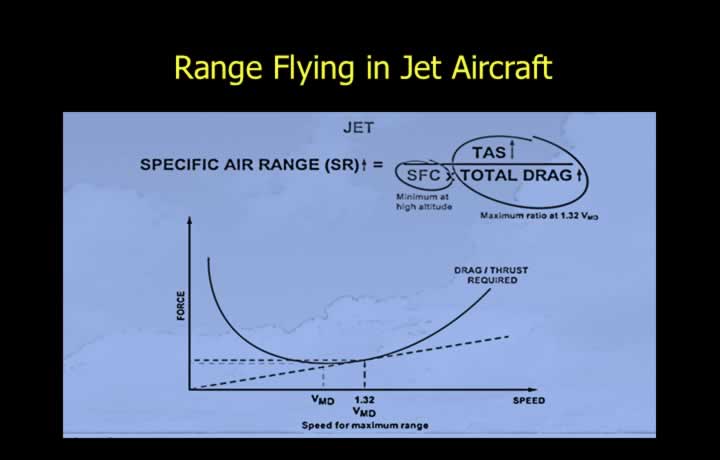
- Minimum drag occurs at Vmd.
- Maximum Specific Air Range occurs at approximately 1.32 × Vmd.
- Jet aircraft achieve best range by flying at high altitude near 1.32 Vmd.
- Lower SFC increases Specific Air Range.
Range Flying in Propeller Aircraft
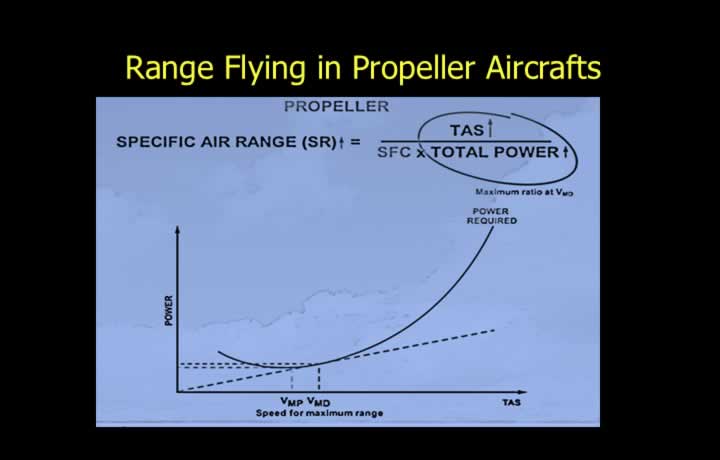
- Minimum power occurs at Vmp.
- A slight increase in speed produces only a small increase in power required.
- Higher TAS improves Specific Air Range.
- Maximum speed-to-drag ratio occurs at Vmd.
- Turboprop aircraft normally achieve best range at medium altitudes.
- Reduced SFC increases Specific Air Range.
Effect of Weight on Range
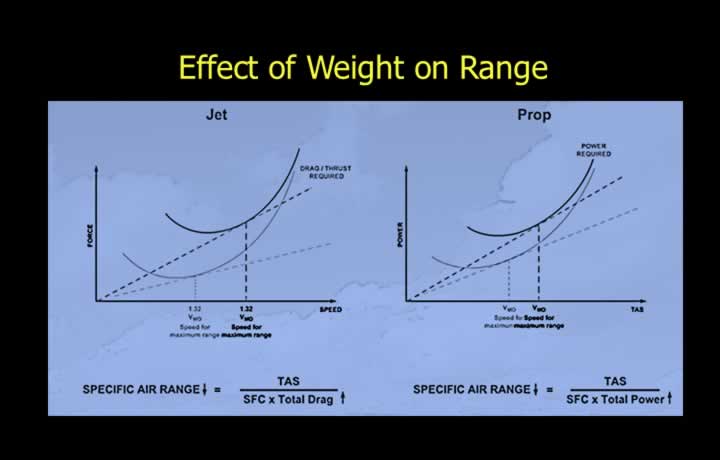
- Increasing weight shifts the drag curve upward and to the right.
- Total drag and power required increase.
- Fuel flow increases, reducing range.
- Best range speeds increase for both jet and propeller aircraft.
- Higher weight results in lower cruising altitude.
- Lower cruising altitude increases fuel consumption.
- Aircraft selection should balance payload and fuel requirements.
Fuel and Payload Planning
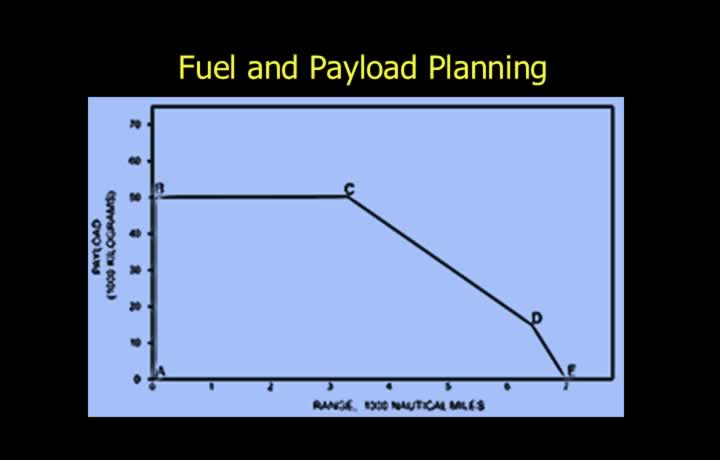
- Fuel and payload planning is commonly illustrated using a payload-range diagram.
- From point A to B, payload is increased until the Zero Fuel Mass (ZFM) is reached.
- At point B, range is zero because fuel has not yet been added.
- From point B to C, fuel is added until Maximum Take-off Mass (MTOM) is reached.
- Additional range beyond point C requires replacing payload with fuel.
- At point D, fuel tanks are completely full.
- Any further increase in range is possible only by reducing payload.
Effect of Configuration on Range
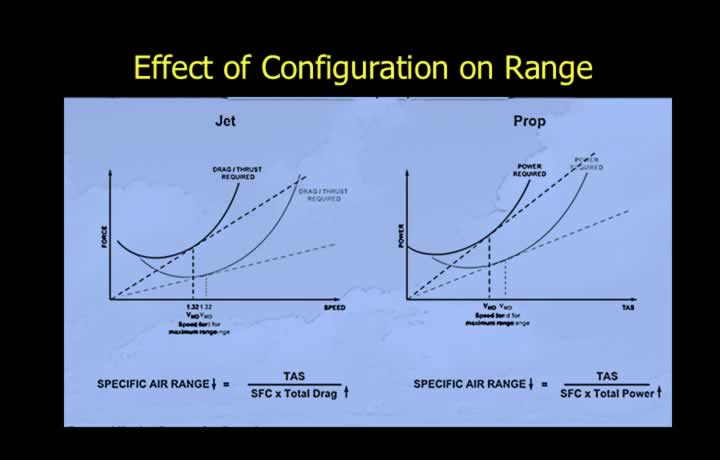
- Flaps and landing gear increase drag and power required.
- Fuel flow increases, reducing range.
- The drag curve shifts upward and to the left.
- Best range speed decreases in dirty configuration.
- Best range speeds are approximately Vmd for propeller aircraft and 1.32 Vmd for jet aircraft.
- Proper trimming and aircraft balance improve range.
- Airframe icing increases weight and drag, reducing range.
Effect of Wind on Range
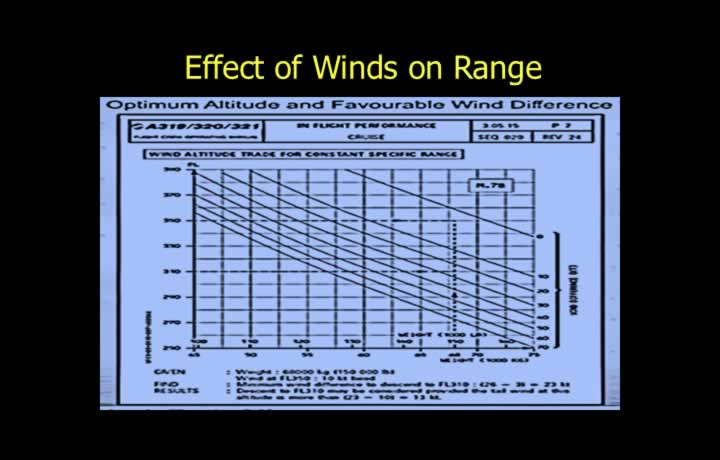
- Cruising altitude selection should consider prevailing winds.
- The benefit of higher TAS at altitude should be balanced against stronger winds.
- Maximum range speed is approximately 1.32 Vmd.
- Headwinds require a higher optimum range speed.
- Tailwinds allow a lower optimum range speed.
Long Range Cruise Speed
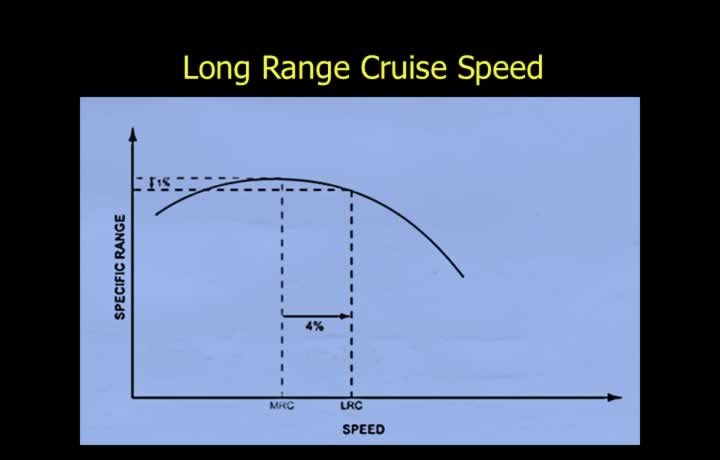
- Long Range Cruise (LRC) considers both fuel economy and operating costs.
- A slightly higher cruise speed may reduce total journey time.
- LRC speed is approximately 4% higher than maximum range speed.
- Specific Air Range decreases by only about 1%.
Types of Cruise Techniques
Climb Cruise Technique
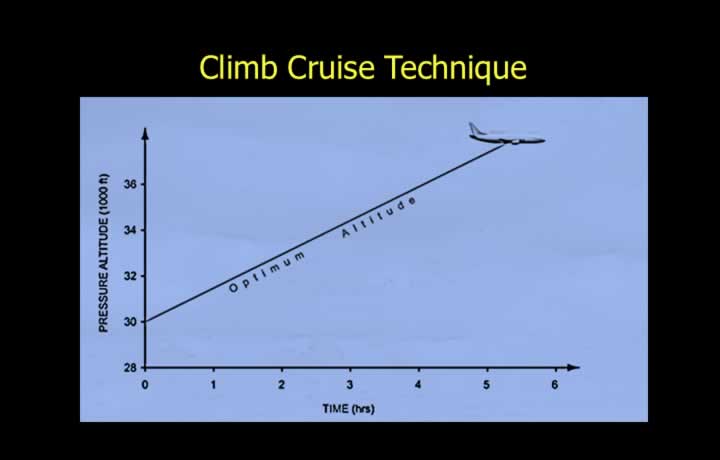
- Maximum Specific Air Range is achieved by flying at the optimum altitude.
- As fuel burns, aircraft weight decreases and optimum altitude increases.
- An ideal cruise would involve a continuous climb.
- Continuous climb is generally impractical in normal operations.
Step Cruise Technique
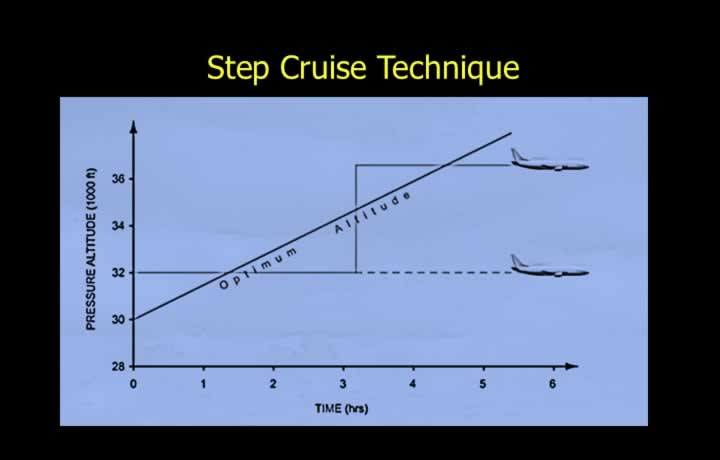
- Step climb is the standard cruise technique for transport aircraft.
- Aircraft climb approximately 2,000 ft whenever operationally appropriate.
- The optimum altitude gradually catches up as fuel is consumed.
- Further step climbs cease near the top of descent.
- Cruising continuously at optimum altitude provides maximum Specific Air Range.
- Step climb achieves approximately 99% of maximum Specific Air Range.
- Maintaining one constant cruise altitude provides approximately 90% of maximum Specific Air Range.
Cruise Technique in Turboprop Aircraft
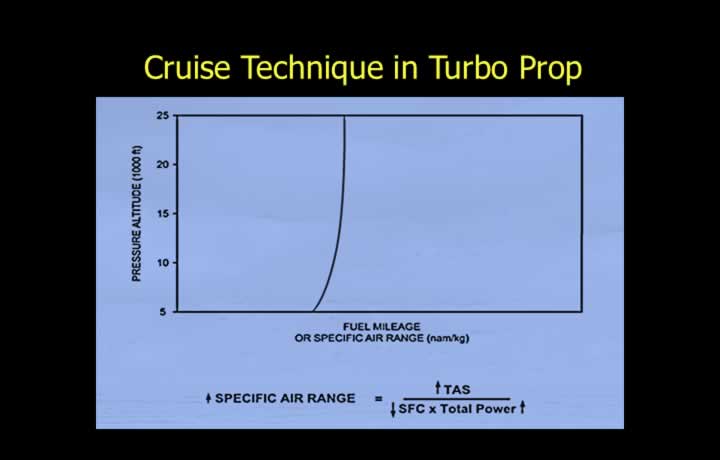
- Turboprop aircraft cruise at lower altitudes than jet aircraft.
- Increasing altitude increases TAS and reduces SFC.
- However, higher altitude also increases power required.
- Altitude selection is therefore largely influenced by wind conditions.
Cruise Technique in Piston Aircraft
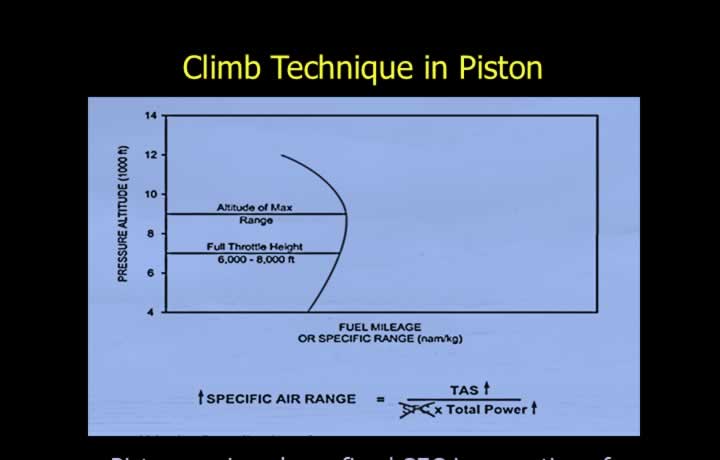
- Piston-engine aircraft have relatively constant SFC with altitude.
- SFC increases with higher manifold pressure, lower RPM and incorrect mixture settings.
- SFC has only a small influence on range.
- Power required increases with altitude.
- Higher TAS is largely offset by increased power required.
- Full-throttle height is the altitude where full throttle is required to maintain a given speed.
- Above this altitude, the aircraft cannot maintain the selected speed.
- Maximum specific range is normally achieved just above the full-throttle height.
Summary of Cruise Speeds