Descent Performance
Descent performance refers to the aircraft’s ability to descend safely and efficiently from cruise altitude to the approach phase. It includes the rate of descent, descent gradient, speed control, fuel consumption and compliance with altitude restrictions. Descent performance is influenced by aircraft weight, configuration, weather and engine settings.
Introduction to Descent Performance
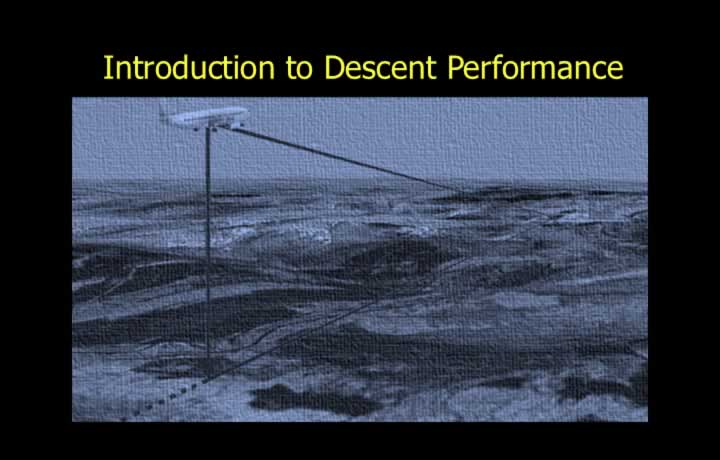
- The descent segment begins at the Top of Descent (TOD).
- For large transport aircraft, the Top of Descent is typically about 200 NM before the destination aerodrome.
- Descent may also be initiated due to emergencies such as cabin pressurisation failure.
- Descent performance is measured in two ways:
- Descent range (angle of descent).
- Descent endurance (rate of descent).
Mechanics of Descent
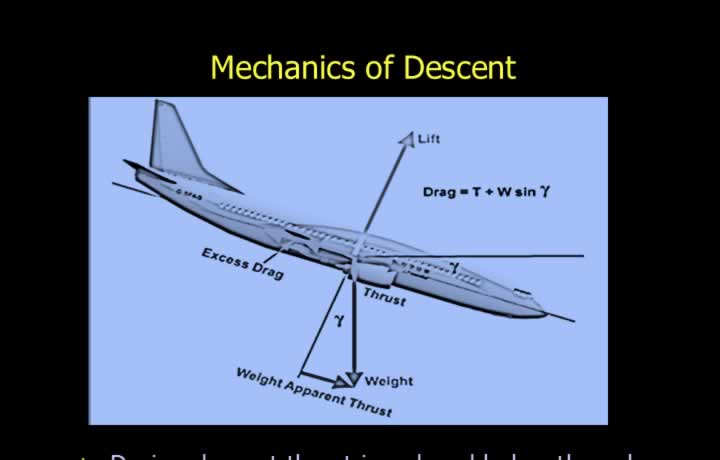
- During descent, engine thrust is reduced below the drag acting on the aircraft.
- The amount by which drag exceeds thrust is called excess drag.
- The aircraft nose is lowered to balance the excess drag.
- Lowering the nose decreases the pitch angle.
- This creates a forward component of weight known as weight apparent thrust.
- Further reduction in thrust increases excess drag.
- The pitch angle must be reduced further to increase weight apparent thrust.
- Descent Gradient (%) = (Excess Drag ÷ Weight) × 100
- Descent Gradient (%) = ((Total Drag − Total Thrust) ÷ Weight) × 100
Maximum Descent Gradient
- Maximum descent gradient may be required during emergencies.
- Air Traffic Control (ATC) requirements may also demand a steep descent.
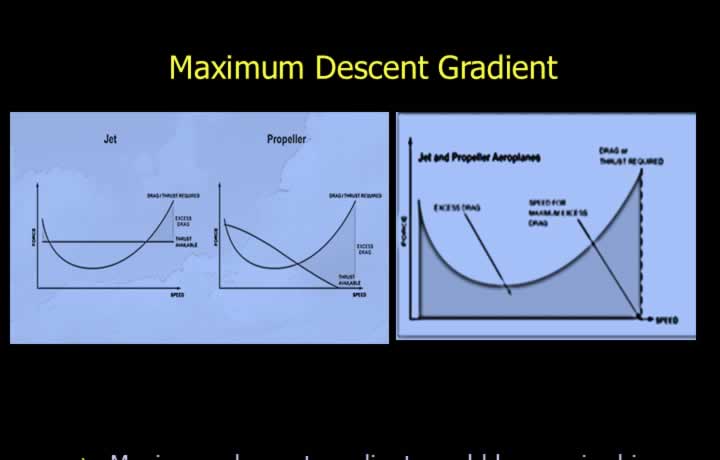
- Excess drag increases as aircraft speed increases in both jet and propeller aircraft.
- Deploying drag devices such as landing gear and flaps further increases drag.
- Maximum excess drag is achieved with thrust reduced to idle or minimum.
- The aircraft nose is lowered to increase weight apparent thrust.
- Higher descent speeds further increase aerodynamic drag.
- Maximum descent gradient is obtained with minimum thrust and high-drag configuration.
Minimum Descent Gradient (Best Glide Angle)
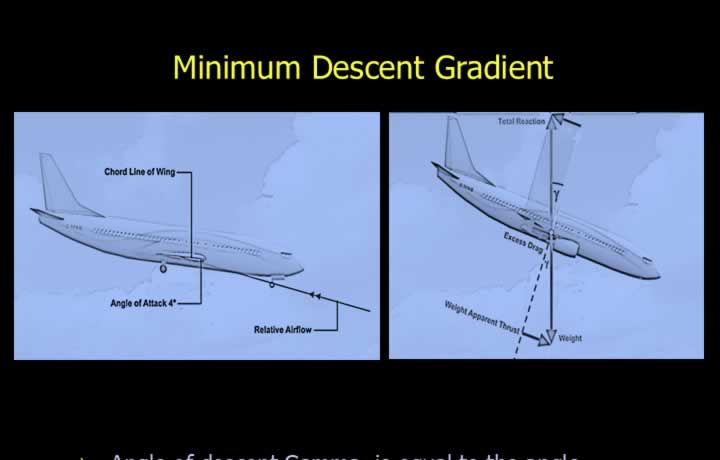
- The descent angle (γ) is the angle between the glide path and the horizontal.
- It is also the angle between the lift vector and the total reaction vector.
- During engine failure, the objective is to achieve the minimum glide angle (maximum glide range).
- The glide angle depends on the aircraft’s Lift-to-Drag (L/D) ratio.
- The maximum L/D ratio occurs at approximately 4° angle of attack.
- The resultant of lift and drag is called the total reaction.
- The total reaction vector determines the glide angle.
- Minimum Drag Speed (Vmd) occurs at approximately 4° angle of attack.
- For maximum glide range, the aircraft should descend at Vmd.
- Flying faster or slower than Vmd increases the descent angle.
- Increasing pitch angle alone may create the illusion of a flatter glide, but does not improve glide performance.
Rate of Descent
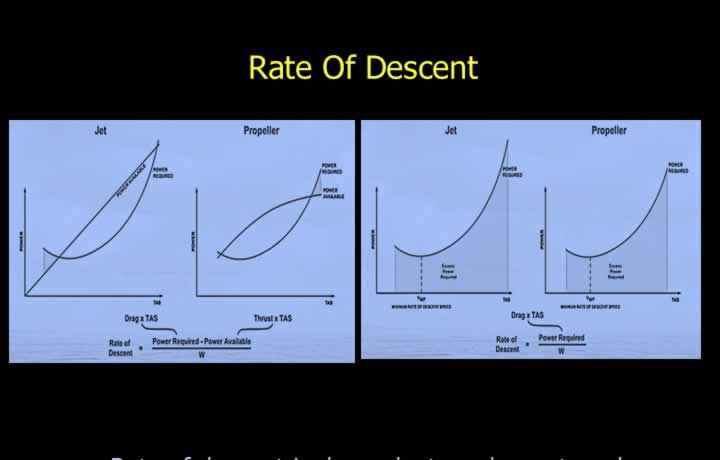
- Rate of descent depends on both descent angle and aircraft speed.
- It is determined by the excess power required.
- Rate of Descent = Excess Power Required ÷ Weight
- Rate of Descent = (Power Required − Power Available) ÷ Weight
- Rate of Descent = ((Drag − Thrust) × Velocity) ÷ Weight
- Maximum rate of descent occurs with minimum thrust and high airspeed.
- Excess power required is greatest with idle thrust at high speed.
- Minimum rate of descent occurs at the Minimum Power Speed (Vmp).
Emergency Descent
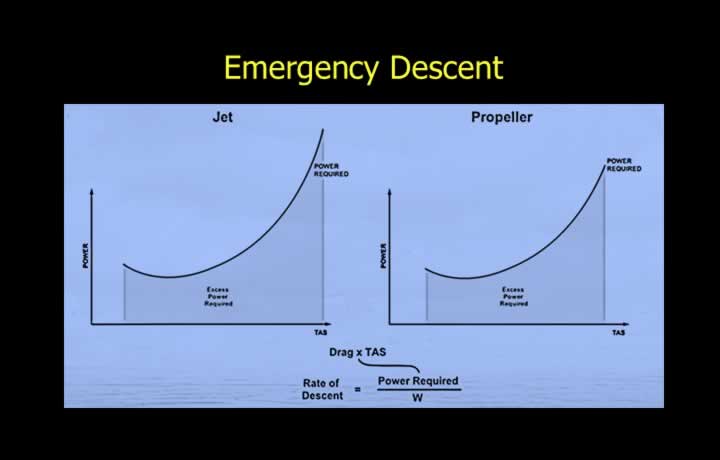
- Emergency descent is required for situations such as cabin pressurisation failure.
- The objective is to achieve the highest practical rate of descent.
- Emergency descents are normally flown at the Maximum Operating Speed (VMO).
- Speed brakes or spoilers are deployed to further increase the descent rate.
Factors Affecting Descent Performance
Effect of Weight on Descent Angle
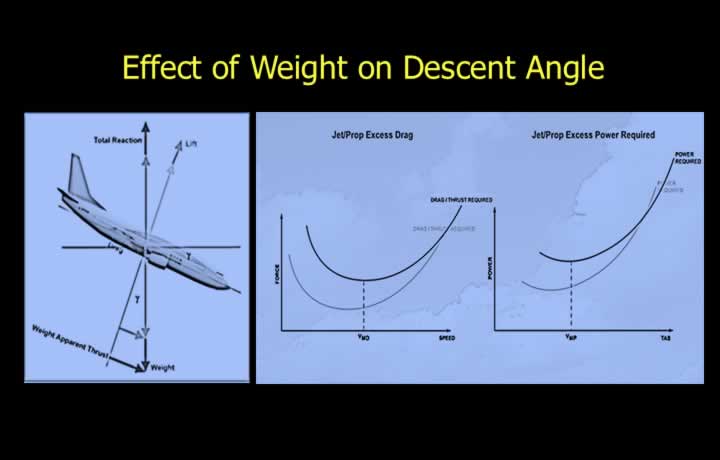
- Increasing aircraft weight increases weight apparent thrust.
- A higher pitch attitude is required at the same speed.
- Weight also increases weight apparent drag.
- The best glide angle itself is essentially unchanged by weight.
- However, heavier aircraft descend at a higher speed.
- The Minimum Drag Speed (Vmd) increases with aircraft weight.
- The minimum rate of descent also increases.
Effect of Aircraft Configuration on Descent Angle
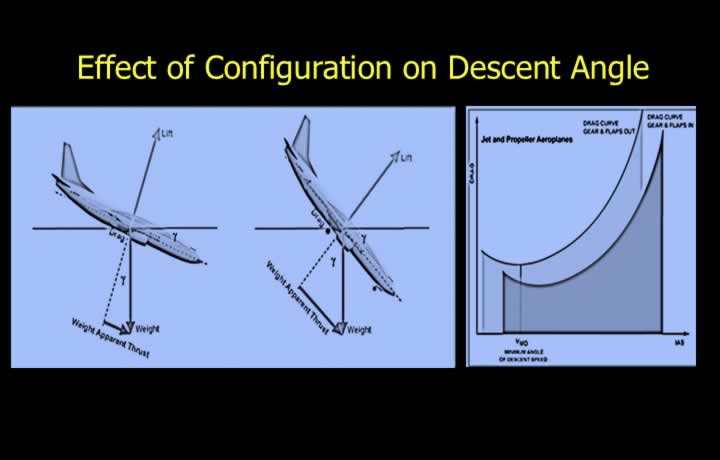
- Extending flaps and landing gear increases drag.
- The aircraft must lower its nose further to balance the forces.
- This results in a steeper descent angle.
- The descent rate is higher than in the clean configuration.
- The total drag curve shifts upward and to the left for both jet and propeller aircraft.
- The speed for minimum descent angle becomes lower.
- Minimum Drag Speed (Vmd) remains the best speed for minimum descent angle.
Effect of Aircraft Configuration on Rate of Descent
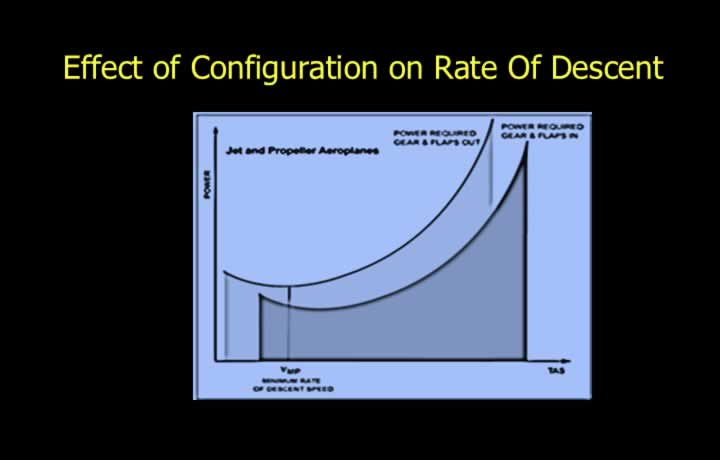
- Rate of descent depends on power required.
- Deploying flaps and landing gear shifts the power required curve upward and to the left.
- Speeds for minimum descent angle decrease for both jet and propeller aircraft.
- Minimum Power Speed (Vmp) remains the best speed for minimum rate of descent.
- Landing gear and flap extension increase both descent angle and descent rate.
- The optimum speeds for minimum angle and minimum rate of descent are reduced.
Effect of Headwinds on Descent
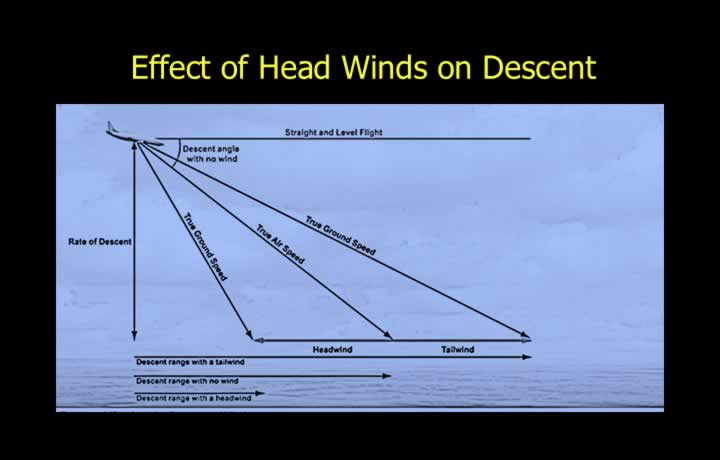
- Headwinds produce a steeper ground glide angle.
- Ground range during descent is reduced.
- Rate of descent through the air remains unchanged.
- Descent should normally be commenced later when flying into a headwind.
Effect of Tailwinds on Descent
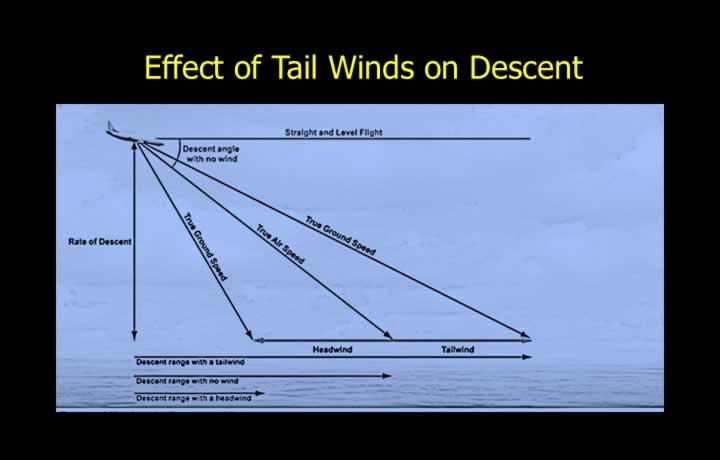
- Tailwinds produce a flatter ground glide angle.
- Ground range during descent increases.
- Rate of descent remains unchanged.
- Descent should normally be commenced earlier when flying with a tailwind.
Maximum Range During Descent
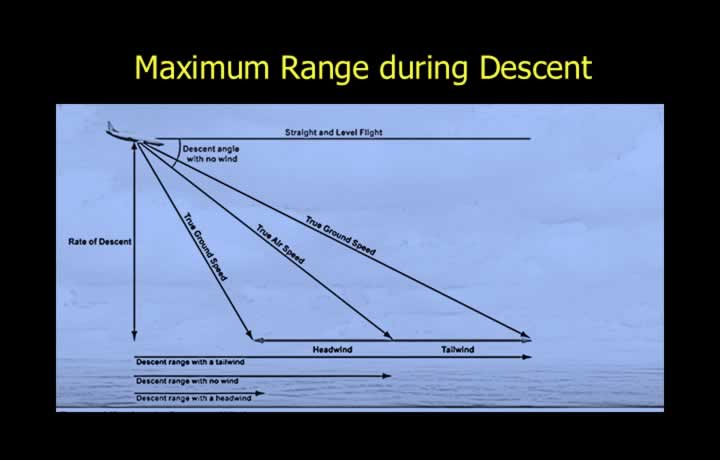
- Maximum descent range requires adjusting glide speed according to wind conditions.
- Fly slightly faster than Vmd in headwinds to reduce time spent in the headwind.
- Fly slightly slower than Vmd in tailwinds to maximise the benefit of the tailwind.