Calculation of Climb Performance
Climb performance is the aircraft’s ability to gain altitude after takeoff or during flight. It is measured by the rate of climb or climb gradient achieved under given conditions. Climb performance depends on factors such as aircraft weight, engine power, air density and configuration.
Measurement of Climb Performance
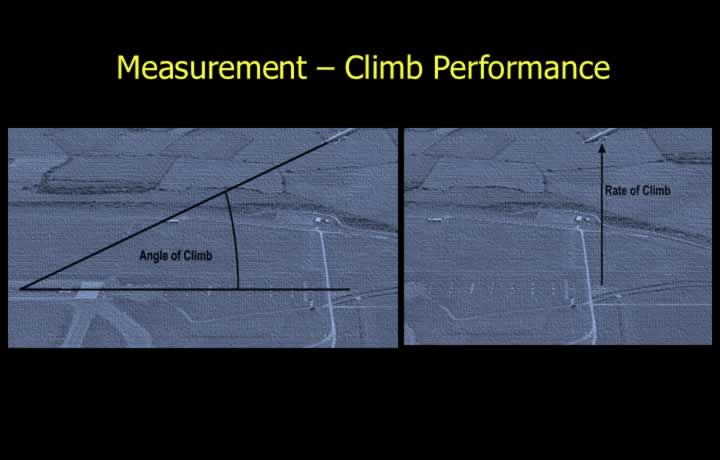
- Climb performance is measured in two ways.
- Angle of climb.
- Rate of climb.
Weight Apparent Drag
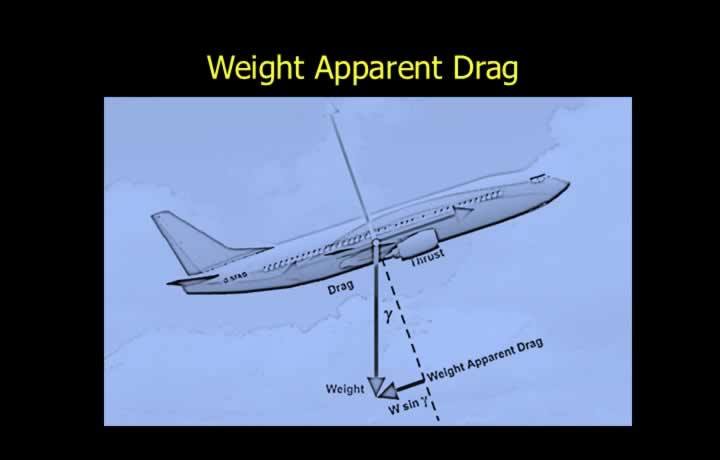
- Weight apparent drag is caused by the component of weight acting opposite to the direction of climb.
- The climb angle is represented by the Greek letter γ (gamma).
- Weight Component = Weight × sin(γ)
- Climb performance is generally expressed as climb gradient rather than climb angle.
- Climb gradient is the ratio of vertical distance gained to horizontal distance travelled.
- Climb gradient is expressed as a percentage.
Gradient of Climb
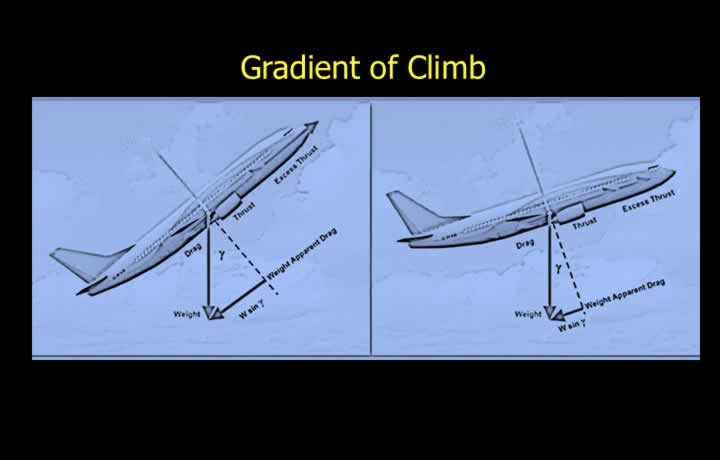
- Excess thrust is required in addition to the thrust needed to overcome drag.
- Engine thrust must overcome both aerodynamic drag and weight apparent drag.
- Greater excess thrust allows the aircraft to balance a larger backward weight component.
- Higher excess thrust enables greater payload capability.
- Climb angle is directly proportional to excess thrust.
- Excess Thrust = Total Thrust − Aerodynamic Drag
- Climb Gradient (%) = ((Thrust − Drag) ÷ Weight) × 100
Best Climb Speed for Jet Aircraft
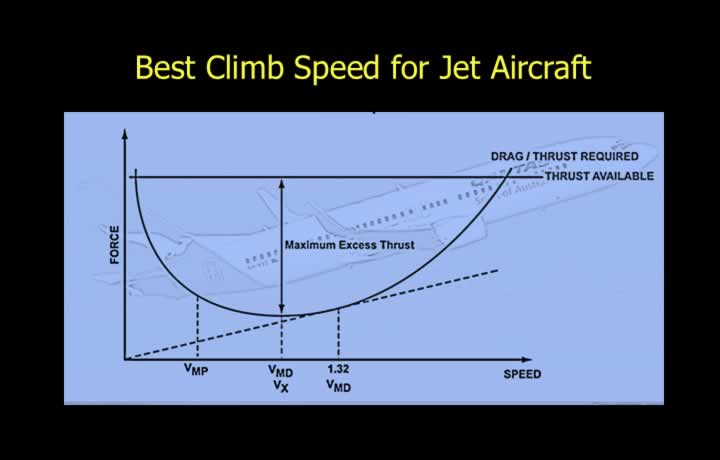
- Excess thrust is represented by the area between the thrust available curve and the total drag curve.
- Minimum drag speed (Vmd) is also the best angle of climb speed (Vx) for jet aircraft.
- Minimum power speed (Vmp) is approximately 0.76 × Vmd.
- The point of maximum excess power occurs at approximately 1.32 × Vmd.
- Vx provides the maximum climb angle.
Best Climb Speed for Propeller Aircraft
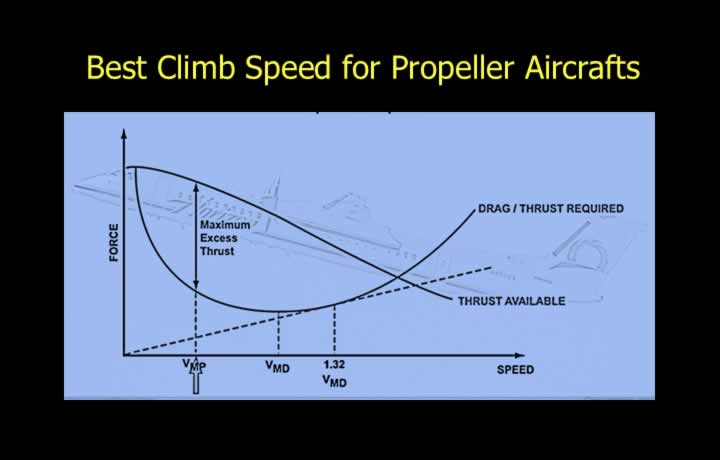
- Excess thrust is represented by the area between the thrust available curve and the total drag curve.
- Maximum excess thrust occurs at Vmp rather than Vmd.
- Vmp is approximately 0.76 × Vmd.
- Vx is the speed for the best angle of climb.
Effect of Weight on Climb Performance
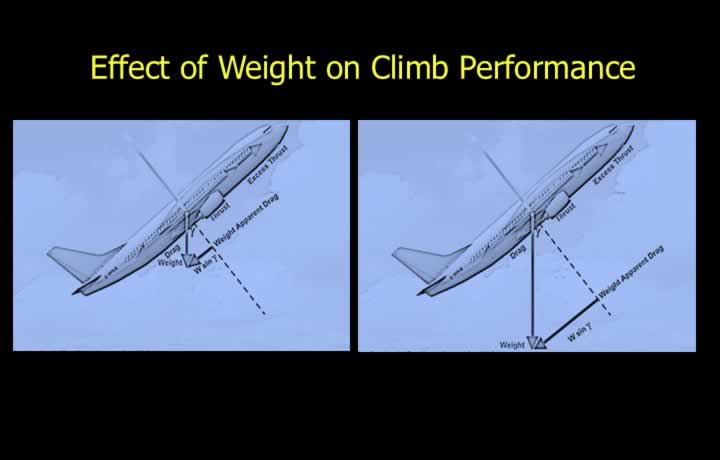
- Climb Gradient = ((Thrust − Drag) ÷ Weight) × 100
- Increasing aircraft weight requires greater lift, increasing induced drag.
- Higher induced drag reduces excess thrust.
- Weight apparent drag also increases with aircraft weight.
- As weight increases, climb angle decreases.
Effect of Weight on the Total Drag Curve
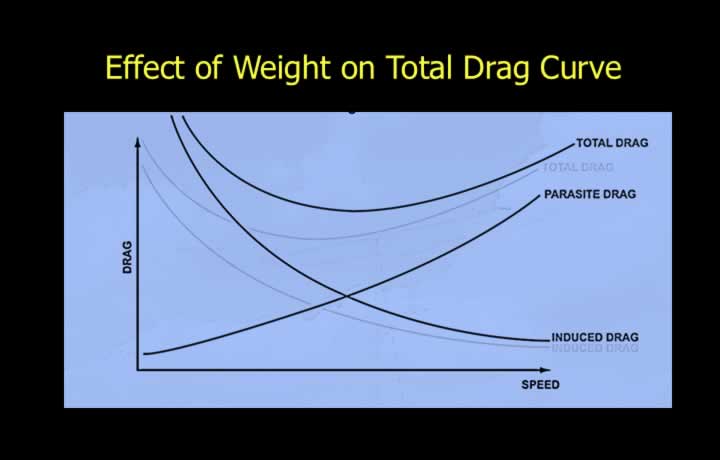
- Increasing aircraft weight increases induced drag.
- The total drag curve shifts upward and to the right.
Factors Affecting Climb Speeds
Effect of Weight on Climb Speeds
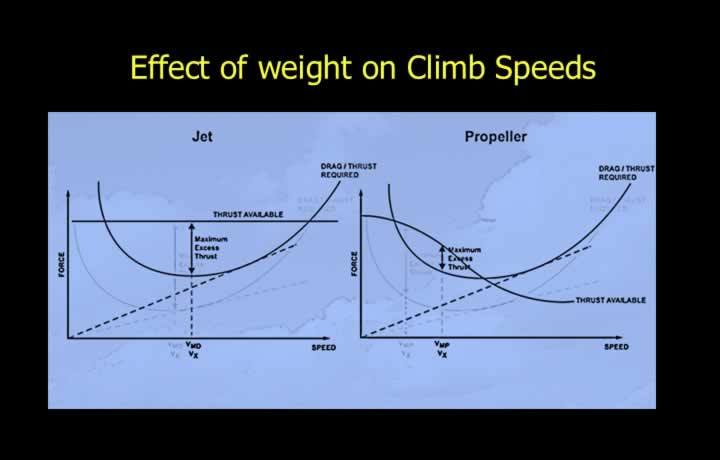
- Higher weight shifts the drag curve upward and to the right.
- This effect is similar for both jet and propeller aircraft.
- Excess thrust decreases at the previous Vmd.
- The new Vmd is higher than before.
- Best climb speed increases.
- Higher aircraft weight results in higher best climb speeds.
Effect of Flaps and Undercarriage on the Drag Curve
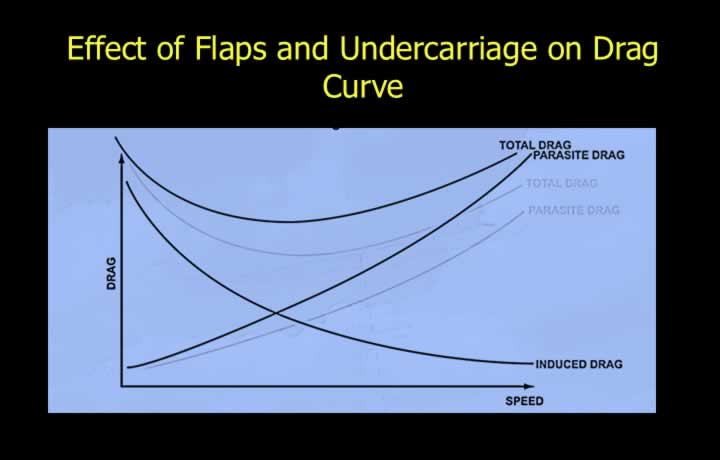
- Extending flaps and landing gear increases parasite drag.
- Total drag increases and the drag curve shifts upward and to the left.
- Excess thrust decreases.
- Climb angle decreases.
Effect of Flaps and Undercarriage on Climb Speed
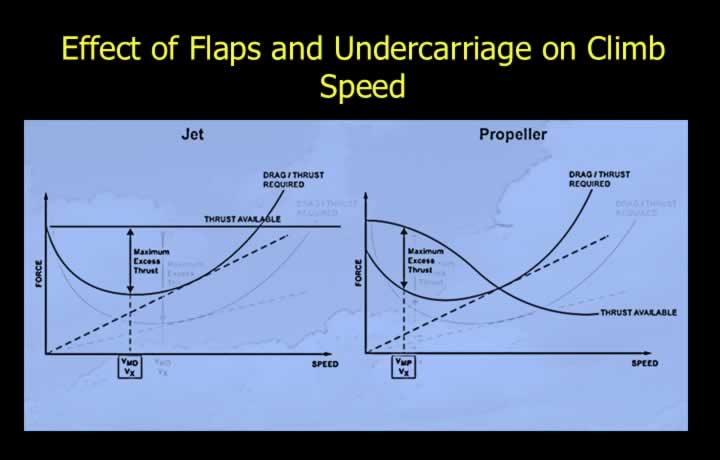
- The drag curve shifts upward and to the left.
- The effect is similar for both jet and propeller aircraft.
- Excess thrust decreases at the previous Vmd.
- The new Vmd becomes lower.
- Best angle of climb speed (Vx) decreases.
- Flaps are normally retracted gradually because they also increase lift.
Factors Affecting Climb Gradient
Effect of Air Density on Excess Thrust
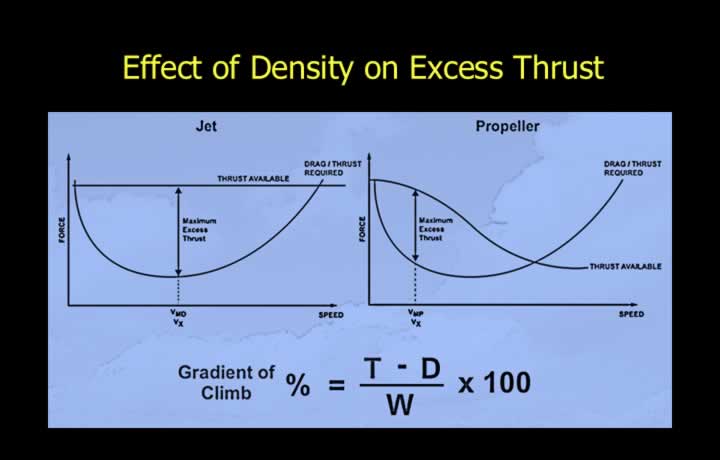
- Reduced air density lowers excess thrust.
- Climb gradient and climb angle decrease.
- High altitude, high temperature and high humidity reduce air density.
- Aircraft performance decreases under hot, high and humid conditions.
- True Airspeed (TAS) remains essentially constant for the best climb angle.
Effect of Air Density on Indicated Airspeed
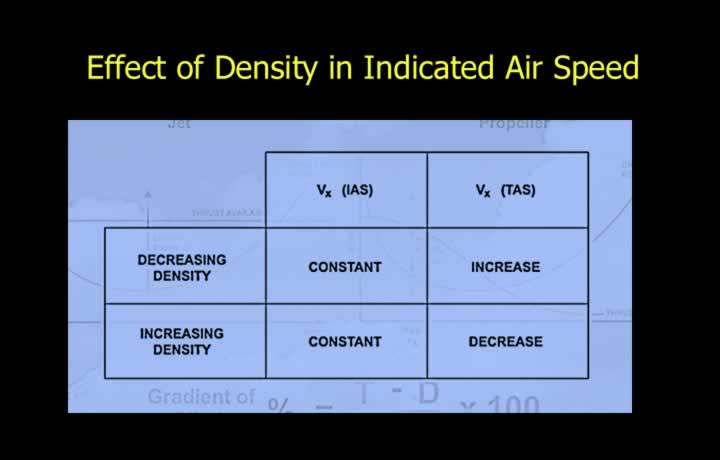
- Reduced excess thrust decreases climb angle.
- Best climb speed in TAS remains approximately constant.
- Lower air density increases TAS for the same IAS.
- Pilots must reduce IAS to maintain the same TAS.
Air Gradient and Ground Gradient
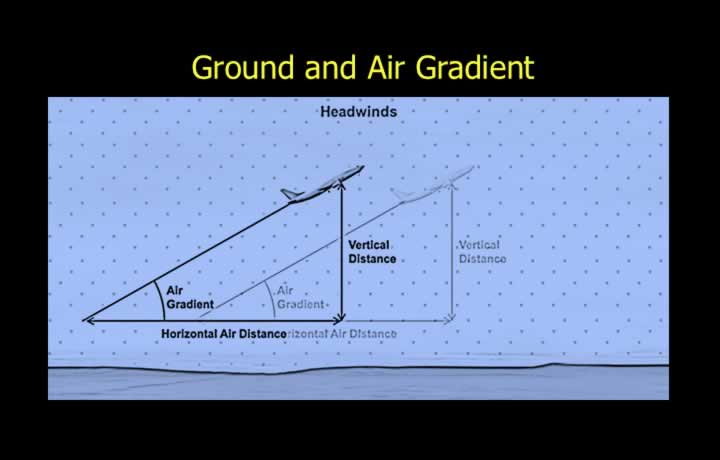
- Air gradient is the climb gradient relative to the surrounding air.
- It is used to specify minimum aircraft climb performance.
- Air gradient is unaffected by wind.
- Ground gradient is measured relative to the ground.
- Ground gradient changes with headwind or tailwind.
Effect of Wind on Ground Gradient
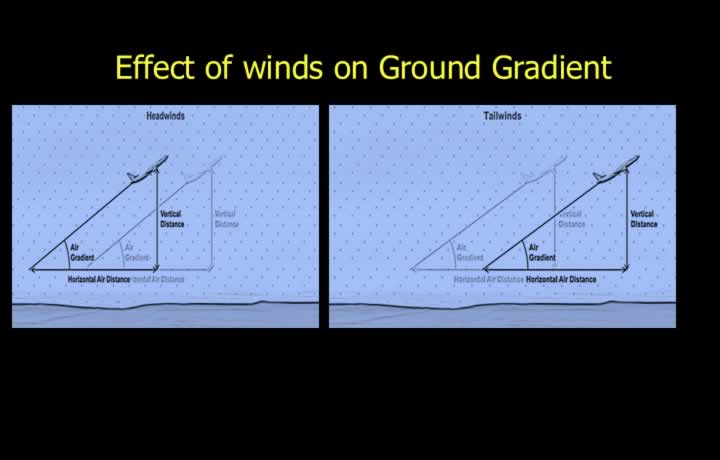
- Ground gradient is used for obstacle clearance calculations.
- Headwinds improve ground climb gradient.
- Tailwinds reduce ground climb gradient.
- Ground Gradient = Air Gradient × Wind Factor
- Headwind Wind Factor = TAS ÷ Ground Speed.
- Tailwind Wind Factor = Ground Speed ÷ TAS.
- Obstacle clearance calculations normally assume 50% headwind credit and 150% tailwind penalty.
Calculation of Obstacle Clearance
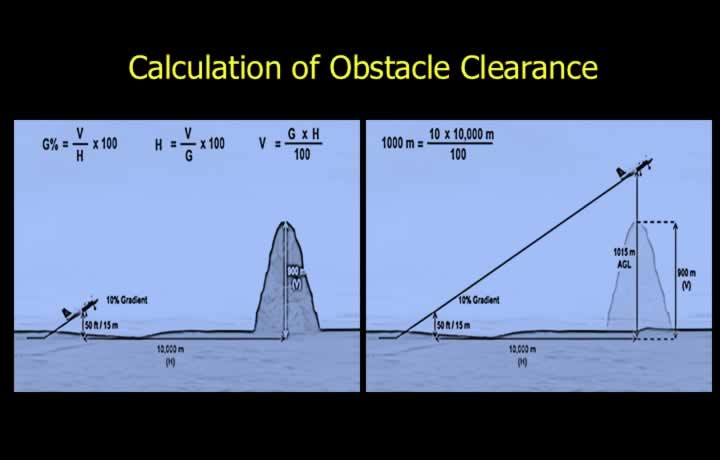
- Ground Gradient (%) = (Vertical Distance ÷ Horizontal Distance) × 100
- Vertical Distance = (Ground Gradient × Horizontal Distance) ÷ 100
Factors Affecting Rate of Climb
Rate of Climb (Vertical Speed)
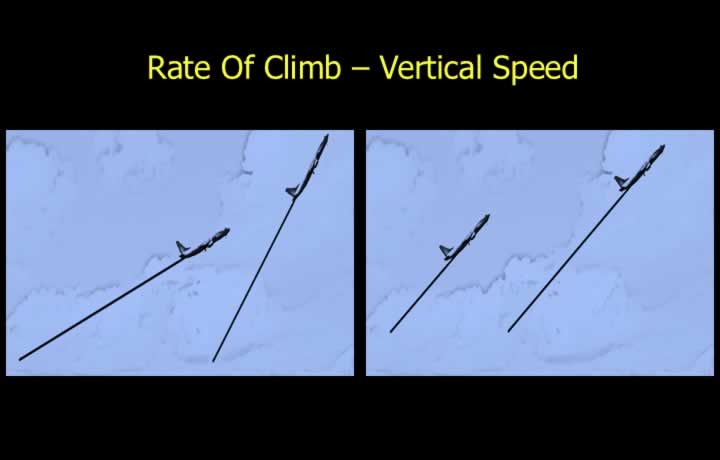
- The Vertical Speed Indicator (VSI) measures vertical speed.
- Rate of climb depends on both climb angle and True Airspeed.
- At the same TAS, a larger climb angle produces a higher rate of climb.
- At the same climb angle, a higher TAS also increases the rate of climb.
Rate of Climb Formula
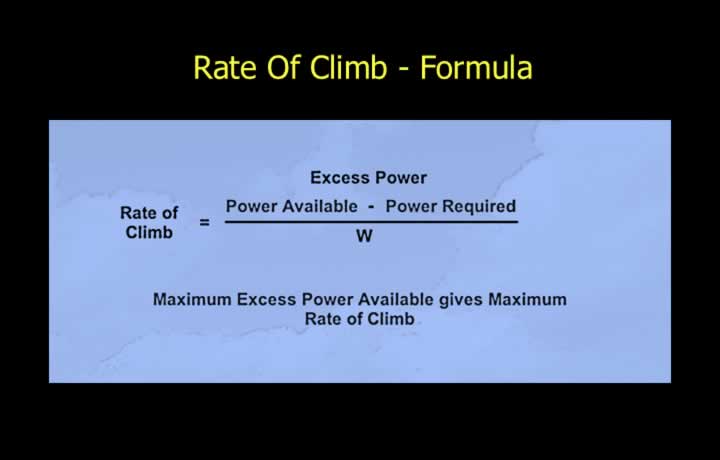
- Rate of climb equals excess power divided by aircraft weight.
- Rate of Climb = Excess Power ÷ Weight
- Excess Power = Power Available − Power Required.
- Maximum excess power provides the maximum rate of climb.
- The recommended climb speed is the speed producing maximum excess power.
Summary of Power Relationships
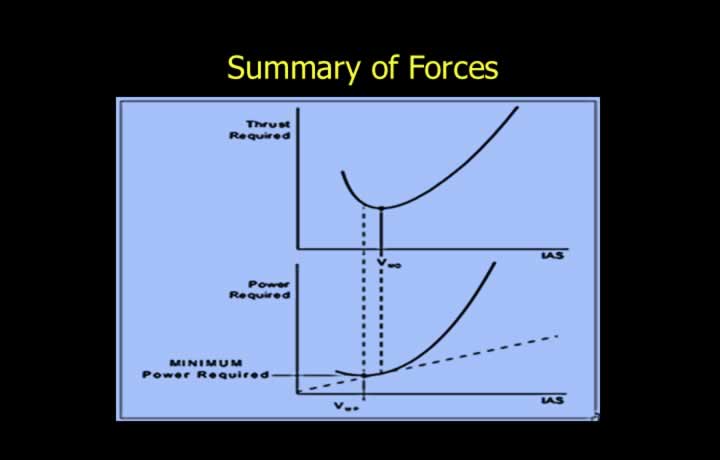
- Power is the rate of doing work.
- Work = Force × Distance
- Power = Force × (Distance ÷ Time)
- Force can be replaced by drag.
- Power = Drag × True Airspeed
- Power required equals drag multiplied by True Airspeed.
Minimum Power Required
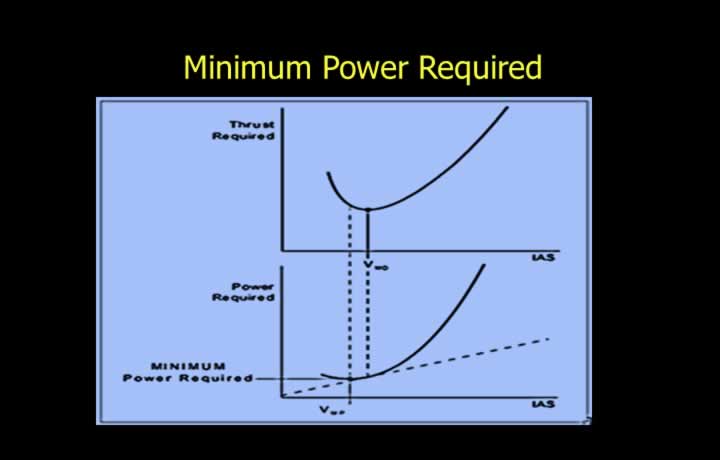
- Minimum power speed is lower than minimum drag speed.
- At constant IAS, aircraft drag remains approximately constant.
- As altitude increases, TAS must increase to maintain the same IAS.
- Power required therefore increases with altitude while maintaining constant IAS.
Important Speeds
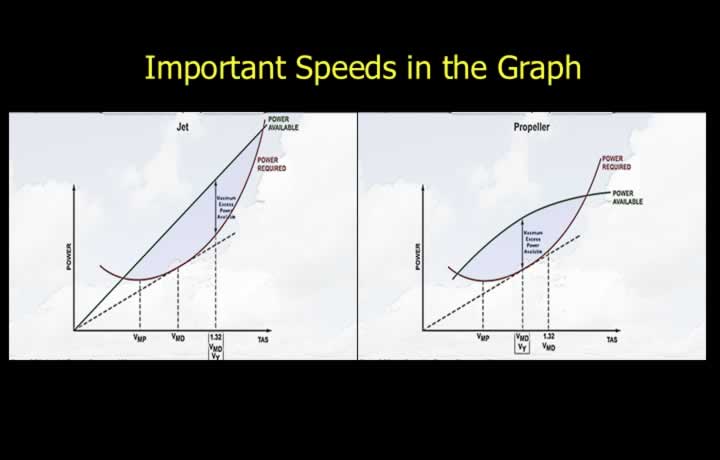
- Important reference speeds are Vmp and Vmd.
- Vmp is the minimum power speed.
- Vmd is the minimum drag speed.
- The tangent point on the power required curve identifies Vmd.
- Another important reference speed is 1.32 × Vmd.
Best Rate of Climb Speeds
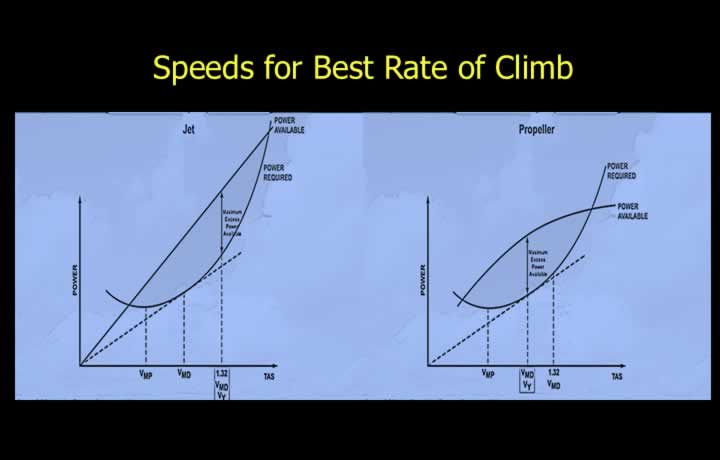
- For jet aircraft, the best rate of climb speed (VY) is approximately 1.32 × Vmd.
- For propeller aircraft, the best rate of climb speed (VY) is approximately Vmd.
- Best rate of climb occurs where excess power is greatest.
Effect of Weight on Rate of Climb
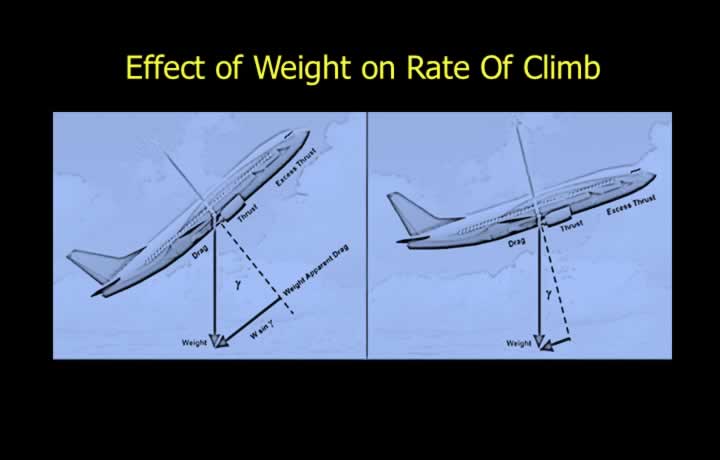
- Increasing aircraft weight decreases climb angle.
- Weight apparent drag increases.
- Higher lift is required, increasing induced drag.
- Excess thrust decreases.
- Rate of climb decreases.
Effect of Weight on Best Rate of Climb Speed
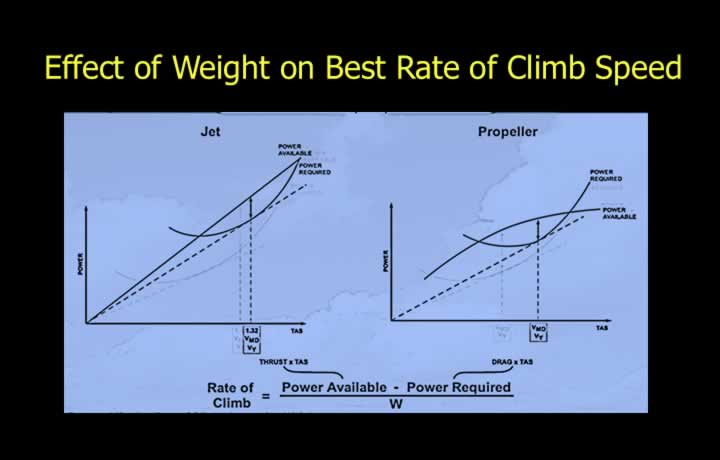
- Increasing aircraft weight increases induced drag.
- The drag curve shifts upward and to the right.
- Best rate of climb speed (VY) increases.
- Maximum rate of climb decreases.
- For jet aircraft, 1.32 × Vmd increases.
- For propeller aircraft, Vmd increases.
- Heavier aircraft must climb at higher speeds.
Effect of Aircraft Configuration
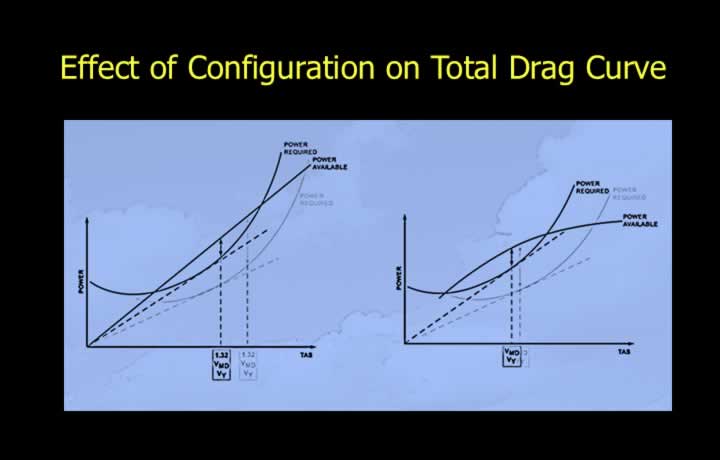
- Flaps and landing gear increase parasite drag.
- Total drag increases and excess thrust decreases.
- Climb angle and rate of climb decrease.
- The drag curve shifts upward and to the left.
- Best rate of climb speed becomes lower with landing gear and flaps extended.
- A dirty configuration means flaps and landing gear are extended.
- Flaps are normally retracted gradually because they increase lift.
- Aircraft should accelerate while retracting flaps to maintain VY.
Effect of Air Density on Rate of Climb
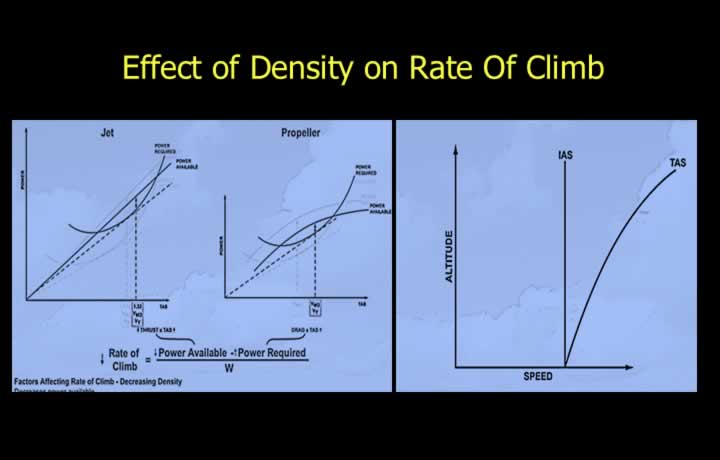
- Rate of Climb = ((Thrust Available − Thrust Required) × TAS) ÷ Weight
- Reduced air density decreases available thrust.
- TAS increases for the same IAS.
- The loss of thrust is greater than the increase in TAS.
- Overall, excess power and rate of climb decrease.
Absolute Ceiling and Service Ceiling
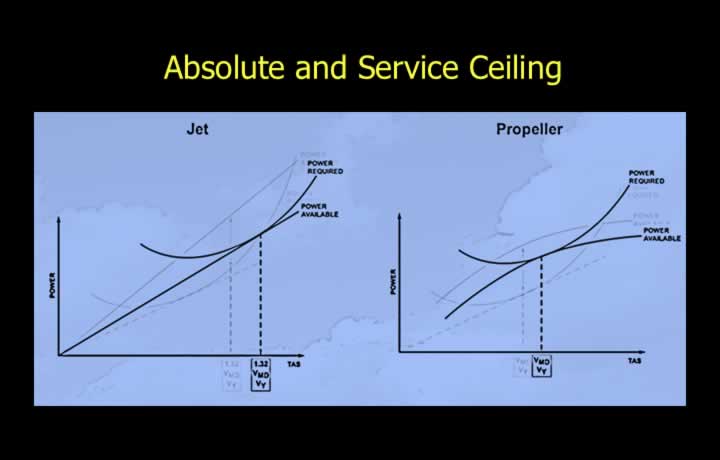
- Increasing altitude reduces engine power because of lower air density.
- At the absolute ceiling, the aircraft has zero rate of climb.
- At the absolute ceiling, excess power is zero.
- The service ceiling is the altitude where only a specified minimum rate of climb remains.
- The best rate of climb speed produces this specified climb rate.
Effect of Wind on Rate of Climb
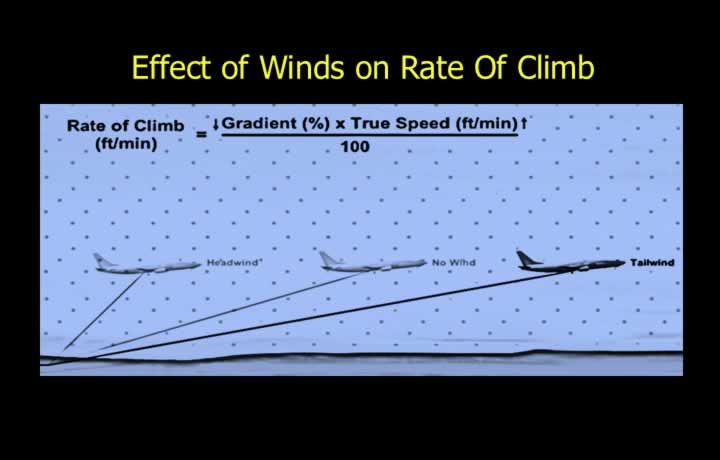
- Rate of Climb = (Gradient × TAS) ÷ 100
- Headwinds increase climb gradient but reduce best climb speed over the ground.
- Tailwinds decrease climb gradient but increase best climb speed over the ground.
- The overall rate of climb remains unchanged.
- Wind does not affect the aircraft’s rate of climb through the air.